


 Cart
Cart
 Get 20% off ordering today: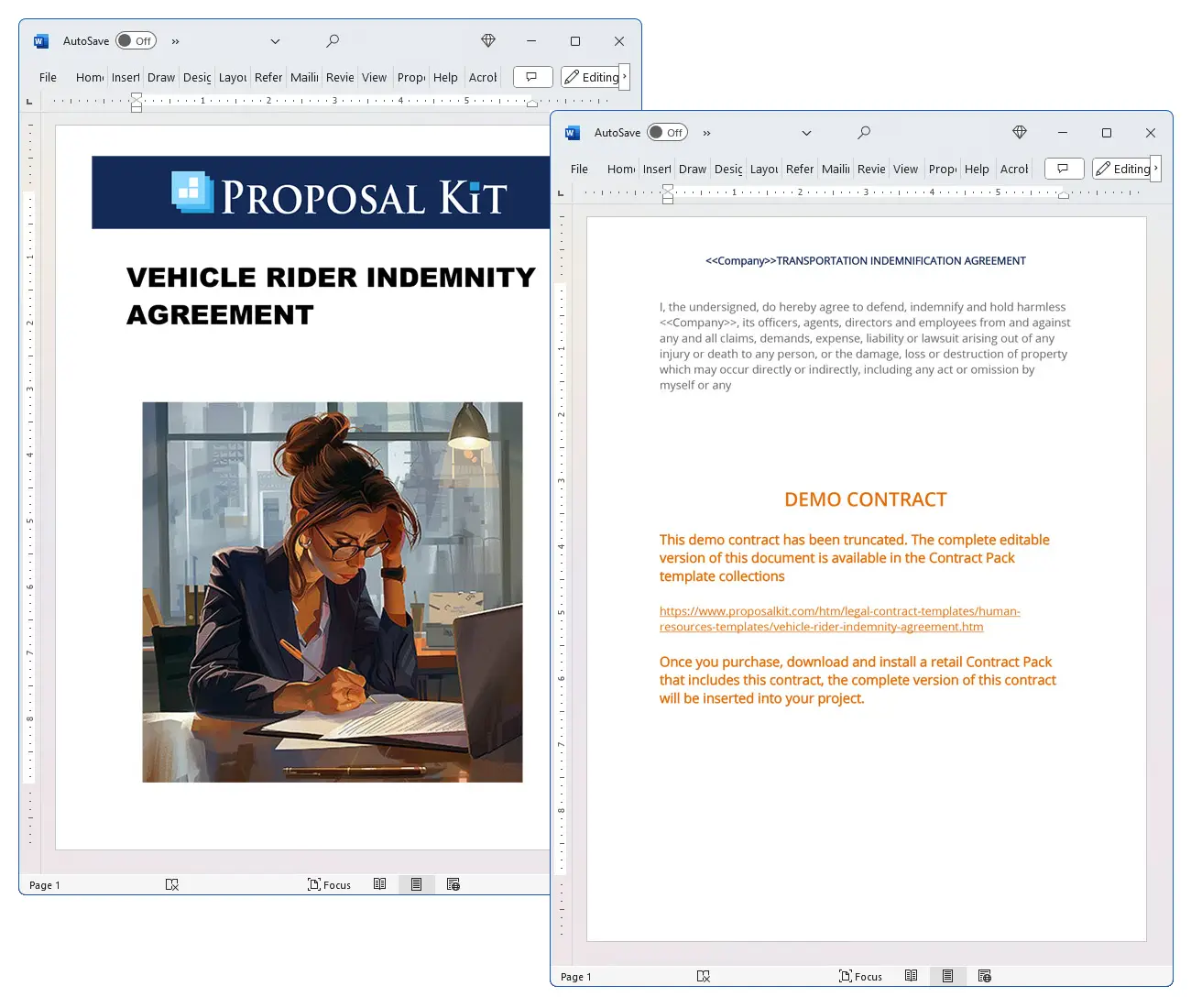

How to write your Vehicle Rider Indemnity Agreement
We include this 1 page template with Advertising/Marketing Contract Pack and the Proposal Kit Professional. You will get more content and software automation for data merging, managing client documents, and creating proposals with line item quoting with a Contract Pack or the Professional.
 DOWNLOADABLE, ONE-TIME COST, NO SUBSCRIPTION FEES
 What Our Clients Say
I have used the contract package I purchased from you and it has helped in many ways."
1. Get Advertising/Marketing Contract Pack or the single template that includes this business contract document.
We include this contract in editable Word format that can be customized using your office software.
2. Download and install after ordering.
Once you have ordered and downloaded your template or pack, you will have all the content you need to get started.
3. Customize the contract template with your information.
You can customize the contract document as much as you need. If you get a Contract Pack or Professional Bundle, you can also use the included Wizard software to automate name/address data merging.
Use cases for this template
RoadRelay's peer-to-peer launch faces insurance gray areas
The Challenge
When RoadRelay Inc. prepared to onboard shared vehicle owner Maya Singh and shared vehicle driver Leo Park, the team realized their peer-to-peer car sharing program needed clear assumption of liability terms, definitions for the car sharing start time, car sharing delivery period, and car sharing termination time, and alignment with uninsured motorist provisions so third parties would be protected if a loss occurred during the car sharing period.
The Solution
They implemented a transportation indemnification agreement assigning primary liability to the operator for incidents they cause, preserving the company's right to seek indemnification and recovery, and clarifying that insurance maintained by the program could be primary during each period subject to exclusions in motor vehicle liability insurance while keeping the platform exempt from vicarious liability where permitted.
The Implementation
RoadRelay set driver's license verification, safety recalls checks, and recordkeeping with time-stamped pickup and return to an alternatively agreed upon location, plus an emergency telephone number; using Proposal Kit, they assembled a program overview, consumer protection disclosures, and a driver onboarding plan with the AI Writer, and built fee schedules and daily rate models with line-item quoting to support the car sharing transaction.
The Outcome
After a fender-bender, the liability insurance policy responded on a primary basis, uninsured and underinsured motorist questions were resolved through clear policy references, the duty to defend such a claim was honored, and the company handled settlement negotiation or litigation efficiently with its authorized insurer while maintaining indemnity rights against the at-fault driver.
BlueForge Builders tightens mixed-fleet risk controls
The Challenge
BlueForge Builders relied on a mix of personally owned, rented, and company trucks, but accidents revealed gaps due to exclusions in motor vehicle liability insurance, unclear primary liability between a personal automobile insurance policy and the business program, and inconsistent claim coverage investigation when third parties alleged bodily injury or property damage.
The Solution
BlueForge adopted the indemnification agreement to assign assumption of liability to drivers for negligent acts, defined when company insurance coverage is primary during each period, addressed uninsured motorist and medical payments coverage, and retained the right to seek indemnification from the owner or driver without allowing contribution against indemnification to erode remedies.
The Implementation
They added driver's license verification, lienholder and safety recall checks, incident reporting protocols, and return the vehicle checklists; with Proposal Kit, the team produced a fleet safety plan, incident response guide, and policy summaries using the AI Writer, and created cost models for rentals and insurance premiums via line-item quoting, all organized from the template library.
The Outcome
When a jobsite collision occurred, the motor vehicle insurer accepted the duty to defend, primary liability was allocated per the program agreement, BlueForge stayed exempt from vicarious liability for the driver's acts, and the company could seek recovery for damages after third-party claims were resolved.
HarborHealth Outreach safeguards its volunteer shuttle
The Challenge
Nonprofit HarborHealth Outreach ran a volunteer-driven shuttle using a shared motor vehicle and worried about uninsured motorist exposure, minimum financial responsibility, and how to protect riders and donors while keeping the organization exempt from vicarious liability for volunteer mistakes.
The Solution
They rolled out the transportation indemnification agreement with clear car-sharing period definitions, the driver's duty to defend claims they cause, and policy language confirming an insurable interest, minimum coverage amounts, and the organization's right to seek indemnity if a false or fraudulent report or negligence led to losses affecting third parties.
The Implementation
HarborHealth verified driver's licenses, set an emergency telephone number, required prompt notice to the shared vehicle owner of any comprehensive physical damage or collision physical damage, and kept detailed recordkeeping; using Proposal Kit, staff created a grant proposal, rider information sheets, and an operational risk study with the AI Writer, plus a funding budget using line-item quoting for fuel, training, and insurance maintained by program.
The Outcome
After a minor property damage incident, the liability insurance policy and uninsured motorist terms triggered as intended, the organization's duty to defend such claim was coordinated with its authorized insurer, riders experienced no service interruption, and donors gained confidence in HarborHealth's policy discipline.
Abstract
This transportation indemnification agreement requires the signer to assume liability and to defend, indemnify, and hold harmless the company and its personnel against claims arising from bodily injury, death, or property damage connected to the signer's presence as a passenger or operation of any company-owned, rented, leased, or personally owned vehicle used for company business. It gives the company indemnity rights, including the right to seek indemnity, seek recovery, and the signer's duty to defend such claim, including costs, legal fees, and expenses.
Companies can adapt this framework to a peer-to-peer car-sharing program operating on a business platform. Within a car-sharing program agreement, parties may define the shared vehicle, the shared vehicle owner, and the shared vehicle driver, and align liability across the car-sharing start time, car-sharing delivery period, and car-sharing termination time. Clear terms on the car sharing period, return the vehicle to an alternative agreed-upon location, notify the shared vehicle owner, and financial consideration, such as a daily rate or fees paid, help structure the car sharing transaction.
Insurance coverage often complements this indemnity. Organizations commonly reference a motor vehicle liability insurance policy that is primary during each period, identify minimum coverage amounts or minimum financial responsibility, and address uninsured and underinsured motorist, medical payments coverage, and comprehensive physical damage or collision coverage. A personal automobile insurance policy may contain insurance exclusions or exclude coverage; insurance maintained by a program may operate on a primary basis during specified periods.
The agreement supports a duty to defend, claim coverage investigation, settlement negotiation, or litigation with a motor vehicle insurer or authorized insurer. It can also help manage exposure to vicarious liability, insurable interest issues, and contribution against indemnification while preserving a right to seek indemnification from the owner or driver.
Operational controls that pair well with this policy include driver's license verification, procedures to verify driver's licenses, recordkeeping, consumer protection disclosures, checks for safety recalls or automobile safety recalls, lienholder notifications, an emergency telephone number, and safeguards against false or fraudulent statements consistent with guidance from a commissioner of insurance.
Use cases include employees driving personal cars for sales calls, contractors transporting equipment in a shared motor vehicle, volunteers riding in a company shuttle, or a peer-to-peer fleet supporting temporary projects.
Proposal Kit can help organizations assemble this type of program agreement and related policy language, generate automated line-item quoting for daily rate structures, and use the AI Writer to build consistent supporting documents from an extensive template library, streamlining setup and ongoing updates.
Expanding on the risk framework, this agreement formalizes the signer's assumption of liability and makes clear that primary liability for incidents they cause can rest with the driver, including the duty to defend claims by third parties. Because exclusions in motor vehicle liability insurance vary by policy, the agreement's indemnity reduces gaps that can appear when a personal automobile insurance policy or business policy excludes coverage for business use. Programs should consider how uninsured motorist and underinsured motorist provisions coordinate with the indemnity so that claim handling, medical payments, and recovery rights remain consistent. Many organizations also aim to be exempt from vicarious liability where permitted, using clear program agreement terms to allocate responsibility to the operator while preserving the company's right to seek indemnification if needed.
From an operational standpoint, linking this indemnity to claim reporting, driver's license verification, and recordkeeping improves response speed and supports coverage reviews. Proposal Kit can help teams assemble consistent assumptions of liability clauses, attach insurance schedules that address primary liability and uninsured motorist details, and keep policy references aligned with your insurer's requirements. Its extensive template library, document assembly tools, automated line-item quoting for daily rate models, and AI Writer for supporting disclosures make it easier to produce a coherent package that third parties can understand and that your internal stakeholders can manage with ease.
Further strengthening the framework, organizations can tie the indemnity to clear operational checkpoints. Define the car sharing start time, delivery period, and termination time in the program agreement, and require the driver to return the vehicle to an alternative agreed-upon location. Add pre-trip and post-trip recordkeeping, including photos, odometer readings, and prompt notice of incidents to an emergency telephone number.
Require drivers to notify the shared vehicle owner of any collision, physical damage, or comprehensive physical damage issues, and confirm no open automobile safety recalls or safety recalls before use. Integrate driver's license verification at onboarding and periodic rechecks, and maintain consumer protection disclosures and lienholder notices where applicable.
Align the policy language with insurance maintained by the program and any personal automobile insurance policy to clarify primary liability and what is primary during each period. Address exclusions in motor vehicle liability insurance that may exclude coverage for certain uses, and reconcile uninsured motorist and underinsured motorist treatment with minimum financial responsibility and minimum coverage amounts. Preserve the company's indemnity rights, including the duty to defend such claim, claim coverage investigation, settlement negotiation, or litigation handled with a motor vehicle insurer or authorized insurer.
Keep the company exempt from vicarious liability where permitted, while retaining the right to seek indemnification from the owner or driver and to seek recovery without allowing contribution against indemnification to dilute remedies. Reinforce that false or fraudulent statements breach the program agreement and harm third parties.
Administer signatures with a company-authorized witness and a clear execution date. Proposal Kit helps teams standardize this documentation across a business platform, assemble coordinated clauses on assumption of liability, insurance maintained, and policy references, and generate supporting checklists, disclosures, and pricing models using automated line-item quoting and its AI Writer, all grounded in an extensive template library for efficient, consistent rollout.
How to write my Vehicle Rider Indemnity Agreement document - The Narrative
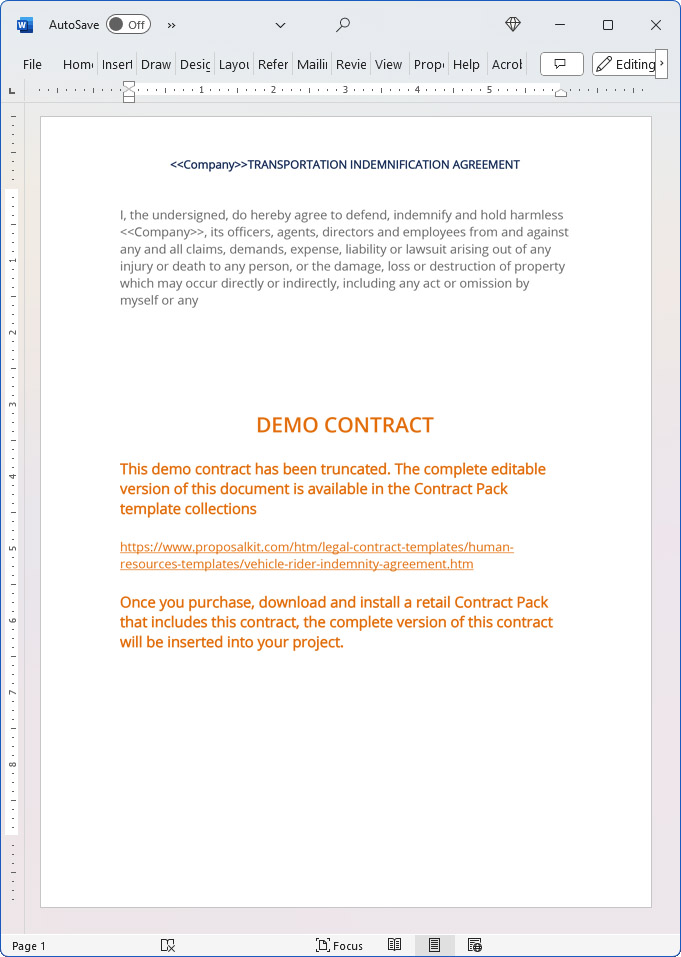
TRANSPORTATION INDEMNIFICATION AGREEMENT
I, the undersigned, do hereby agree to defend, indemnify and hold harmless Company Name, its officers, agents, directors and employees from and against any and all claims, demands, expense, liability or lawsuit arising out of any injury or death to any person, or the damage, loss or destruction of property which may occur directly or indirectly, including any act or omission by myself or any and all costs, expenses and legal fees, investigative cost, or any and all expenses incurred by Company Name as a result of any claim, demand, or causes of actions arising out of my presence as a passenger in, or my driving a Company Name or personally owned, borrowed or leased vehicle, including any vehicles rented or leased by Company Name or an employee and being used in connection with Company Name business. Thus done and signed on the day of, 20XX. WITNESS: (Note: Must be Company authorized witness). EXECUTED as of the date first written above.
20% Off Discount
 Add To Cart This Word Template Only
 Add To Cart Advertising/Marketing Contract Pack
 Add To Cart Proposal Kit Professional Bundle
 4.7 stars, based on 850 reviews
How to Build a Legal Contract with Proposal Kit
This video illustrates how to create a legal contract using the Proposal Pack Wizard software. It also shows how to create a proposal with an invoice and contract at the same time.
Frequently Asked Questions
How do I customize this contract to fit my business needs?
Customizing this contract involves editing the document to include your business details, terms, and conditions. The templates are designed to be flexible, allowing you to insert your company's name, address, and other relevant information. You can modify clauses to reflect your unique business practices and legal requirements.
Is this contract compliant with laws and regulations?
The legal contract templates are written by legal professionals and designed to comply with current laws and regulations at the time of their writing. However, laws can vary by jurisdiction and change over time, so it's recommended to have your contract reviewed by a local attorney to ensure it meets all legal requirements specific to your region and industry. Templates are licensed as self-help information and not as legal advice.
Can I use the same contract for different clients or projects?
You can use the same contract for different clients or projects. The templates are versatile and easily adapted for various scenarios. You will need to update specific details such as client names, project descriptions, and any unique terms for each new agreement to ensure that each contract accurately reflects the particulars of the individual client or project.
What should I do if I encounter a clause or term I don't understand?
If you encounter a clause or term in the contract that you need help understanding, you can refer to guidance notes explaining each section's purpose and use. For more complex or unclear terms, it's advisable to consult with a legal professional who can explain the clause and help you determine if any modifications are necessary to suit your specific needs.
How do I ensure that the contract is legally binding and enforceable?
To ensure that the contract is legally binding and enforceable, follow these steps:
- Complete all relevant sections: Make sure all blanks are filled in with accurate information.
- Include all necessary terms and conditions: Ensure that all essential elements, such as payment terms, deliverables, timelines, and responsibilities, are clearly defined.
- Signatures: Both parties must sign the contract, and it is often recommended that the contract be witnessed or notarized, depending on the legal requirements in your jurisdiction.
- Consult a legal professional: Before finalizing the contract, have it reviewed by an attorney to ensure it complies with applicable laws and protects your interests.
 Published by Proposal Kit, Inc.
Disclaimers
Proposal Kit, Inc. makes no warranty and accepts no responsibility for the suitability of any materials to the licensee's business. Proposal Kit, Inc. assumes no responsibility or liability for errors or inaccuracies. Licensee accepts all responsibility for the results obtained. The information included is not legal advice. Names in use cases have been fictionalized. Your use of the contract template and any purchased packages constitutes acceptance and understanding of these disclaimers and terms and conditions.
 Facebook
 YouTube
 Bluesky
 Search Site