


 Cart
Cart
 Get 20% off ordering today: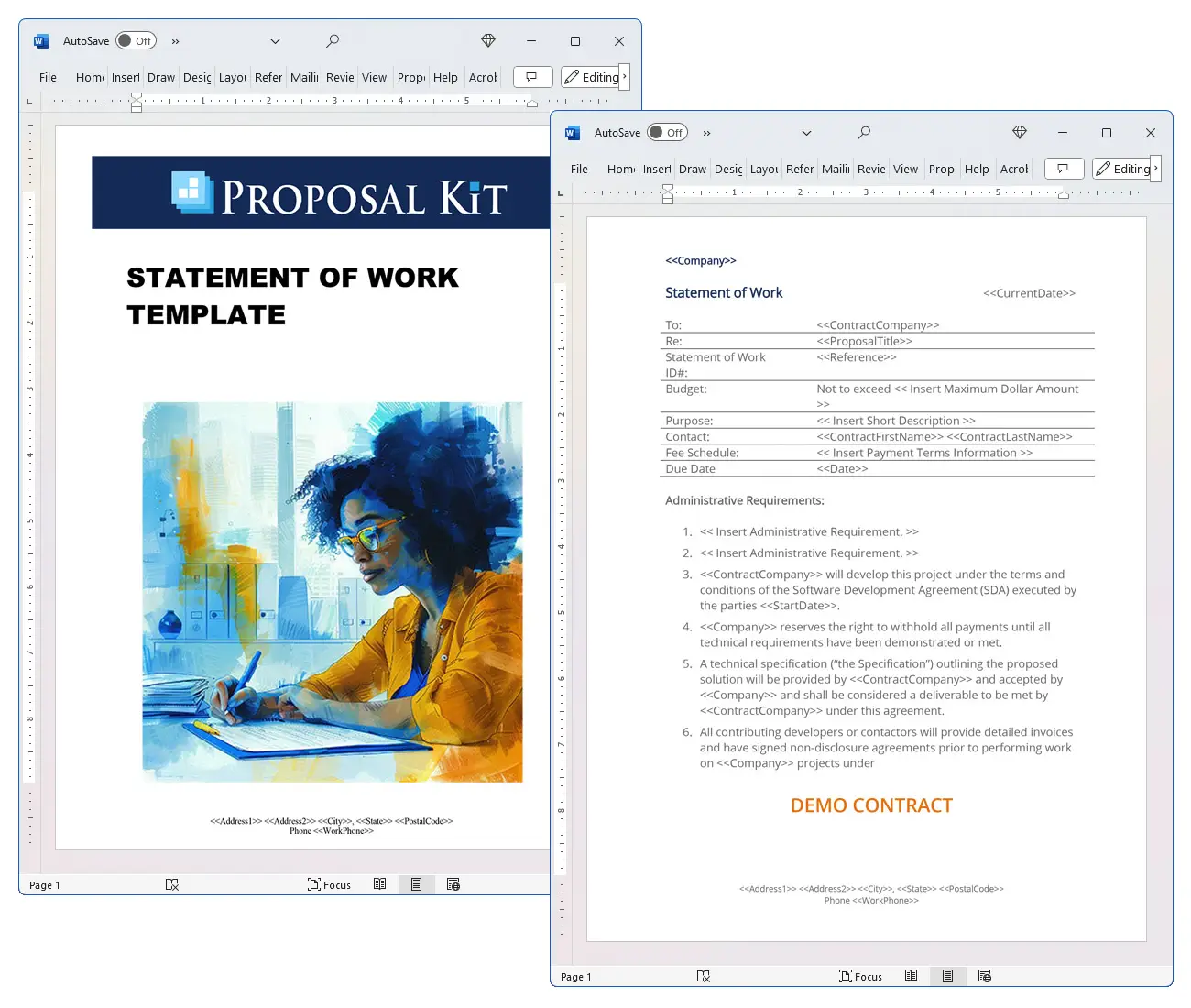

How to write your Statement of Work Template
We include this 1 page template with IT/Software/Hardware Contract Pack and the Proposal Kit Professional. You will get more content and software automation for data merging, managing client documents, and creating proposals with line item quoting with a Contract Pack or the Professional.
 DOWNLOADABLE, ONE-TIME COST, NO SUBSCRIPTION FEES
 What Our Clients Say
I love this Product! I have been using this since 2008 and it has helped numerous times and saved me lots of money. I can customize them to make them my own."
Aleph, Inc.
1. Get IT/Software/Hardware Contract Pack or the single template that includes this business contract document.
We include this contract in editable Word format that can be customized using your office software.
2. Download and install after ordering.
Once you have ordered and downloaded your template or pack, you will have all the content you need to get started.
3. Customize the contract template with your information.
You can customize the contract document as much as you need. If you get a Contract Pack or Professional Bundle, you can also use the included Wizard software to automate name/address data merging.
Use cases for this template
LedgerLift tames scope creep on a fintech API build with Blue Harbor Systems
The Challenge
LedgerLift, a fast-growing payments startup, hired Blue Harbor Systems to build a merchant onboarding API, but vague project objectives and scope, hazy project roles, and a loose payment schedule let change requests pile up, threatening the project timeline and milestones and pushing the project budget toward overrun.
The Solution
They tightened the statement of work with a clear project scope statement, project deliverables and milestones, acceptance and approval steps, and a roles and responsibilities matrix; meanwhile, using Proposal Kit only for supporting materials, the PM generated a business proposal addendum, a project charter, and a project communication plan, while the AI Writer produced a risk mitigation brief and stakeholder status report templates, and line-item quoting priced optional endpoints without altering the legal contract.
The Implementation
At project kickoff, the client and contractor mapped project assumptions, dependencies, and the project location, set a project schedule with milestones, and used Proposal Kit's document creation to assemble a project documentation template, set-scope tables, change process overview, and a project reporting cadence-so every vendor and client stakeholder knew the path from build to project acceptance criteria.
The Outcome
The team delivered the API on time and within project budget and costs, handled three change orders transparently with quoted estimated fees, secured client approval and acceptance and signatures, and avoided rework by aligning client expectations to the scope of work statement and project deliverables schedule.
WellNest Clinics standardizes a patient portal rollout with Aurora DevWorks
The Challenge
WellNest Clinics needed a multi-site portal integration, but mixed project stakeholders and roles, unclear vendor responsibilities versus client responsibilities, and scattered project resources produced conflicting interpretations of project objectives and scope, and inconsistent reporting.
The Solution
They kept the SOW intact while leveraging Proposal Kit to create a project management tool onboarding guide, a statement of objectives summary for executives, and a project schedule and timelines brief; the AI Writer created evaluation and testing protocols, a training plan, and weekly status report narratives, and line-item quoting modeled consulting fees and project fees for an analytics add-on.
The Implementation
A change management methodology and policy were documented with Proposal Kit, a project timeline and milestones roadmap were published, and a project roles digest clarified client and vendor handoffs; the PM used Proposal Kit's document assembly to distribute a project deliverables schedule and project payment schedule without touching the vendor contracts.
The Outcome
Milestones were met, project costs and pricing stayed within estimated costs, SLA expectations were held, and stakeholder approval was smooth because everyone could trace progress to project acceptance and approval criteria, and a consistent project documentation template was set.
Summit Fabrication modernizes plant data with Northline Digital's IoT dashboard
The Challenge
Summit's leadership wanted a performance-based rollout but faced pressure on project costs, uneven scope definition, and uncertainty about project roles across IT, operations, and the vendor, risking delays at the acceptance process.
The Solution
Keeping the legal SOW as the governing contract, the team used Proposal Kit to produce an RFP response recap, scope of work, and exclusions, and a work breakdown with resource allocation; the AI Writer drafted a project collaboration playbook and change control explainer, while line-item quoting supported phased payment installments tied to measurable goals.
The Implementation
They ran a project kickoff workshop to confirm project objectives and deliverables, project schedule with milestones, and project location constraints; Proposal Kit documents captured project assumptions, project reporting requirements, and a roles and responsibilities reference so the vendor and contractor could navigate client approval gates.
The Outcome
The dashboard launched in two phases, met project acceptance criteria on quality and performance, stayed within the agreed project budget, and won rapid acceptance and sign off because supporting documents kept proposal vs SOW boundaries clear and anchored expectations to the project scope and deliverables.
Abstract
This Statement of Work sits under a Software Development Agreement and frames how a vendor and client will deliver a software project. It functions as the scope statement for project objectives and goals, defines the project scope and deliverables, and links pricing and payment to project acceptance. The document points to a technical specification as a formal deliverable that must be accepted, which anchors acceptance criteria for deliverables and helps prevent misunderstandings among project stakeholders.
Administrative requirements set clear roles and responsibilities. All developers must sign confidentiality clauses (NDAs) and submit detailed invoices, aligning with a contractor agreement for a service provider. The client may withhold payments until technical requirements are met, tying the acceptance process to the pricing section and project payment terms. This connection supports measurable goals, assessment criteria, and project success criteria for project acceptance and sign-off.
The product requirements section hints at a time and materials approach with level of effort estimates (hours at an hourly rate). To strengthen project governance, teams typically add a project overview, project plan, project schedule, milestones, deliverables schedule, project timeline phases, project schedule terms, period of performance, place of performance, and working location. A work breakdown structure with project tasks, project team details, resources required, and resource allocation improves clarity. Defining project boundaries and exclusions, out-of-scope services, assumptions, constraints, and dependencies is vital to prevent scope creep.
A simple change management process should outline change requests, change order steps, and a change control process to handle project risks and project dependencies. A communication plan with project reporting, status reports, and knowledge sharing supports project execution across the project life cycle. Where relevant, teams may add a service level agreement, quality standards, evaluation and testing, project success criteria, and a client signoff process. This SOW can follow a request for proposal and vendor selection and may adopt performance-based SOW, functional statement of work, hybrid statement of work, or performance work statement styles, depending on project phases and project constraints.
Example uses include a web app built with project milestones and payment installments, a CRM integration with a project schedule and budget, a marketing sow with deliverables by phase, or research and development under government contracts.
Proposal Kit helps organizations assemble consistent project documentation with an extensive template library, document assembly tools, automated line-item quoting, and an AI Writer that can build supporting documents, making it easier to create a complete SOW and related business proposal materials.
Beyond the core specification and invoicing rules, a well-formed SOW gives executives and project managers a practical playbook. Start with a project charter and statement of objectives that translate client expectations into a scope definition. Document project assumptions, project constraints, and risk mitigation steps that guide the change process.
Map project stakeholders and roles in a roles and responsibilities matrix so vendor responsibilities and client responsibilities are clear. At project kickoff, confirm the project location, project resources, and project communication cadence to keep the client and contractor aligned.
Budget clarity matters. Show project budget and costs, project costs and pricing, and a project payment schedule with a payment schedule tied to project deliverables and milestones. Include estimated costs, estimated fees, project fees, and consulting fees when applicable.
For time-and-materials work, align the project schedule with milestones and a project deliverables schedule. Add scope tables and a scope of work statement that establishes project boundaries. A precise project scope statement, project objectives, and deliverables help set project acceptance criteria and prevent rework.
Governance reduces risk. Define a change management methodology and change management policy that explain how change requests move through stakeholder approval, client approval, acceptance, and sign off. State the project acceptance and approval steps, acceptance and signatures requirements, and project reporting requirements.
Outline project timeline and milestones, project schedule and timelines, and project collaboration practices. Note project documentation template standards so teams can reuse a statement of work example across vendor contracts and government-style vendor and contractor agreements.
Context helps buyers. Clarify proposal vs RFP, rfp vs SOW, sla vs SOW, and contract vs SOW so the client and vendor understand where obligations live. A design scope for user interface work may differ from a build-focused scope of work and exclusions, but both benefit from clear project objectives and a timeline.
Proposal Kit supports this structure with an extensive template library, document assembly, automated line-item quoting, and an AI Writer that can produce cohesive SOWs and related business proposal content, speeding consistent, audit-ready documentation.
To turn this SOW into day-to-day execution, translate the specification and invoicing rules into clear project roles and checkpoints. Define an accountability model that distinguishes decision makers, approvers, contributors, and reviewers so handoffs do not stall. Many teams label this section as roles and roles or roles and responsibilities to make search and onboarding easier, but the aim is the same: assign who does what, by when, and with what inputs. Document project roles for the vendor and the client so both sides understand who validates the technical requirements and who controls the purse strings when acceptance gates are met.
Connect project objectives and scope to a practical delivery rhythm. Break the specification into task groups with owners, then mirror those tasks in your project management tool for scheduling, time tracking, and status reporting. Use the SOW's cost model to set baselines and to monitor burn against the agreed level of effort. This linkage helps maintain alignment between the contract's acceptance triggers and the team's sprint or phase reviews, reducing cycle time between build, evaluation, and signoff.
Plan onboarding at project start: access to environments, NDA verification, billing set-up for hourly time entries, and how change requests will be triaged. Publish a short working agreement that summarizes escalation paths, decision SLAs, and documentation expectations, so the SOW remains the source of truth while daily collaboration stays efficient.
Proposal Kit can streamline this handoff. Its template-driven SOW, line-item quoting, and AI-assisted writing help teams produce consistent, structured documents that map cleanly into work plans and budgets, making it easier to keep the SOW, project plan, and tool-based schedules synchronized.
Writing the Statement of Work Template document - The Narrative
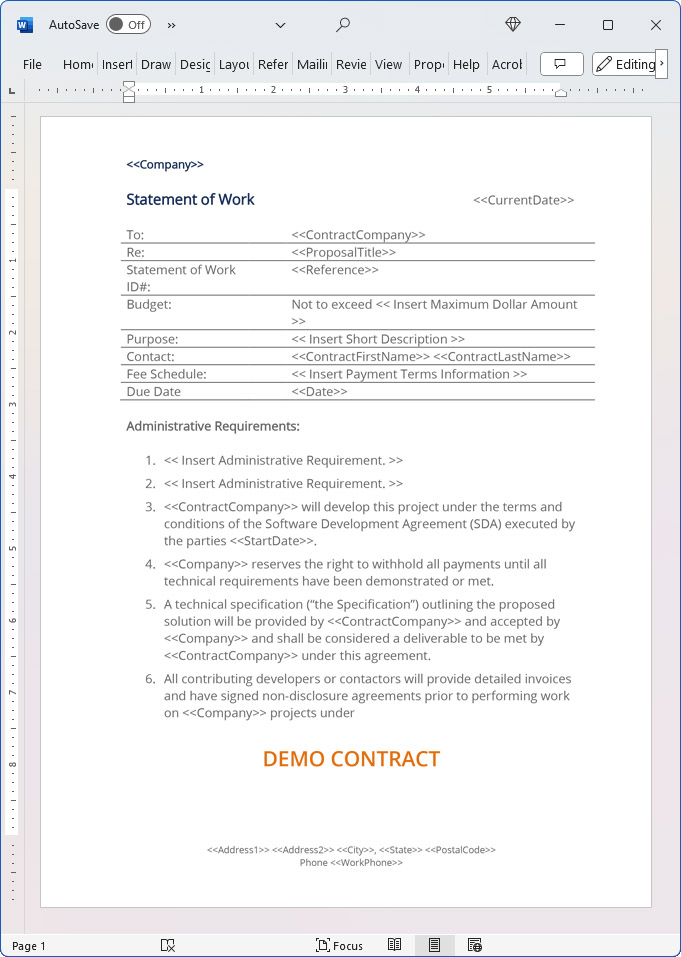
Statement of Work
Administrative Requirements:
Company Contract With will develop this project under the terms and conditions of the Software Development Agreement (SDA) executed by the parties Start Date. Company Name reserves the right to withhold all payments until all technical requirements have been demonstrated or met. A technical specification ("the Specification") outlining the proposed solution will be provided by Company Contract With and accepted by Company Name and shall be considered a deliverable to be met by Company Contract With under this agreement.
All contributing developers or contactors will provide detailed invoices and have signed non-disclosure agreements prior to performing work on Company Name projects under this agreement.
Product Requirements:
Description Time/Cash Allotted Insert Description Here Hours hours @ Hourly Rate/hr.
20% Off Discount
 Add To Cart This Word Template Only
 Add To Cart IT/Software/Hardware Contract Pack
 Add To Cart Proposal Kit Professional Bundle
 4.7 stars, based on 850 reviews
How to Build a Legal Contract with Proposal Kit
This video illustrates how to create a legal contract using the Proposal Pack Wizard software. It also shows how to create a proposal with an invoice and contract at the same time.
Frequently Asked Questions
How do I customize this contract to fit my business needs?
Customizing this contract involves editing the document to include your business details, terms, and conditions. The templates are designed to be flexible, allowing you to insert your company's name, address, and other relevant information. You can modify clauses to reflect your unique business practices and legal requirements.
Is this contract compliant with laws and regulations?
The legal contract templates are written by legal professionals and designed to comply with current laws and regulations at the time of their writing. However, laws can vary by jurisdiction and change over time, so it's recommended to have your contract reviewed by a local attorney to ensure it meets all legal requirements specific to your region and industry. Templates are licensed as self-help information and not as legal advice.
Can I use the same contract for different clients or projects?
You can use the same contract for different clients or projects. The templates are versatile and easily adapted for various scenarios. You will need to update specific details such as client names, project descriptions, and any unique terms for each new agreement to ensure that each contract accurately reflects the particulars of the individual client or project.
What should I do if I encounter a clause or term I don't understand?
If you encounter a clause or term in the contract that you need help understanding, you can refer to guidance notes explaining each section's purpose and use. For more complex or unclear terms, it's advisable to consult with a legal professional who can explain the clause and help you determine if any modifications are necessary to suit your specific needs.
How do I ensure that the contract is legally binding and enforceable?
To ensure that the contract is legally binding and enforceable, follow these steps:
- Complete all relevant sections: Make sure all blanks are filled in with accurate information.
- Include all necessary terms and conditions: Ensure that all essential elements, such as payment terms, deliverables, timelines, and responsibilities, are clearly defined.
- Signatures: Both parties must sign the contract, and it is often recommended that the contract be witnessed or notarized, depending on the legal requirements in your jurisdiction.
- Consult a legal professional: Before finalizing the contract, have it reviewed by an attorney to ensure it complies with applicable laws and protects your interests.
 Published by Proposal Kit, Inc.
Disclaimers
Proposal Kit, Inc. makes no warranty and accepts no responsibility for the suitability of any materials to the licensee's business. Proposal Kit, Inc. assumes no responsibility or liability for errors or inaccuracies. Licensee accepts all responsibility for the results obtained. The information included is not legal advice. Names in use cases have been fictionalized. Your use of the contract template and any purchased packages constitutes acceptance and understanding of these disclaimers and terms and conditions.
 Facebook
 YouTube
 Bluesky
 Search Site