

 Cart
Cart
Sample RACI Matrix Worksheet
 Get 20% off ordering today: Click here for the code
Proposal Kit Professional adds business proposals, all six Contract Packs,
Project Management Pack library, and Expert Edition software.
We include this editable document in the Proposal Kit Professional. Order and download it for $199. Follow these steps to get started.
 DOWNLOADABLE, ONE-TIME COST, NO SUBSCRIPTION FEES
Key Takeaways
- One-time License, No Subscriptions: Pay once and use Proposal Kit forever-no monthly fees or per-use charges.
- Built for Business Projects: Start with a proven Sample RACI Matrix Worksheet and tailor sections, fields, and branding for your day-to-day project work.
- Instant Access: Download immediately and open the document right away-no waiting, no onboarding delay.
- Project-Ready Structure: Use a ready, professional layout for real-world project tasks (checklists, forms, analysis pages) so teams can execute consistently.
- Fully Editable in Word: Edit everything in Microsoft Word-swap text, add/remove sections, and apply your logo/colors without special skills.
- Step-by-Step Wizard Help: The Proposal Pack Wizard guides you with training/help and keeps you moving-no getting stuck on formatting or assembly steps.
- Wizard Data Merge & Project Management: Let the Wizard manage projects and merge recurring data (company/client names, addresses, dates) across your project documents.
- Included in Proposal Kit Professional: Available exclusively in the Proposal Kit Professional bundle.
 What Our Clients Say
I have been using Proposal Kit Professional for the past year now and I love that it gives me the opportunity to submit neat, professional looking proposals that have helped me to obtain several lucrative government contracts. The software is very comprehensive and easy to use. I am able to respond to an RFP, RFI or RFQ’s in half of the time than it would usually take me to respond while writing freestyle. After some getting used to, even the most novice proposal writer can write like a seasoned pro. This is well worth the purchase!"
Royal Finish Building and Janitorial Service LLC
1. Get Proposal Kit Professional that includes this business document.
We include this Sample RACI Matrix Worksheet in an editable format that you can customize for your needs.
2. Download and install after ordering.
Once you have ordered and downloaded your Proposal Kit Professional, you will have all the content you need to get started with your project management.
3. Customize the project template with your information.
You can customize the project document as much as you need. You can also use the included Wizard software to automate name/address data merging.
Use cases for this document
Cirrus MedTech stabilizes its knowledge base with an RACI-led turnaround
The Challenge
When a surge of duplicate incident tickets and missed publish deadlines hit Cirrus MedTech, Content Operations Manager Janelle Park found no clear decision rights, no RACI chart, and conflicting instructions from project sponsors, leaving subject matter experts and the technical representative at odds and stakeholders uninformed across ITIL incident and change workflows.
The Solution
Janelle convened a change-advisory board and stood up a responsibility assignment matrix using a Google Sheets RACI model to assign roles across project phases and project deliverables, marking one accountable per task and defining who was responsible, consulted, and kept informed to restore task ownership and streamline decision-making.
The Implementation
The project team used a pre-filled template with a project title, column A for project tasks, a project phases column, and a project deliverable column; drop-down boxes with data validation and conditional formatting ensured exactly one A, while a linked TeamGantt chart tracked milestones and the approval process, and Proposal Kit's document creation produced the governance charter and playbook, AI Writer generated the communications plan and training syllabus, the RFP Analyzer compared CMS vendor submissions, and line-item quoting forecasted migration and licensing costs.
The Outcome
Within two sprints, content errors fell, incident management knowledge articles met target publish times, the executive sponsor saw faster approvals, and informed stakeholders received consistent updates, with the RACI matrix becoming the backbone for ongoing team collaboration.
Axiom Retail HR launches a compliant training library without chaos
The Challenge
At Axiom Retail, HR Director Diego Alvarez faced audit pressure to publish data loss prevention and safety modules while agile teams worked remotely, but undefined project roles and responsibilities caused duplicated effort, late deliverables, and confusion over who to consult versus keep informed.
The Solution
Diego mapped a RASCI variant of the RACI model to clarify roles, assigning accountable owners for each course, and consulted subject matter experts, aligning ITIL-aligned change windows with content releases and setting clear decision-making paths for approvals.
The Implementation
Using a Microsoft Excel template, the team built a roles grid with example data, a project phases column, and a project deliverable column; a drop-down list enforced R/A/C/I selections while Smartsheet automated workflows and gates; Proposal Kit's document creation produced an executive brief and style guide, AI Writer drafted the rollout plan and benefits study, the RFP Analyzer organized a state training grant response, and line-item quoting scoped vendor localization costs.
The Outcome
The training library launched on schedule, auditors praised the clarity of roles, cycle time shrank as team collaboration improved, and stakeholders were kept informed through concise weekly reports generated from the matrix example.
NovaGrid Utilities modernizes content during a risky cloud migration
The Challenge
As NovaGrid prepared to migrate its content management system to the cloud, Program Lead Priya Iyer confronted aging taxonomy, weak backup procedures, and unclear ownership for capacity planning, code deployments, and vendor integration, threatening service continuity.
The Solution
Priya established a responsibility matrix aligned to ITIL change management, assigning accountable owners for taxonomy redesign, disaster recovery, and performance tuning while consulting with engineers and informing business units to prevent bottlenecks and escalation churn.
The Implementation
A Google Sheets RACI with a clear project title, column A tasks, and linked milestones enforced one A per task via conditional formatting; the team synced the matrix to a Gantt chart for approvals and release windows, while Proposal Kit's document creation produced the change impact study and stakeholder briefings, AI Writer generated weekly status reports and a lessons-learned report, the RFP Analyzer scored managed services proposals, and line-item quoting modeled storage and archiving costs.
The Outcome
The migration closed without major incidents, search accuracy and publish velocity improved, the CAB signed off on releases with fewer meetings, and the project team kept informed stakeholders aligned through consistent, matrix-driven communications.
Abstract
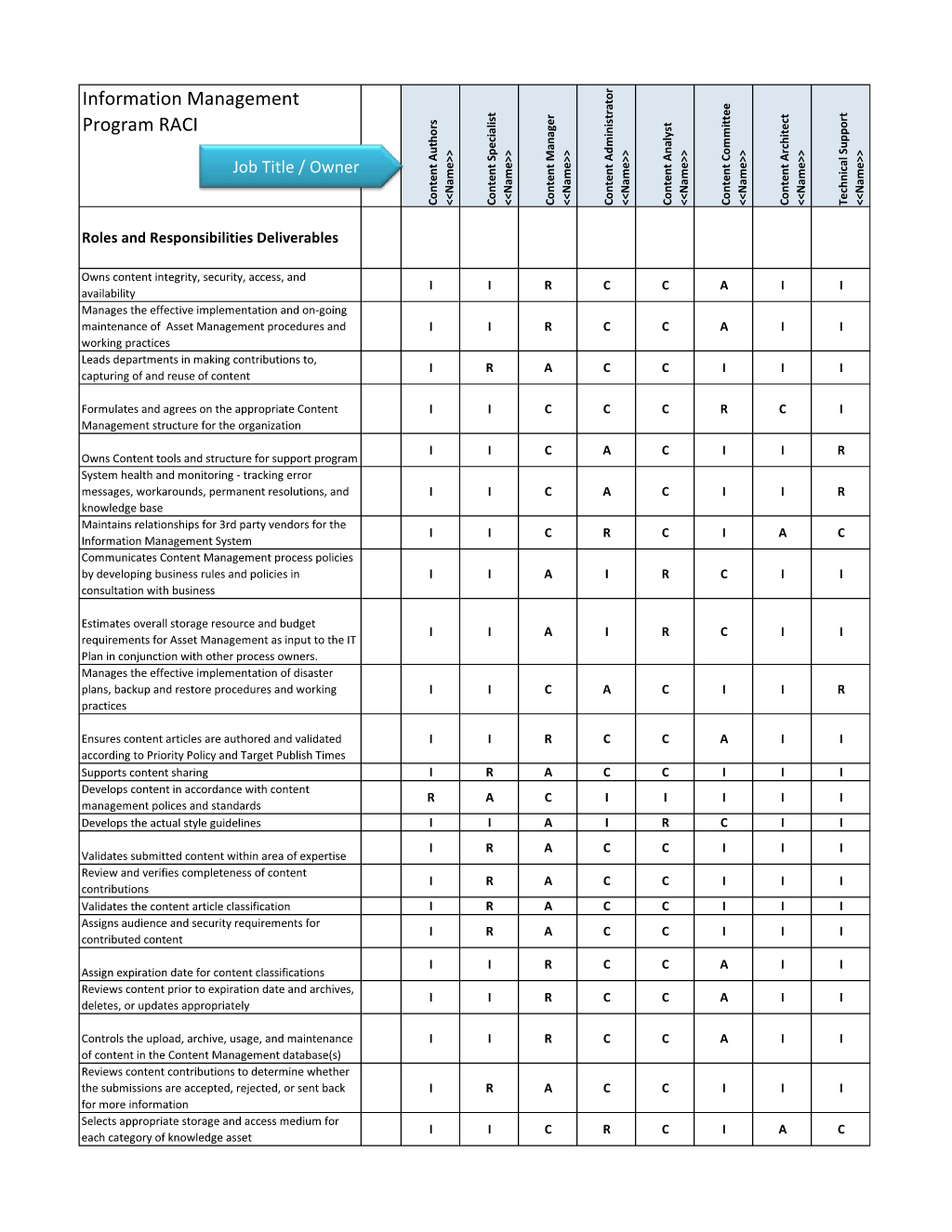
This Information Management document defines clear roles and responsibilities for governing enterprise content. It outlines who owns content integrity, security, access, and availability; who manages asset management procedures; and who leads the organization in capturing, classifying, validating, publishing, and archiving knowledge. It also assigns ownership for taxonomy design, style guidelines, category schemas, keywording, audience and security classification, expiration reviews, disaster planning, storage budgeting, and vendor relationships. Technical duties span system health monitoring, upgrades, hot fixes, patching, capacity planning, code deployments, performance tuning, migration, and documentation of the content management system.
The content manager, content authors, content specialists, IT architects, and administrators each have defined project roles across project phases and tasks. Decision-making and decision rights are supported by a responsibility assignment matrix. Teams can translate this into an RACI chart to assign responsible, accountable, consulted, and informed RACI roles to project tasks and deliverables, keeping project stakeholders and project sponsors aligned.
The same mapping works in Microsoft Excel or Google Sheets RACI using an Excel worksheet or Google Sheets template: list project phases and tasks in column A, put team members or roles across row 1, assign RACI values via a drop-down list with data validation, and use conditional formatting to avoid confusion and increase efficiency. This roles grid doubles as a matrix chart for agile teams, scrum ceremonies, milestones, and approval process checkpoints. Variants such as rasci, daci, rapid, rasic, drasci, cars model, and cairo model can fit specific workflows and communications needs.
Practical applications include: standing up an IT service management knowledge base for incident management and change management with a change-advisory board, where a technical representative is responsible and an executive sponsor is accountable while subject matter expert contributors are consulted and others are kept informed; migrating legacy content to a new platform with defined project tasks and phases, automated workflows, and a gantt chart in Smartsheet or TeamGantt; and building an HR training library with data loss prevention topics, where assignments and task ownership are tracked to keep teams in sync.
Proposal Kit can help teams document these role definitions and the responsibility matrix, assemble a complete project plan with project deliverables and project phases columns, and produce related documents. Its document assembly, automated line-item quoting, AI Writer for supporting content, and extensive template library streamline creating consistent, easy-to-use materials for stakeholders.
Building on the document, organizations can align Information Management with ITIL practices by using a RACI model to clarify roles across incident, change, and knowledge processes. When you define roles and project roles and responsibilities up front, you create clarity of roles that accelerates decision-making and improves team collaboration. The project team can assign roles, assign accountable owners for project deliverables, and specify who must be consulted and who to keep informed, ensuring project stakeholders remain engaged without bottlenecks.
A practical way to operationalize this is a responsibility assignment matrix maintained as an Excel template. Start with a clear project title, then add a project phases column and a project deliverable column to structure project tasks by lifecycle stage. Provide a matrix example with example data in a pre-filled template, so teams can quickly assign responsibility using a drop-down box for R, A, C, and I values. This approach helps define roles, assign accountable leads, and keep informed stakeholders aligned as work progresses, while offering an auditable map of decision rights and dependencies.
Use cases include IT knowledge-base rollouts under ITIL, HR and AIHR-style training libraries, and cross-functional content migrations where the project team must coordinate taxonomy, security, and publishing schedules. Each scenario benefits from the RACI model's ability to clarify roles and streamline approvals tied to project deliverables.
Proposal Kit supports this work by helping teams document project roles and responsibilities, assemble proposals and plans that mirror the matrix example structure, and produce companion materials. Its document assembly, automated line-item quoting, AI Writer for supporting documents, and extensive template library make it easier to communicate assignments, schedule phases, and keep stakeholders aligned.
Expanding on the Information Management framework, organizations can translate the document's duties into a structured responsibility assignment matrix to tighten governance and speed decision-making. Under an ITIL lens, change management, incident management, and knowledge management benefit when project sponsors, executive sponsors, technical representatives, and each subject matter expert have unambiguous task ownership. Use the RACI model to assign roles across project phases and project deliverables: make one person accountable, identify who is responsible for the work, specify who is consulted for expertise, and list who must be kept informed. This clarity of roles reduces handoffs, prevents rework, and aligns project stakeholders and team members.
Operationalize the model in an Excel worksheet or Google Sheets using a simple roles grid. Put the project title at the top. In column A, list project tasks by lifecycle, with a project phases column and a project deliverable column.
Across row 1, list team members or roles. Use a drop-down list or drop-down box with data validation to assign responsibility (R, A, C, I). Add conditional formatting to ensure exactly one A per task and to highlight missing assignments. Provide a matrix example with example data in a pre-filled template so new teams can define roles fast, assign accountable owners, and keep informed stakeholders visible. This same approach scales to variants such as RASCI or DACI when decision rights require more nuance.
Tie the matrix to your project plan and schedule. In Smartsheet, TeamGantt, or Google Sheets, link RACI to a Gantt chart, milestones, approval process gates, and automated workflows. As work proceeds, the responsibility matrix anchors communications, supports audits, and keeps teams in sync. HR and AIHR-style training initiatives, content migrations, and service desk knowledge-base rollouts are common use cases where defined project roles and responsibilities and clear assignments reduce risk and speed delivery.
Proposal Kit helps teams document role definitions, assemble plans, and produce companion materials aligned to the matrix example. Its document assembly, automated line-item quoting, AI Writer for supporting documents, and extensive template library make it easier to create consistent responsibility matrices, project plans, and stakeholder communications with minimal effort.
Writing the Sample RACI Matrix Worksheet document
business,project,records,management,toolkit,information,documents,templates,boilerplate,form,outline,textThe editable Sample RACI Matrix Worksheet document - complete with the actual formatting and layout is available in the retail Proposal Kit Professional.
20% Off Discount
 4.7 stars, based on 850 reviews
 Published by Proposal Kit, Inc.
We include a library of documents you can use based on your needs. All projects are different and have different needs and goals. Pick the documents from our collection, such as the Sample RACI Matrix Worksheet, and use them as needed for your project.
 Facebook
 YouTube
 Bluesky
 Search Site
© 1997 - 2026, Proposal Kit, Inc. All rights reserved. Privacy Policy