


 Cart
Cart
 Get 20% off ordering today:

How to write your Waiver and Release of Lien
We include this 1 page template with Contractors Contract Pack and the Proposal Kit Professional. You will get more content and software automation for data merging, managing client documents, and creating proposals with line item quoting with a Contract Pack or the Professional.
 DOWNLOADABLE, ONE-TIME COST, NO SUBSCRIPTION FEES
 What Our Clients Say
I’m really impressed with the quality of the content for various contract templates."
1. Get Contractors Contract Pack or the single template that includes this business contract document.
We include this contract in editable Word format that can be customized using your office software.
2. Download and install after ordering.
Once you have ordered and downloaded your template or pack, you will have all the content you need to get started.
3. Customize the contract template with your information.
You can customize the contract document as much as you need. If you get a Contract Pack or Professional Bundle, you can also use the included Wizard software to automate name/address data merging.
Use cases for this template
Sierra Crest Builders clears a stalled draw with California progress waivers
The Challenge
Sierra Crest Builders, GC for Golden Bay Lofts, hit a cash-flow snag when the construction lender froze a project funding draw pending architect review, confirmation to the lender, and proof that lien rights were waived through date; meanwhile, Pacific Electrical refused to proceed without a conditional waiver and release upon progress payment and a joint check as evidence of payment under the payment application process.
The Solution
The team used the Waiver and Release of Lien Agreement to document a claimant's release for all paid line items and paired it with california waiver forms that substantially follow statutory form under civil code sections 8132 8134 8136 8138, ensuring the waiver is only binding to the consideration of the sum received and binding upon evidence of payment via written acknowledgment of payment and single check endorsement.
The Implementation
Using Proposal Kit, they assembled supporting materials: a lender deposit or draw confirmation cover memo, sworn construction statements, and a contractor application for payment schedule built with automated line-item quoting; the AI Writer produced a concise owner and lender protection narrative and a flow-down provisions brief for subcontractors and suppliers, while the legal waiver forms followed the statute-prescribed language.
The Outcome
The construction lender released the draw, subcontractor waivers were collected as required, retainage retention stayed intact, and progress payment moved on schedule; the owner, architect, and lender team accepted the package, and potential mechanic's lien and payment bond rights were preserved for items not paid because the release does not cover all items beyond the stated rights waived through date.
Red Mesa Homes wraps a Texas build with enforceable final waivers
The Challenge
Owner-builder Red Mesa Homes faced competing demands at final payment: suppliers sought an unconditional waiver and release upon final payment, the lender wanted statutory notice forms, and the PM worried about waiver enforceability, indemnification obligations, and ensuring retainage not covered was carved out under Texas waiver forms and Texas Property Code section 53.284.
The Solution
They issued a conditional waiver and release upon final payment first, making it binding upon evidence of payment rather than waiver upon execution, then followed with a full unconditional waiver and final lien waiver once confirmation that payment was made cleared and acknowledgments and proofs were recorded in the written instrument acknowledgment log.
The Implementation
Proposal Kit generated supporting documents only: an owner builder note and consumer caution brief, a compliance checklist on forms prescribed by statute and jurisdiction specific requirements, and a closeout report contrasting waiver categories (progress vs final payment; conditional release vs unconditional release); automated line-item quoting produced the description of property and invoice roll-up for the payment application, while the express written agreement and contractor's waiver remained separate.
The Outcome
Final payment condition was met, subcontractor waivers were filed, the mechanics lien section entries were complete, and the owner, contractor, subcontractor chain closed out without dispute; the lender approved the project funding draw and marked the file contractually required complete with acknowledgment of payment.
HarborPoint Mechanical balances bond and lien releases on a Florida hospital job
The Challenge
On a bonded renovation for Bayside Health, HarborPoint Mechanical faced a surety requiring a payment bond waiver, while SunCoast Build Group requested interim waiver packages and a progress waiver each month; the owner demanded Florida waiver forms that substantially follow statutory requirements and a payment bond claim reservation for disputed change orders.
The Solution
HarborPoint used the base lien release to document paid work and added state-specific forms (florida waiver forms) plus a narrowly drafted payment bond waiver to avoid an unintended release of payment bond rights; for the final payment, they planned an unconditional waiver and release upon progress payment for the last cycle and a contractor supplier downstream certification to show consideration of the sum and description of property.
The Implementation
With Proposal Kit, the team produced supporting collateral only: a risk memo comparing arizona conditional waiver and missouri mechanic's lien release practices for multi-state partners, a subcontractor communications plan, and deposit or draw confirmation letters for the owner architect lender; the AI Writer prepared summaries of waiver language prescribed and forms that substantially follow statutory form, while generic lien waiver forms were attached as waiver form samples for training.
The Outcome
The surety accepted the documentation, the owner released funds on time, and downstream contractors delivered written instrument acknowledgment receipts; no payment bond claims were filed, and the final payment package closed without notarized requirement issues or delays, demonstrating enforceability of the waiver and clean release of claims limited to the rights waived through date.
Abstract
This lien release agreement documents that a company (the grantor) releases the other party (the grantee) from all known mechanic's lien claims for labor, materials, products, and services provided through the date of the agreement. It requires a clear scope description with line items such as invoices, job numbers, dates, and any recorded documents. The signer, as an authorized agent, represents that nothing has been assigned to third parties and that the listed items have been paid in full, making this an unconditional release for the items covered. It binds the claimant and successors and can fit the payment application process under a prime contract with subcontractors and suppliers.
In practice, businesses categorize waivers by progress vs final payment and by conditional release vs unconditional release. A conditional waiver and release upon progress payment or final payment is tied to a payment precondition; an unconditional waiver and release upon progress payment or final payment is effective upon execution and acknowledgment of payment. Interim waiver or partial waiver language can preserve retainage, and the release does not cover all items beyond the rights waived through date.
Many owners, architects, and construction lenders request evidence of payment, a written acknowledgment of payment, or a joint check or single check endorsement before funding the next project draw. This aligns with contractor application for payment workflows, architect review checkpoints, and confirmation to the lender.
Some states require statute-prescribed language or a statutory form. Examples include civil code sections 8132, 8134, 8136, 8138, Texas Property Code section 53.284, and the acknowledgment forms section 121.008. Jurisdiction-specific requirements may include notarized requirements, acknowledgments and proofs, and statutory notice forms. Generic lien waiver forms should substantially follow statutory language for enforceability, and businesses should be aware of owner-builder warning, consumer caution, and check the license resources where applicable.
On projects with a payment bond, the release may also address payment bond rights and release of payment bond rights, protecting the owner, surety, and downstream contractors. Flow down provisions, broad indemnification, and mechanics liens understanding under contract documents forms, such as A201-2017 general conditions and sworn construction statements, often require waiver execution from each lienor.
Proposal Kit helps organizations assemble waiver form samples and related contract clause library materials, generate detailed line-item scopes and quotes, and use its AI Writer to build supporting documents. Its extensive template library supports owner, contractor, and subcontractor payment workflows with ease of use across construction industry resources.
Expanding on the template, businesses typically organize waiver categories by both timing and conditions. For progress waiver uses, a progress payment condition limits lien rights waived through date, while a final lien waiver addresses a final payment condition. A conditional waiver and release upon final payment is binding upon evidence of payment, such as a written instrument acknowledgment or confirmation that payment was made.
An unconditional waiver and release upon final payment operates as a full unconditional waiver and is a waiver upon execution. In all cases, the waiver is only binding to the extent stated, and retainage not covered should be identified so the release does not exceed the consideration of the sum actually received.
State-specific forms matter. Some jurisdictions require forms prescribed by statute and waiver language prescribed, and expect parties to substantially follow the statutory form or substantially follow the form. Examples include California waiver forms, Florida waiver forms, Texas waiver forms, Georgia waiver forms, Nevada waiver forms, Utah waiver forms, Wyoming lien waiver, Michigan conditional waiver, Mississippi waiver and release, Missouri mechanic's lien release, and Arizona conditional waiver.
Where a waiver is prescribed by statute or subject to statutory requirements, common fields include a description of property, a dated year lienor entry, and a mechanics lien section. Some states changed notarization before 2021; others still require acknowledgments or forms prescribed by statute for waiver enforceability.
Operationally, a contractor is required to submit waivers downstream with subcontractor waivers as part of construction project payment controls. Owner, contractor, subcontractor chains use waivers for owner and lender protection and construction project funding, including deposit or draw confirmation by the construction lender and the owner, architect, and lender team. On bonded jobs, parties may include a payment bond waiver while preserving any payment bond claim or payment bond claims as permitted. Clear waiver representations, express written agreement terms, and attention to indemnification obligations support the enforceability of the waiver for each construction lien claimant and contractor supplier downstream.
Proposal Kit helps organizations assemble contractually required documents that align with construction owner requirements, including contractor's waiver packages and state-specific variations. Its document assembly, automated line-item quoting, AI Writer for supporting documents, and extensive template library streamline preparation and updates across funding draws and waivers.
Further considerations help teams avoid gaps between progress vs final payment paperwork. For any construction lien claimant acting as a lienor, ensure the description of property, consideration of the sum, and rights waived through date align with the payment application and project funding draw. Where a waiver is prescribed by statute, many state-specific forms include a mechanics lien section and a dated one-year lienor line plus a written instrument acknowledgment.
Owners should verify that retainage not covered is clearly noted, that waiver representations are consistent across the contractor's waiver and subcontractor waivers, and that the waiver is only binding to the extent stated. On owner-builder projects, include an owner-builder note and any statutory notice forms so that the owner-builder does not miss deposit or draw confirmation steps required by the construction lender or the owner-architect lender team. When bond coverage applies, parties may issue a payment bond waiver while preserving a payment bond claim if allowed. Waiver enforceability improves when the forms substantially follow statutory form, reflect an express written agreement, and are binding upon evidence of payment rather than waiver upon execution when a conditional form is intended.
Use cases include: a supplier releasing a progress waiver after a joint check clears; a GC issuing a full unconditional waiver and a final lien waiver once final payment condition is met; and a surety asking downstream contractors to submit waivers before confirming construction project payment. Proposal Kit supports these workflows by helping owner, contractor, subcontractor teams assemble forms prescribed by statute or generic lien waiver forms that substantially follow form, generate line-item scopes that match payment application entries, and produce confirmation that payment was made narratives. Its document assembly, automated line-item quoting, AI Writer for supporting documents, and extensive template library streamline contractually required waiver execution while supporting owner and lender protection.
How do you write a Waiver and Release of Lien document? - The Narrative
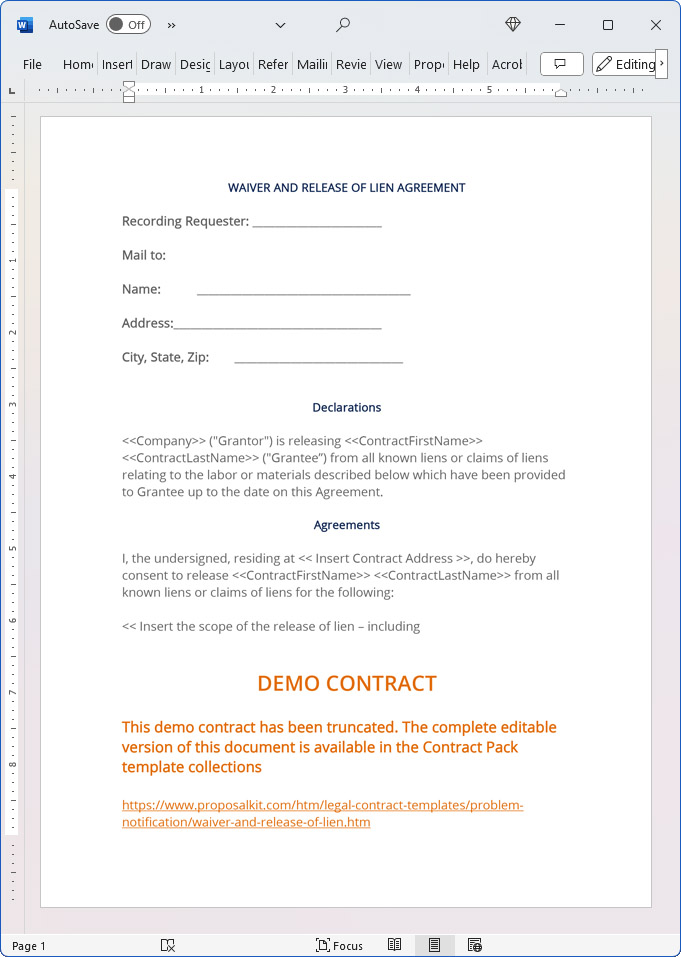
WAIVER AND RELEASE OF LIEN AGREEMENT
Recording Requester:
Mail to:
City, State, Zip:
Company Name ("Grantor") is releasing First Last ("Grantee") from all known liens or claims of liens relating to the labor or materials described below which have been provided to Grantee up to the date on this Agreement.
I, the undersigned, residing at Insert Contract Address, do hereby consent to release First Last from all known liens or claims of liens for the following:
Insert the scope of the release of lien - including line items for all labor, materials, products, services, dates, invoices, job numbers, legal or recorded documents or any other relevant information. I further attest that I have not assigned any of my rights concerning any claims or obligations covered under this Agreement to any third party or individual, and I do hereby swear that the above-listed labor and/or materials have been paid in full. I further agree that this release shall bind me and my successors.
In witness whereof, the parties have executed this Agreement this Current Day day of Current Month, Current Year. Job title of signator, authorized signature or signer. Job title of signator, authorized signature or signer.
Date of Agreement:
20% Off Discount
 Add To Cart This Word Template Only
 Add To Cart Contractors Contract Pack
 Add To Cart Proposal Kit Professional Bundle
 4.7 stars, based on 850 reviews
Related Documents
How to Build a Legal Contract with Proposal Kit
This video illustrates how to create a legal contract using the Proposal Pack Wizard software. It also shows how to create a proposal with an invoice and contract at the same time.
Frequently Asked Questions
How do I customize this contract to fit my business needs?
Customizing this contract involves editing the document to include your business details, terms, and conditions. The templates are designed to be flexible, allowing you to insert your company's name, address, and other relevant information. You can modify clauses to reflect your unique business practices and legal requirements.
Is this contract compliant with laws and regulations?
The legal contract templates are written by legal professionals and designed to comply with current laws and regulations at the time of their writing. However, laws can vary by jurisdiction and change over time, so it's recommended to have your contract reviewed by a local attorney to ensure it meets all legal requirements specific to your region and industry. Templates are licensed as self-help information and not as legal advice.
Can I use the same contract for different clients or projects?
You can use the same contract for different clients or projects. The templates are versatile and easily adapted for various scenarios. You will need to update specific details such as client names, project descriptions, and any unique terms for each new agreement to ensure that each contract accurately reflects the particulars of the individual client or project.
What should I do if I encounter a clause or term I don't understand?
If you encounter a clause or term in the contract that you need help understanding, you can refer to guidance notes explaining each section's purpose and use. For more complex or unclear terms, it's advisable to consult with a legal professional who can explain the clause and help you determine if any modifications are necessary to suit your specific needs.
How do I ensure that the contract is legally binding and enforceable?
To ensure that the contract is legally binding and enforceable, follow these steps:
- Complete all relevant sections: Make sure all blanks are filled in with accurate information.
- Include all necessary terms and conditions: Ensure that all essential elements, such as payment terms, deliverables, timelines, and responsibilities, are clearly defined.
- Signatures: Both parties must sign the contract, and it is often recommended that the contract be witnessed or notarized, depending on the legal requirements in your jurisdiction.
- Consult a legal professional: Before finalizing the contract, have it reviewed by an attorney to ensure it complies with applicable laws and protects your interests.
 Published by Proposal Kit, Inc.
Disclaimers
Proposal Kit, Inc. makes no warranty and accepts no responsibility for the suitability of any materials to the licensee's business. Proposal Kit, Inc. assumes no responsibility or liability for errors or inaccuracies. Licensee accepts all responsibility for the results obtained. The information included is not legal advice. Names in use cases have been fictionalized. Your use of the contract template and any purchased packages constitutes acceptance and understanding of these disclaimers and terms and conditions.
 Facebook
 YouTube
 Bluesky
 Search Site