


 Cart
Cart%20-%20The%20Software%20Test%20Use%20Case%20(Master%20Plan)%20worksheet%20is%20used%20to%20keep%20track%20of%20information%20during%20software%20testing.%20Hundreds%20of%20specialty%20contracts%20available%20from%20ProposalKit.com. "Pin to Pinterest")
 Get 20% off ordering today: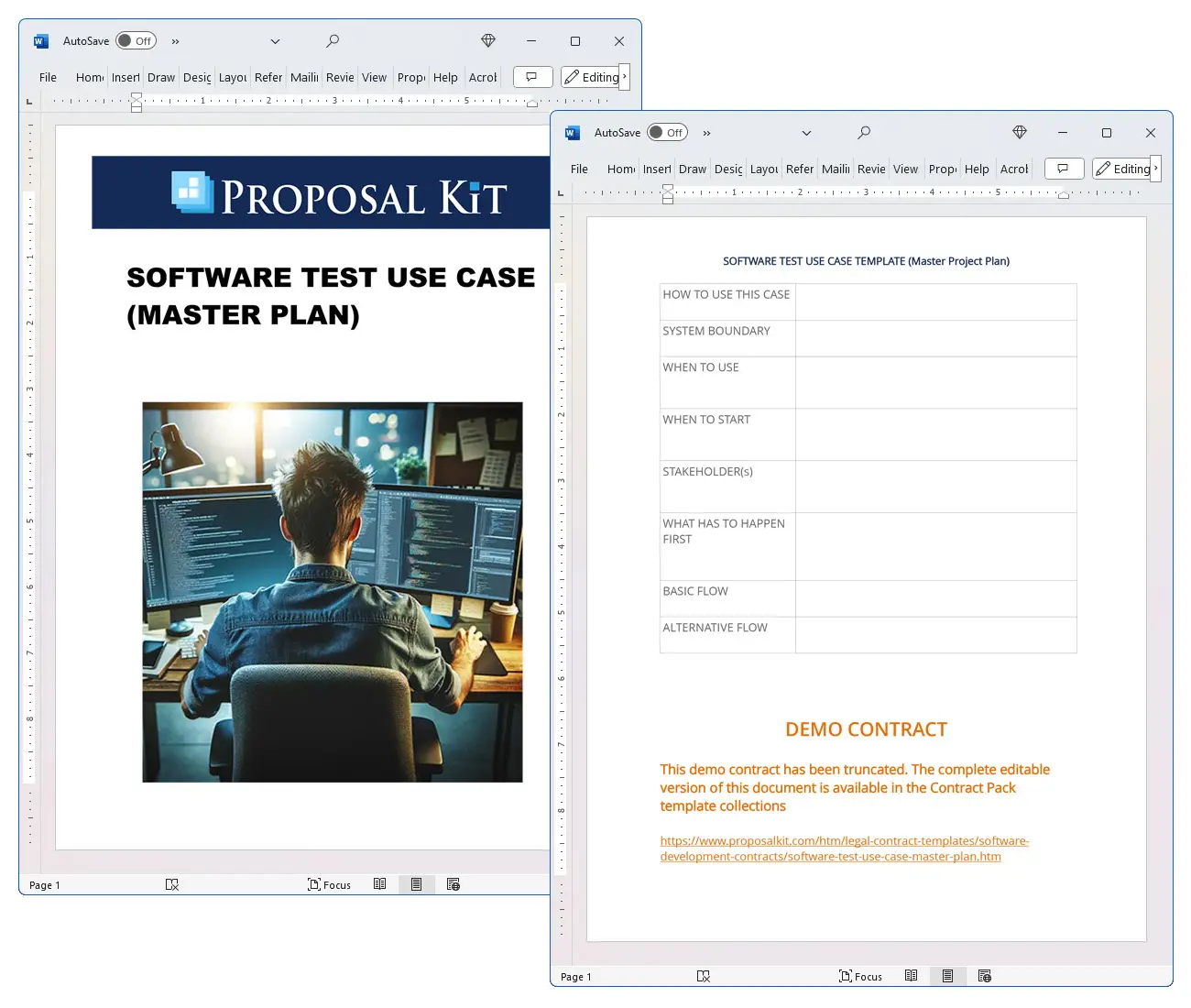

How to write your Software Test Use Case (Master Plan)
We include this 1 page template with IT/Software/Hardware Contract Pack and the Proposal Kit Professional. You will get more content and software automation for data merging, managing client documents, and creating proposals with line item quoting with a Contract Pack or the Professional.
 DOWNLOADABLE, ONE-TIME COST, NO SUBSCRIPTION FEES
 What Our Clients Say
WOW! I wish I had this when I was consulting for clients! It would have saved me a lot time."
ERMm
1. Get IT/Software/Hardware Contract Pack or the single template that includes this business contract document.
We include this contract in editable Word format that can be customized using your office software.
2. Download and install after ordering.
Once you have ordered and downloaded your template or pack, you will have all the content you need to get started.
3. Customize the contract template with your information.
You can customize the contract document as much as you need. If you get a Contract Pack or Professional Bundle, you can also use the included Wizard software to automate name/address data merging.
Use cases for this template
Nimbus Cart's holiday checkout overhaul stays on schedule
The Challenge
As Nimbus Cart LLC prepared a peak-season checkout redesign, CTO Ava Moreno faced unclear project scope, uneven requirements quality, missing acceptance criteria, and no shared test plan template, all while a tight timeline and schedule threatened time to market and left test objectives, test case priority, and stakeholder feedback scattered across teams.
The Solution
The team adopted the software test use case template as a master plan, assigning a test plan id and shaping a test strategy, test plan structure, and test plan content that mapped project scope to test objectives and approach, acceptance criteria, entry and exit criteria, risk based testing, test plan milestones, and test plan benefits, supported by a test planning tool and test management solution (Azure Test Plans, TestRail, Confluence pages, and a requirements widget).
The Implementation
They set up the test environment and test data management, executed unit testing, integration testing, functional testing, regression testing, performance testing, security testing, and usability testing through manual testing, exploratory testing (via an exploratory testing extension), and automated testing with Visual Studio Test in CI CD pipelines; test suites, test case management, test design, test case execution, and test reporting fed a test log, defect report, test summary report, progress report, and analytics service that published test results, tracked defect density, test coverage, and defect detection efficiency with traceability across requirements and builds.
The Outcome
With exit criteria met and UAT approval achieved, pass rate improved, critical bugs dropped after focused bug triage, and time to market accelerated; Proposal Kit supported the contract by generating extra documents-plan summaries, test reports, progress reports, a risk matrix template, roles and responsibilities template, release notes, and line-item quoting for the statement of work-using document assembly and the AI Writer to craft companion proposals and studies that kept team collaboration aligned.
BrightPulse Health secures a high-stakes lab integration
The Challenge
BrightPulse Health, led by QA Director Lila Chen, needed to integrate a third-party lab system, where non-functional testing, strict acceptance criteria, and auditable test artifacts were mandatory, yet resource planning, a fragmented project timeline, and inconsistent test plan elements put quality assurance and compliance at risk.
The Solution
They framed a test plan overview and test plan purpose from the use case template, defined test objectives, testing methodology, testing phases and deliverables, and used a test plan checklist, roles and responsibilities template, and risk matrix template to enforce governance; requirements and builds were linked for traceability in a test management solution, while a test plan example clarified test case priority and type and the cadence for test reporting and progress report reviews.
The Implementation
Teams established test configurations, shared parameters, and data anonymization in the test environment setup, ran compatibility testing plus unit and integration suites, combined automated checks with targeted manual and exploratory sessions, and coordinated acceptance testers and UAT stakeholders through entry criteria gates, test reports, a test completion report, and a UAT report to prove exit criteria met with evidence.
The Outcome
Critical bugs were surfaced early, regulatory risk decreased, and stakeholder approval arrived on schedule with UAT approval; Proposal Kit backed the legal contract by producing supporting documents-security assessment summaries, a test plan template packet, compliance progress reports, and line-item quoting for change orders-while the AI Writer assembled executive summaries and case studies that clarified decisions without altering the contract itself.
BlueLattice accelerates a data dashboard launch
The Challenge
At BlueLattice Analytics, PM Jordan Reyes inherited scope creep, a slipping test schedule, and uneven team collaboration that masked gaps in test case management and muddled the project timeline for a new analytics dashboard feature.
The Solution
Using the use case template, the team created an agile test plan and a page test plan with a unique test plan ID, clarified test plan elements, test plan milestones, and acceptance criteria, and applied test planning best practices-shift left testing, stakeholder feedback loops, and a risk-based testing matrix-to prioritize work and align test case priority with business value.
The Implementation
They organized test suites and a test runner, tuned test configurations and shared parameters, executed exploratory testing and regression packs through a devops pipeline, generated real-time reports and test analytics to monitor test results trend, and closed each sprint with a retrospective and continuous improvement actions driven by bug triage and targeted test design updates.
The Outcome
Coverage rose, defects stabilized, and time to market improved as stakeholders signed off on acceptance testing; Proposal Kit supported the contract by assembling auxiliary materials-an investor proposal, ROI study, resource requirements plan, and SOW with line-item quoting-while the AI Writer produced supplemental reports and plans that kept documentation coherent and on-message without drafting the contract itself.
Abstract
This software testing use case template functions as a lightweight master project plan. It prompts teams to define the system boundary, scope, and objectives, and success criteria before work begins. By clarifying in scope and out of scope items, entry and exit criteria, and pass fail criteria, the document aligns project objectives to testing goals and reduces scope creep. It also supports risk assessment and risk management by directing teams to record a risk matrix, risk mitigation steps, and suspension criteria.
The basic flow and alternative flow sections translate into the testing approach and testing phases. Teams describe test situations mapped to user stories and product requirements, then outline unit testing, integration testing, functional testing, performance testing, security testing, usability testing, regression testing, and acceptance testing, including UAT. The template encourages agile testing with shift left testing for early feedback and shift right testing to observe production behavior.
It covers test environment setup, test data management, test configurations, shared parameters, and test environments and tools to ensure repeatable test execution. It also supports manual testing, exploratory testing (with an exploratory testing extension), and automated testing integrated with CI CD pipelines and a devops pipeline, using tools such as Azure Test Plans, TestRail, Confluence pages, Visual Studio Test, a test runner, and a test management tool for requirements traceability and requirements coverage across test suites and a test case repository.
Governance and reporting requirements include test deliverables like a test plan document, a test suite, test case templates, test case design, test case approval, test runs, and test execution progress. Teams track a test log, defect report, defect management and bug triage, a test summary report, a test completion report, a UAT report, and release notes. Metrics such as defect density, test coverage, pass rate, and defect detection efficiency feed test analytics, real-time reports, progress reports, and a test results trend via an analytics service that can publish test results. The order of events and responsible party prompts drive a clear test schedule and milestones, testing timelines, resource allocation, resource requirements, roles and responsibilities, and stakeholder approval from project managers, QA teams, acceptance testers, and UAT stakeholders.
Example uses include an e-commerce checkout update with compatibility testing across browsers, a healthcare integration with strict entry criteria and traceability, or a SaaS release guided by an agile test plan, one-page test plan, test plan review and finalization, and a retrospective for continuous improvement.
Proposal Kit helps teams produce this content quickly through document assembly, automated line-item quoting for the statement of work, an AI Writer that can build supporting documents, and an extensive template library, making test planning and test documentation easier to structure and reuse.
Building on the template's foundation, teams should formalize a test strategy anchored by a clear test plan purpose, test plan overview, and test plan structure. Assign a unique test plan ID and outline test plan content that ties project scope, test objectives, acceptance criteria, and approach to a realistic timeline and schedule. Define test plan milestones along the project timeline, align resource planning to roles and responsibilities (a roles and responsibilities template helps), and state the testing methodology, testing phases, and deliverables.
Use a test plan checklist to confirm entry conditions and document how exit criteria will be verified before user acceptance testing and UAT approval. These practices improve predictability, governance, and time to market.
A robust test planning tool or test management solution should support risk-based testing, non-functional testing, and test case management. Prioritize work using test case priority and type, then drive test case execution with well-formed test design and test artifacts. Improve requirements quality by linking requirements and builds; a requirements widget can surface traceability within dashboards.
Throughout, gather stakeholder feedback and escalate critical bugs with a targeted progress report and test reports cadence. Standardized test reporting helps executives compare a test plan example across releases and measure test plan benefits. Organize acceptance criteria and user acceptance testing checkpoints so that risk matrix template outcomes inform what to test first and how to manage residual risk.
Proposal Kit can streamline this documentation process for business teams. Its document assembly, automated line-item quoting for the statement of work, AI Writer for building supporting documents, and an extensive template library help you produce a test plan template, risk matrix narratives, and plan summaries that fit your team collaboration workflows. By standardizing plan topics and providing reusable structures, Proposal Kit makes it easier to assemble consistent plans, align stakeholders, and keep testing activities on schedule.
To deepen quality assurance, establish quality gates that tie business risks to release decisions and make prevention a first-class activity. Before execution, review requirements for clarity and testability, run design walkthroughs, and perform dry runs of critical workflows using production-like data patterns. Baseline the test plan and manage change; every scope update should trigger impact analysis on schedule, resources, and risk exposure. Strengthen environmental parity with documented rollback and data protection steps to reduce deployment risk.
Clarify core test plan topics so teams share a single source of truth: objectives and scope, acceptance criteria, environments and data, schedule and milestones, roles and responsibilities, reporting cadence, risks and assumptions, dependencies, and approvals. Treat the plan as a living artifact with version control and traceable decisions.
Adopt test planning best practices that improve predictability: collaborate early with engineering, security, and support; prioritize by business value and user risk; pilot user acceptance testing on a small cohort; use checklists for entry and exit reviews; and run focused lessons-learned sessions that translate into corrective actions. Track leading indicators such as requirements readiness, test case readiness, and environment readiness alongside lagging indicators like escaped defects and rework. This discipline tightens feedback loops, minimizes surprises, and increases confidence in release outcomes.
How do you write a Software Test Use Case (Master Plan) document? - The Narrative
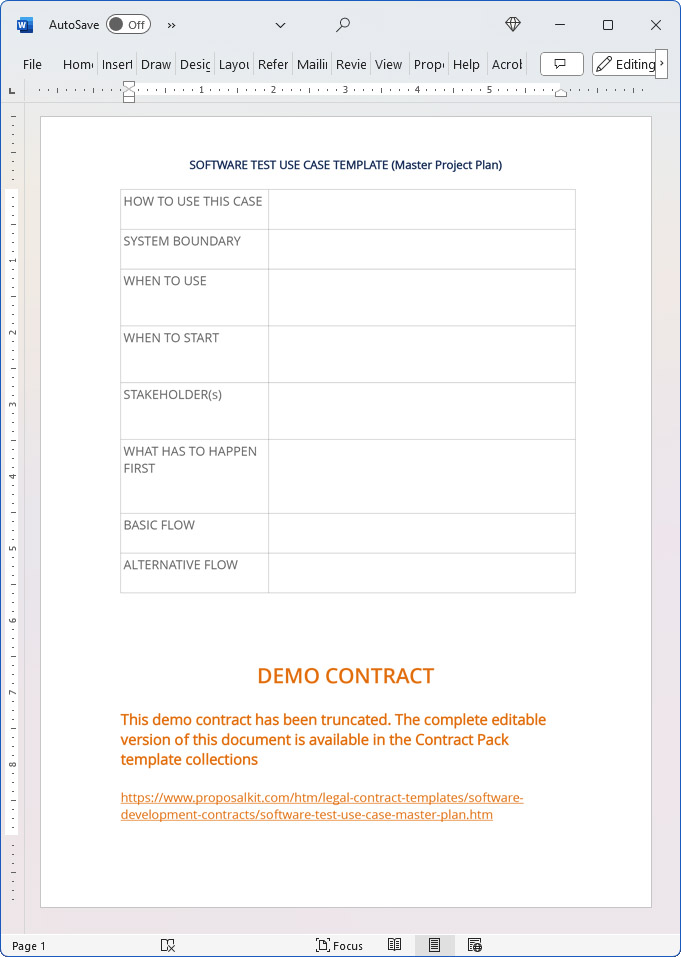
SOFTWARE TEST USE CASE TEMPLATE (Master Project Plan)
HOW TO USE THIS CASE.
SYSTEM BOUNDARY
WHEN TO USE
WHEN TO START
WHAT HAS TO HAPPEN FIRST.
BASIC FLOW
ALTERNATIVE FLOW
SPECIAL REQUIREMENTS
WHO IS INTERESTED IN THIS INFORMATION. ORDER OF EVENTS RESPONSIBLE PARTY SYSTEM ISSUE(s) N/A.
20% Off Discount
 Add To Cart This Word Template Only
 Add To Cart IT/Software/Hardware Contract Pack
 Add To Cart Proposal Kit Professional Bundle
 4.7 stars, based on 850 reviews
Related Documents
How to Build a Legal Contract with Proposal Kit
This video illustrates how to create a legal contract using the Proposal Pack Wizard software. It also shows how to create a proposal with an invoice and contract at the same time.
Frequently Asked Questions
How do I customize this contract to fit my business needs?
Customizing this contract involves editing the document to include your business details, terms, and conditions. The templates are designed to be flexible, allowing you to insert your company's name, address, and other relevant information. You can modify clauses to reflect your unique business practices and legal requirements.
Is this contract compliant with laws and regulations?
The legal contract templates are written by legal professionals and designed to comply with current laws and regulations at the time of their writing. However, laws can vary by jurisdiction and change over time, so it's recommended to have your contract reviewed by a local attorney to ensure it meets all legal requirements specific to your region and industry. Templates are licensed as self-help information and not as legal advice.
Can I use the same contract for different clients or projects?
You can use the same contract for different clients or projects. The templates are versatile and easily adapted for various scenarios. You will need to update specific details such as client names, project descriptions, and any unique terms for each new agreement to ensure that each contract accurately reflects the particulars of the individual client or project.
What should I do if I encounter a clause or term I don't understand?
If you encounter a clause or term in the contract that you need help understanding, you can refer to guidance notes explaining each section's purpose and use. For more complex or unclear terms, it's advisable to consult with a legal professional who can explain the clause and help you determine if any modifications are necessary to suit your specific needs.
How do I ensure that the contract is legally binding and enforceable?
To ensure that the contract is legally binding and enforceable, follow these steps:
- Complete all relevant sections: Make sure all blanks are filled in with accurate information.
- Include all necessary terms and conditions: Ensure that all essential elements, such as payment terms, deliverables, timelines, and responsibilities, are clearly defined.
- Signatures: Both parties must sign the contract, and it is often recommended that the contract be witnessed or notarized, depending on the legal requirements in your jurisdiction.
- Consult a legal professional: Before finalizing the contract, have it reviewed by an attorney to ensure it complies with applicable laws and protects your interests.
 Published by Proposal Kit, Inc.
Disclaimers
Proposal Kit, Inc. makes no warranty and accepts no responsibility for the suitability of any materials to the licensee's business. Proposal Kit, Inc. assumes no responsibility or liability for errors or inaccuracies. Licensee accepts all responsibility for the results obtained. The information included is not legal advice. Names in use cases have been fictionalized. Your use of the contract template and any purchased packages constitutes acceptance and understanding of these disclaimers and terms and conditions.
 Facebook
 YouTube
 Bluesky
 Search Site