

 Cart
Cart
Sample Stakeholder Concerns Log
 Get 20% off ordering today: Click here for the code
Proposal Kit Professional adds business proposals, all six Contract Packs,
Project Management Pack library, and Expert Edition software.
We include this editable document in the Proposal Kit Professional. Order and download it for $199. Follow these steps to get started.
 DOWNLOADABLE, ONE-TIME COST, NO SUBSCRIPTION FEES
Key Takeaways
- One-time License, No Subscriptions: Pay once and use Proposal Kit forever-no monthly fees or per-use charges.
- Built for Business Projects: Start with a proven Sample Stakeholder Concerns Log and tailor sections, fields, and branding for your day-to-day project work.
- Instant Access: Download immediately and open the document right away-no waiting, no onboarding delay.
- Project-Ready Structure: Use a ready, professional layout for real-world project tasks (checklists, forms, analysis pages) so teams can execute consistently.
- Fully Editable in Word: Edit everything in Microsoft Word-swap text, add/remove sections, and apply your logo/colors without special skills.
- Step-by-Step Wizard Help: The Proposal Pack Wizard guides you with training/help and keeps you moving-no getting stuck on formatting or assembly steps.
- Wizard Data Merge & Project Management: Let the Wizard manage projects and merge recurring data (company/client names, addresses, dates) across your project documents.
- Included in Proposal Kit Professional: Available exclusively in the Proposal Kit Professional bundle.
 What Our Clients Say
I am in the video production and media content creation business and Proposal Kit Professional has been my goto resource for preparing paperwork to land new accounts. When trying to acquire new business, especially higher end accounts, the companies I pursue, require very professional proposals which can be more time consuming then doing the production itself. Proposal Kit Professional makes me more profitable now, saving me valuable time I need."
1. Get Proposal Kit Professional that includes this business document.
We include this Sample Stakeholder Concerns Log in an editable format that you can customize for your needs.
2. Download and install after ordering.
Once you have ordered and downloaded your Proposal Kit Professional, you will have all the content you need to get started with your project management.
3. Customize the project template with your information.
You can customize the project document as much as you need. You can also use the included Wizard software to automate name/address data merging.
Use cases for this document
BlueRidge Health Systems tames OS upgrade risks during a CMS rollout
The Challenge
As BlueRidge Health Systems began a content management system rollout, project manager Dana Ortiz faced a rising concern: a governance stakeholder warned of technical debt if workstation operating systems were not upgraded first, so Dana opened an issue in the issue log template with high priority, captured risk vs issue notes, assigned to the desktop team, and documented stakeholder expectations around budget accuracy and timing.
The Solution
Dana built a structured issue register with standard fields-issue description, reported by, date logged, assignee, status (open, in progress, closed), and target resolution date-then convened project stakeholders using a power interest grid to align level of influence and level of support, while using Proposal Kit to assemble supporting documents: an executive brief, a risk mitigation plan, and a cost comparison report with line-item quoting for upgrade options.
The Implementation
The team followed a defined workflow to identify risks, track issues, and escalate when needed; Proposal Kit's AI Writer produced a stakeholder engagement plan and weekly status report templates, and the RFP Analyzer helped BlueRidge evaluate OEM patch support RFPs, while the issue tracker's timeline showed work in progress until the desktop OS upgrade passed acceptance tests.
The Outcome
The concern closed with a final resolution and rationale, the CMS launch met project objectives on schedule and budget, and senior leadership praised the audit trail of issue details and the clarity of Proposal Kit-created reports that kept the team collaboration focused and the project on track.
Kestrel Aerotech navigates supplier delays and material shortages
The Challenge
During a tooling upgrade program, Kestrel Aerotech hit project challenges when a third-party supplier slipped, raising material shortages and test failures; engineering lead Marcus Lee logged the problems as separate issues, each with issue fields for severity, impact on the project schedule, and an assigned owner to ensure accountability.
The Solution
Marcus used an issue tracking template to assign issues to team members across procurement and QA, set priorities (low, medium, high), and defined an issue resolution process; in parallel, Proposal Kit generated a contingency sourcing proposal with line-item quoting, a variance analysis report, and an updated communication plan to keep stakeholder groups informed.
The Implementation
With Proposal Kit's AI Writer, Marcus produced a lessons-learned brief and a supplier risk study, while the RFP Analyzer compared alternative vendors' specs; the team updated the project plan, maintained a review cadence, and plotted stakeholders on matrix quadrants to tailor communication as work moved from open to in progress to closed.
The Outcome
Alternate materials were qualified, the issue resolution timeline stabilized, and the program recovered two weeks on the timeline; leadership credited the clean issue log example and the Proposal Kit's supporting documents for enabling precise decisions and renewed confidence.
NovaLedger streamlines a customer portal launch under staffing constraints
The Challenge
Fintech startup NovaLedger planned a portal launch but faced human resources capacity limits and security compliance questions, so PM Priya Shah logged multiple roadblocks with clear issue IDs, who raised them, and escalation needed to senior leadership, while capturing stakeholder expectations from the project sponsor.
The Solution
Priya used an issue register and kanban-style visual board to track progress and assign an owner for each task, then applied stakeholder mapping to analyze stakeholders by level of interest and influence; she used Proposal Kit to create a SOC 2 readiness summary, a rollout communication brief, and pricing addenda with line-item quoting for optional support tiers.
The Implementation
Proposal Kit's AI Writer produced a training plan and a post-launch service report, and the RFP Analyzer helped compare penetration-testing vendors; as the team advanced through project phase coverage, they updated mandatory fields, tracked issues in real time, and coordinated team collaboration to resolve problem statements before go-live.
The Outcome
Issues closed with documented final solutions, the portal launched on time, and customers received clear updates; Proposal Kit's supporting documents unified messaging and equipped NovaLedger to demonstrate control, keeping stakeholders confident throughout the rollout.
Abstract
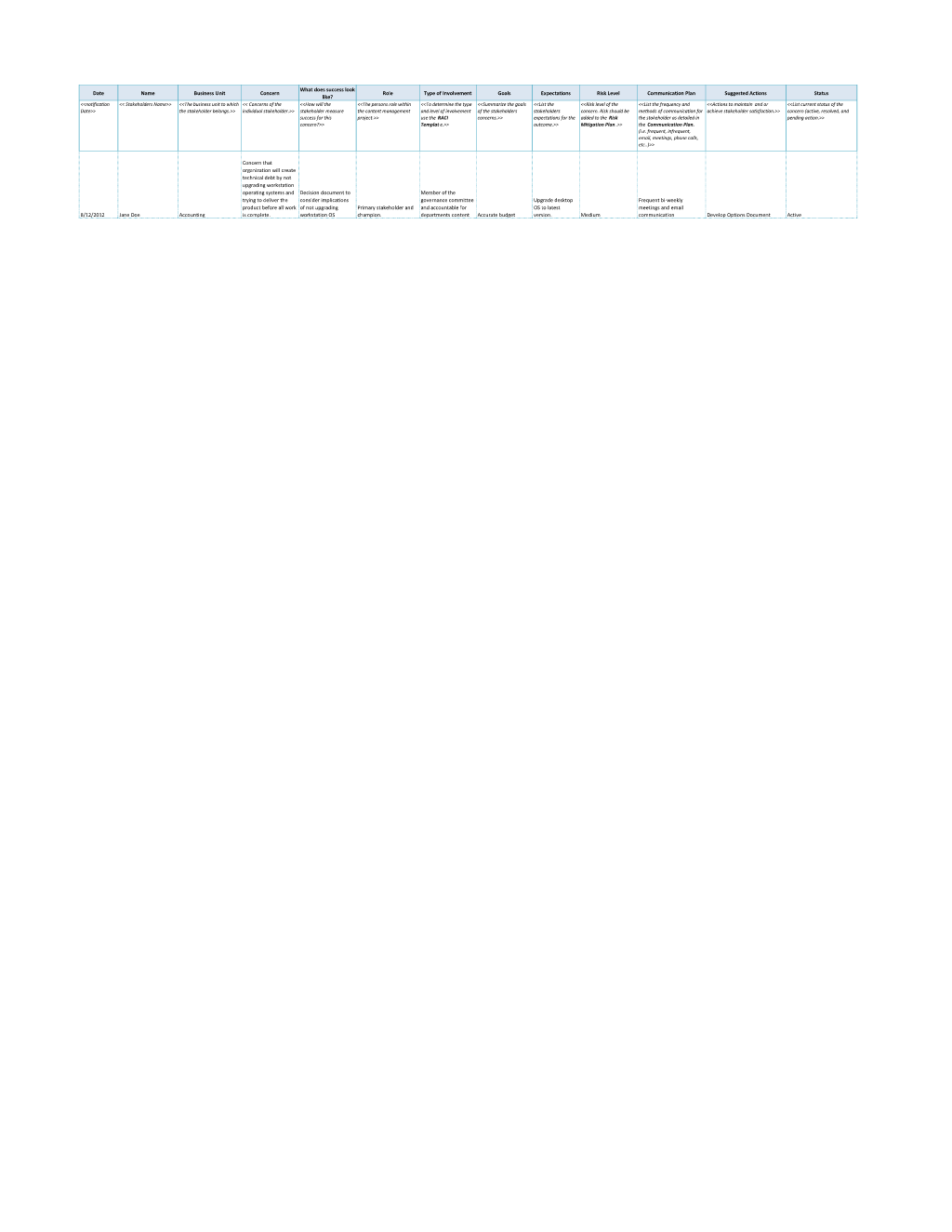
This stakeholder concerns record functions as a central repository for project issues and expectations in a content management initiative. It captures each stakeholder's business unit, role, concern, success measures, expectations, risk level, communication needs, and the current status of the concern. It also directs the team to use a RACI Template to define who is responsible and accountable, and to add relevant items to the risk register and mitigation plan.
In practice, this aligns with the components of an issue log or issue register: an issue name and issue description, a unique identifier or issue number, issue owner, assigned to, reporter, and reported date, open date, target resolution date, closed date, final solution, and comments. Clear issue priority, severity, and issue status (open, in progress, resolved, closed) support consistent issue tracking throughout the project lifecycle.
A primary example in the document addresses a stakeholder's concern about creating technical debt by delivering before upgrading workstation operating systems. The stakeholder is a champion and governance committee member, accountable for departmental content. Success is measured by an accurate project budget and completion of a desktop OS upgrade.
The project manager should log the issue type and issue category (technical), assess issue impact on the project schedule and project budget, set priority (high, medium, low), and escalate issues as needed. Actions to maintain stakeholder satisfaction depend on the Communication Plan, including frequency, methods, and accountability for the assignee. The status field should indicate active, resolved, or pending action with an estimated resolution date and final resolution and rationale.
To keep stakeholders informed, teams can pair this tracking template with a stakeholder matrix, power interest grid, or power predictability matrix to visualize stakeholders, categorize stakeholders, and tailor engagement strategies. High influence stakeholders belong in the manage closely quadrant; others may fit the keep informed quadrant. Regularly review the tracking system to keep it current and aligned with milestones, change requests, and the project roadmap.
Common use cases include OS upgrade programs, CMS rollouts with third-party integrations, and resolving technical failures or resource conflicts. Teams can log issues in an Excel template, spreadsheet, database, or Jira Software, view progress on kanban boards or a project dashboard, and summarize outcomes in a project status report.
Proposal Kit can streamline this work through document assembly, automated line-item quoting, and an AI Writer that helps build supporting documents. Its extensive template library, including log templates, a risk register template, a project status report template, and a project dashboard template, helps standardize documentation and makes it easier to deliver on time and on budget.
Expanding on the document, the record doubles as an issue log template and a stakeholder expectations process that supports a standardized process for issue management. Teams can translate each concern into an issue tracking template with standard fields and key fields such as issue id, issue name, issue description, issue details, technical description, reported by or raised by, date logged, assigned to owner, assignee, priority (low medium high), status (open in progress closed), escalation needed, and an issue resolution timeline. This approach clarifies risk vs issue, helps identify issues earlier, and enables monitoring issues and roadblocks in real time across each project phase. The log becomes a single source of truth and historical data used to track progress against the project plan, scope, milestones, and project objectives.
For project stakeholders, add stakeholder analysis and stakeholder mapping to a stakeholder knowledge base. Plot stakeholders on a power interest grid or power influence and knowledge awareness quadrants to capture the level of influence, the level of interest, and the level of support, then tailor communication and engagement communication needs in an engagement plan. Use relationship mapping to identify outliers, set priorities, and meet their needs through the review cadence defined in the Communication Plan. This helps the project sponsor, senior leadership, and each team member stay aligned.
From a tooling perspective, a log template Excel, or an open document spreadsheet with a prebuilt structure and template fields can serve teams that prefer Excel download or PDF download. Others may use project management software with an issue tracker, Jira issue log, visual board, project dashboard, task list, task tracking, and workflow automation to assign issues, preassign issues, assign to team members, and keep the team informed with automated notifications. In any tracking system, maintain a defined workflow from work in progress to closed, and capture project insights, project insights timeline, and project insights impact. This is useful across project risks, human resources constraints, material shortages, support ticket queues, defect tracker results, and test case template outcomes.
Proposal Kit helps standardize documentation for these practices through document assembly, automated line-item quoting, and an AI Writer to build supporting documents. Its extensive template library provides a prebuilt structure for logs, registers, status reports, dashboards, and stakeholder analysis artifacts that keep project tracking consistent and help teams resolve issues and keep the project on track.
Additionally, this record supports structured stakeholder engagement and aligns with the PMBOK Guide by clarifying how teams identify risks, track issues, and resolve problem statements across full project phase coverage. A practical issue log example follows an issue resolution process with mandatory fields and defined handoffs: capture issue fields and mandatory fields at date of entry, triage severity and priority, assign an owner, plan actions and resources, execute fixes, verify outcomes, and close with lessons learned. This flow helps manage project team coordination, improves team collaboration, and prevents duplicated work.
Template includes guidance to assign owner and log standard issue fields such as the problem statement, technical context, affected components, and dependencies, so leaders can track issues and project challenges against milestones. Managers can also analyze stakeholders to tailor communication and support decisions. Use stakeholder groups, plot on matrix tools, and matrix quadrants to visualize the level of influence and interest. A knowledge base chart can capture what each group knows, needs, and supports, making it easier to prioritize engagement tasks and channel updates to the right audiences at the right project phase.
For governance and reporting, track issues through monitoring checkpoints and status transitions, and keep a clear audit trail from identification to close. A concise issue resolution process with an assigned owner, due dates, and verification steps helps maintain momentum and accountability. This approach produces a reusable knowledge base and improves estimations for future work, while keeping leadership informed about progress and risks without slowing delivery.
Writing the Sample Stakeholder Concerns Log document
business,project,records,management,toolkit,information,documents,templates,boilerplate,form,outline,textThe editable Sample Stakeholder Concerns Log document - complete with the actual formatting and layout is available in the retail Proposal Kit Professional.
20% Off Discount
 4.7 stars, based on 850 reviews
 Published by Proposal Kit, Inc.
We include a library of documents you can use based on your needs. All projects are different and have different needs and goals. Pick the documents from our collection, such as the Sample Stakeholder Concerns Log, and use them as needed for your project.
 Facebook
 YouTube
 Bluesky
 Search Site
© 1997 - 2026, Proposal Kit, Inc. All rights reserved. Privacy Policy