


 Cart
Cart
 Get 20% off ordering today: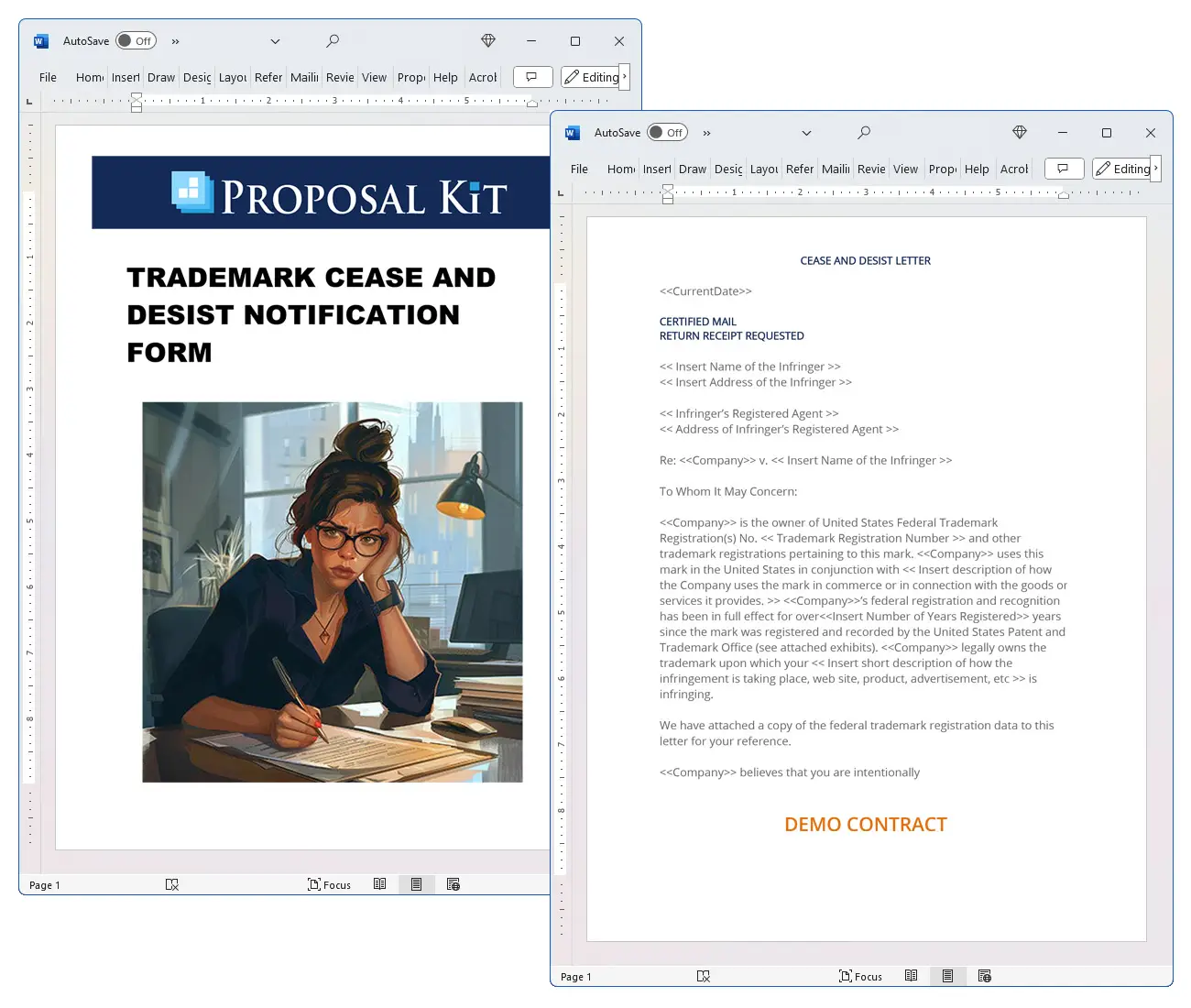

How to write your Trademark Cease and Desist Notification Form
We include this 2 page template with IT/Software/Hardware Contract Pack and the Proposal Kit Professional. You will get more content and software automation for data merging, managing client documents, and creating proposals with line item quoting with a Contract Pack or the Professional.
 DOWNLOADABLE, ONE-TIME COST, NO SUBSCRIPTION FEES
 What Our Clients Say
I was lacking a couple of specific contracts for my presentations. Without your product I would have been unable to deliver a professional approach - possibly putting myself and even my client at risk. Thanks for producing a useful product."
1. Get IT/Software/Hardware Contract Pack or the single template that includes this business contract document.
We include this contract in editable Word format that can be customized using your office software.
2. Download and install after ordering.
Once you have ordered and downloaded your template or pack, you will have all the content you need to get started.
3. Customize the contract template with your information.
You can customize the contract document as much as you need. If you get a Contract Pack or Professional Bundle, you can also use the included Wizard software to automate name/address data merging.
Use cases for this template
When Maple & Mornings Heard Its Name on Someone Else's Sign
The Challenge
Maple & Mornings, a regional coffee roaster, discovered a new cafe chain called Morning Maple using a confusingly similar logo and menu branding, triggering customer messages and receipts misdirected to the roaster and sparking fears of diluted goodwill and marketplace confusion during a planned fundraising round.
The Solution
Their counsel used the cease and desist letter template to demand an immediate stop and the destruction of infringing materials, while the operations lead opened Proposal Kit software for document creation to produce a board brief explaining risks, a brand policing plan, and a retailer outreach memo; the AI Writer generated a customer FAQ and media holding statement, and line-item quoting mapped the projected costs of monitoring and potential repackage scenarios.
The Implementation
They sent the signed threat letter with exhibits, then scheduled retailer calls using the Proposal Kit-generated contact plan, circulated the AI Writer's internal Q&A to align employees, and attached a costed timeline from the line-item quoting output to their investor update to show disciplined enforcement.
The Outcome
The caf agreed to rebrand within 30 days and transfer a domain. Maple & Mornings kept investors confident with the concise Proposal Kit-built briefing package, and the policing program and cost forecast became a reusable playbook for future incidents.
PulsePath Labs Confronts Look-Alike Health Tech Branding
The Challenge
Wearable maker PulsePath Labs found a telehealth startup, PulsePath Health, marketing overlapping services with nearly identical app icons, creating a real likelihood of confusion just as PulsePath prepared to launch in hospital trade channels.
The Solution
Legal issued the cease and desist notice using the contract template and queued TTAB options if needed, while marketing used Proposal Kit's document creation to draft a distributor reassurance letter and an evidence log template; the AI Writer produced a short market-confusion summary and a sales team briefing, and line-item quoting estimated enforcement, re-skinning, and distributor retraining costs.
The Implementation
They served the letter with a timeline for compliance, filed a draft opposition strategy memo built in Proposal Kit in case the other party tried to register, and pushed the AI Writer's briefing to sales reps before a major conference, all supported by the line-item quoting sheet included in leadership reviews.
The Outcome
PulsePath Health agreed to a phased rename and app icon change to avoid escalation, hospital buyers received clear messaging, and PulsePath Labs retained launch momentum with a clean paper trail and repeatable Proposal Kit artifacts.
Red Harbor Brewing Navigates a Hard Choice: License or Litigate
The Challenge
Red Harbor Brewing Co. discovered Harbor Red Distilling selling canned cocktails under "Red Harbor," with a parked domain and ads capturing searches for the brewery's flagship, risking injury to the brand just as the company expanded into grocery chains.
The Solution
The attorney sent a cease and desist notice letter with a proposed domain transfer, while the commercial team used Proposal Kit to create a license term sheet option and a contingency rebrand playbook; the AI Writer produced a retailer briefing, a risk assessment summary, and a phased transition plan, and line-item quoting modeled costs for new packaging, signage, and legal hours to support either settlement or court.
The Implementation
They opened talks using the Proposal Kit-drafted term sheet while preserving litigation readiness, presented the AI Writer's risk summary to the grocery buyer to keep shelf space secure, and attached the line-item quoting worksheet to the finance plan to document cash needs and milestones.
The Outcome
Harbor Red Distilling accepted a short-term sell-off with a rapid rename and domain handover. Red Harbor avoided lost placements, and the comprehensive Proposal Kit package, term sheets, plans, and cost models kept negotiations focused and expedited closure.
Abstract
This contract is a cease and desist notice letter used to put someone on notice that their branding is infringing a valid trademark. It functions as a demand letter asserting rights in intellectual property, typically under the Lanham Act. The sender identifies its federally registered mark, cites the federal registration number, and describes how the mark is used in commerce, often with evidence of use such as a specimen, date of first use, priority date, and the classification of goods and services.
The letter explains the likelihood of confusion by pointing to the similarity of marks, the similarity of goods and services, overlapping trade channels, the strength of the mark, the geographic area of use, and the sophistication of consumers. It may note actual consumer confusion, dilution or tarnishment, and injury to the brand, especially when a famous mark is involved.
The template emphasizes trademark enforcement. It demands an immediate order to cease, destruction or delivery of infringing materials, and sometimes transfer of infringing domain names. It can be sent as a cease and desist email or mailed letter and seeks an acknowledgment of receipt and signature without prejudice to other rights.
The tone can be a lawsuit threat, but it is not a government order or cease and desist order; rather, it preserves the option of a federal lawsuit in federal district court, where a complaint and summons could be served. It also signals that the owner will police and enforce its rights through a trademark monitoring program, trademark database search, and TTAB actions, such as a notice of opposition or petition to cancel registration before the Trademark Trial and Appeal Board (TTAB). Attachments may include TSDR printouts from the trademark registration database, proof that a trademark application matured to a trademark registration issued after publication in the Official Gazette, or a statement of use in an intent-to-use filing.
Recipients typically weigh options: respond to the letter, negotiate a license agreement or license to use the mark, propose design-around technologies, or file a declaratory judgment action. Doing nothing increases the threat of litigation. Some raise fair use, First Amendment, gripe site defenses, or assert common law rights, priority of use, counterclaim, or affirmative defense.
Businesses often engage a U.S.-licensed trademark attorney experienced in trademark disputes for an opinion letter and to negotiate.
Use cases include stopping a reseller using a confusingly similar logo, halting bad faith domain squatting, or addressing marketplace confusion in online ads.
Proposal Kit can streamline writing documents like this through document assembly, automated line-item quoting for related services, an AI Writer to build supporting documents, and an extensive template library. Its ease of use helps teams prepare consistent correspondence, license negotiation materials, and related business forms.
Additional considerations help businesses decide how to act when receiving or sending a trademark notice letter. A cease and desist threat letter is not a government entity directive; it is a threatening letter that can carry a threatening tone, but it does not, by itself, chill speech or function as an official order. The sender often highlights its priority rights and use of the registered trademark symbol to reinforce ownership while policing trademark rights.
Recipients typically face four paths: acknowledge infringement and enter talks; negotiate terms with license negotiations triggered by the demand; file your own lawsuit for declaratory relief; or do nothing and risk a complaint served in federal court. Companies may also oppose application filings or file a petition to oppose before the TTAB if a conflicting mark is pending. If the settlement fails, either side may file a lawsuit, after which a summons and complaint may follow. Engaging a u. s. -licensed attorney to assess exposure and strategy remains prudent across these choices.
On the sender side, a well-structured threat letter can open a business dialogue rather than escalate. Some matters resolve with a narrow coexistence or a short-term transition plan, while others call for a hard stop and delivery or destruction of materials. The same framework supports broader enforcement, from a trademark notice letter to TTAB actions that oppose application attempts by others. Proposal Kit can help teams assemble consistent correspondence and supporting documents, from an initial cease and desist threat letter to TTAB petition drafts and licensing terms, using document assembly, automated line-item quoting for services, an AI Writer for related materials, and an extensive template library to keep workflows clear and easy to use.
Beyond the core demands, this template structures how a business documents evidence and sets deadlines. It references federal registration, the registered trademark symbol, and attached TSDR records to show priority rights and a valid trademark. It asks the recipient to sign and return an acknowledgment of receipt by a specific date, to stop use immediately, and to deliver or destroy inventory.
It allows insertion of terms for domain name transfer, which is common when marketplace confusion or cyber squatting is alleged. The without prejudice reservation preserves all remedies if the recipient ignores the cease and desist notice.
Strategy matters for both sides. A sender may calibrate a threatening tone to underscore the threat of litigation without overreaching or attempting to chill speech, especially where fair use, First Amendment commentary, or a gripe site could be implicated. If the recipient does nothing, the owner may escalate: complaint and summons, complaint served in federal district court, or TTAB actions such as a notice of opposition, petition to cancel registration, or petition to oppose.
A trademark trial and appeal board (TTAB) proceeding can run in parallel with trademark monitoring and a broader monitoring program. If settlement is viable, license negotiations triggered by the letter may yield a limited license to use the mark, a phased rebrand, or coexistence terms defined by trade channels and classification of goods.
Recipients weigh whether to respond to the threat letter, acknowledge infringement, negotiate, oppose application activity, or file a declaratory judgment and file their own lawsuit. Engaging a U.S.-licensed attorney or trademark attorney helps evaluate the similarity of marks, the similarity of goods and services, the strength of the mark, bad faith, actual consumer confusion, and other factors before deciding to file a lawsuit or pursue a counterclaim or affirmative defense.
Proposal Kit supports these workflows by helping teams assemble consistent trademark notice letters, cease language, license agreement drafts, and supporting exhibits with document assembly. Its AI Writer can write related correspondence, and automated line-item quoting helps estimate enforcement or rebranding services. The extensive template library and ease of use assist with policing trademark rights, from initial outreach to negotiation materials.
How do you write a Trademark Cease and Desist Notification Form document? - The Narrative
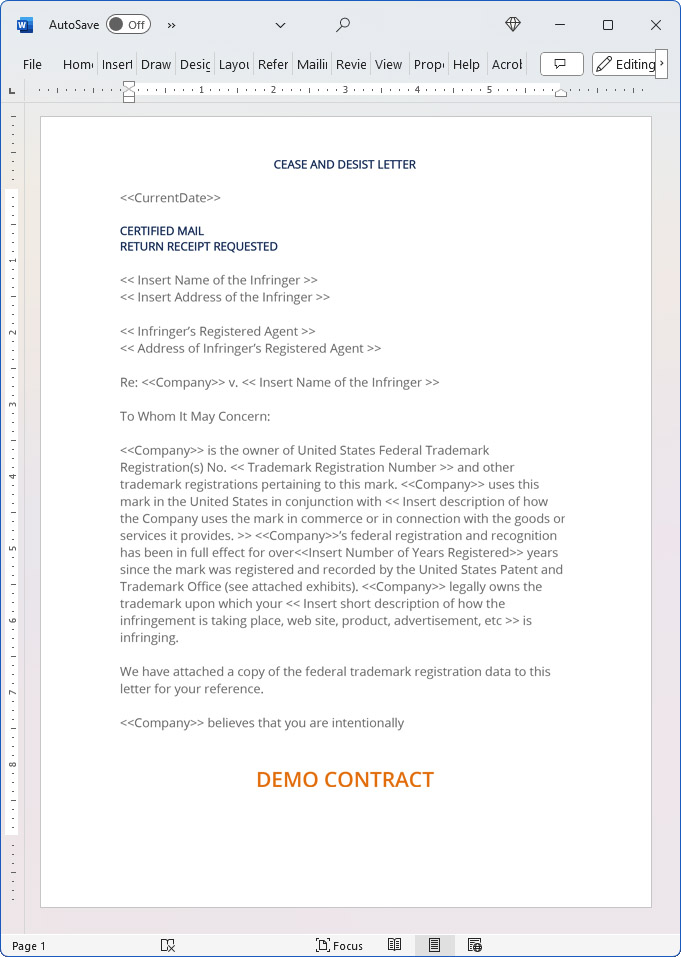
CEASE AND DESIST LETTER
Name of the Infringer. Address of the Infringer. Infringer's Registered Agent. Address of Infringer's Registered Agent.
Re: Company Name v. Name of the Infringer.
To Whom It May Concern:
Company Name is the owner of United States Federal Trademark Registration(s) No. Trademark Registration Number and other trademark registrations pertaining to this mark. Company Name uses this mark in the United States in conjunction with description of how the Company uses the mark in commerce or in connection with the goods or services it provides. Company Name's federal registration and recognition has been in full effect for over Number of Years Registered years since the mark was registered and recorded by the United States Patent and Trademark Office (see attached exhibits).
Company Name legally owns the trademark upon which your short description of how the infringement is taking place, web site, product, advertisement, etc. is infringing. We have attached a copy of the federal trademark registration data to this letter for your reference. Company Name believes that you are intentionally trading on the goodwill of Company Name by using a trademark that is confusingly similar to Trademark Description and that your use of the Trademark does, or is intended to confuse or mislead customers seeking Company Name's products or services.
This activity is actionable under federal law and causes you to be liable to Company Name in every state in which you have made sales or done business. Your activities are unlawful and constitute unfair competition, intentional trademark infringement and dilution, false designation of origin or cyber squatting if the Trademark involves a domain name. Federal Law provides numerous legal remedies for trademark infringement and dilution, including, but not limited to, preliminary and permanent injunctive relief, monetary damages, claim to a defendant's profits, destruction or confiscation of infringing products or items and in cases where infringement is shown to be willful and intentional, legal fees and up to treble (3x) monetary damages. Company Name prefers to resolve matters such as these without the need to take legal action, but it is prepared to take any action it deems necessary to protect its rights and property.
You may avoid legal action by having an authorized representative sign this notice as indicated below and return the signed letter to us at the address listed below on or before Delivery Date. This letter is sent without prejudice to Company Name's rights and claims, all of which are expressly reserved.
The undersigned covenants to take the following actions:
Immediately cease and desist from any and all use of the infringing mark(s), whether the marks are used in commerce or not, now or in the future. Insert whether a transfer of rights of the undersigned to any infringing domain names or other property must occur and the terms of such transfer. Immediately cease the use and distribution of all infringing works, works derived from the marks, whether obscured or not and all copies of such infringing materials.
Deliver all unused, undistributed copies of any infringing works, or proof of the destruction of such copies. Job title of signator, authorized signature or signer. Date when the contact was signed.
20% Off Discount
 Add To Cart This Word Template Only
 Add To Cart IT/Software/Hardware Contract Pack
 Add To Cart Proposal Kit Professional Bundle
 4.7 stars, based on 850 reviews
Related Documents
How to Build a Legal Contract with Proposal Kit
This video illustrates how to create a legal contract using the Proposal Pack Wizard software. It also shows how to create a proposal with an invoice and contract at the same time.
Frequently Asked Questions
How do I customize this contract to fit my business needs?
Customizing this contract involves editing the document to include your business details, terms, and conditions. The templates are designed to be flexible, allowing you to insert your company's name, address, and other relevant information. You can modify clauses to reflect your unique business practices and legal requirements.
Is this contract compliant with laws and regulations?
The legal contract templates are written by legal professionals and designed to comply with current laws and regulations at the time of their writing. However, laws can vary by jurisdiction and change over time, so it's recommended to have your contract reviewed by a local attorney to ensure it meets all legal requirements specific to your region and industry. Templates are licensed as self-help information and not as legal advice.
Can I use the same contract for different clients or projects?
You can use the same contract for different clients or projects. The templates are versatile and easily adapted for various scenarios. You will need to update specific details such as client names, project descriptions, and any unique terms for each new agreement to ensure that each contract accurately reflects the particulars of the individual client or project.
What should I do if I encounter a clause or term I don't understand?
If you encounter a clause or term in the contract that you need help understanding, you can refer to guidance notes explaining each section's purpose and use. For more complex or unclear terms, it's advisable to consult with a legal professional who can explain the clause and help you determine if any modifications are necessary to suit your specific needs.
How do I ensure that the contract is legally binding and enforceable?
To ensure that the contract is legally binding and enforceable, follow these steps:
- Complete all relevant sections: Make sure all blanks are filled in with accurate information.
- Include all necessary terms and conditions: Ensure that all essential elements, such as payment terms, deliverables, timelines, and responsibilities, are clearly defined.
- Signatures: Both parties must sign the contract, and it is often recommended that the contract be witnessed or notarized, depending on the legal requirements in your jurisdiction.
- Consult a legal professional: Before finalizing the contract, have it reviewed by an attorney to ensure it complies with applicable laws and protects your interests.
 Published by Proposal Kit, Inc.
Disclaimers
Proposal Kit, Inc. makes no warranty and accepts no responsibility for the suitability of any materials to the licensee's business. Proposal Kit, Inc. assumes no responsibility or liability for errors or inaccuracies. Licensee accepts all responsibility for the results obtained. The information included is not legal advice. Names in use cases have been fictionalized. Your use of the contract template and any purchased packages constitutes acceptance and understanding of these disclaimers and terms and conditions.
 Facebook
 YouTube
 Bluesky
 Search Site