


 Cart
Cart
 Get 20% off ordering today: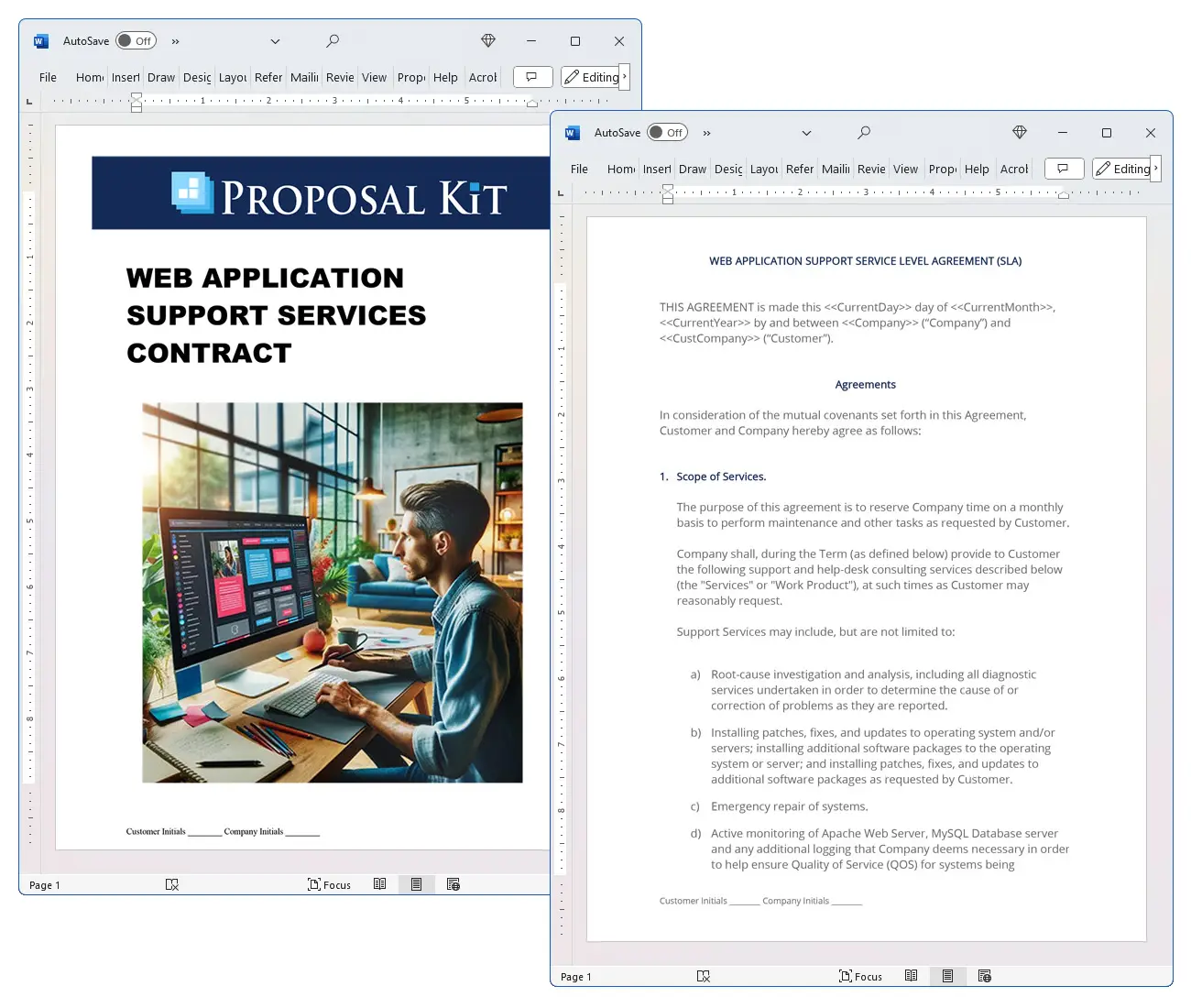

How to write your Web Application Support Services Contract
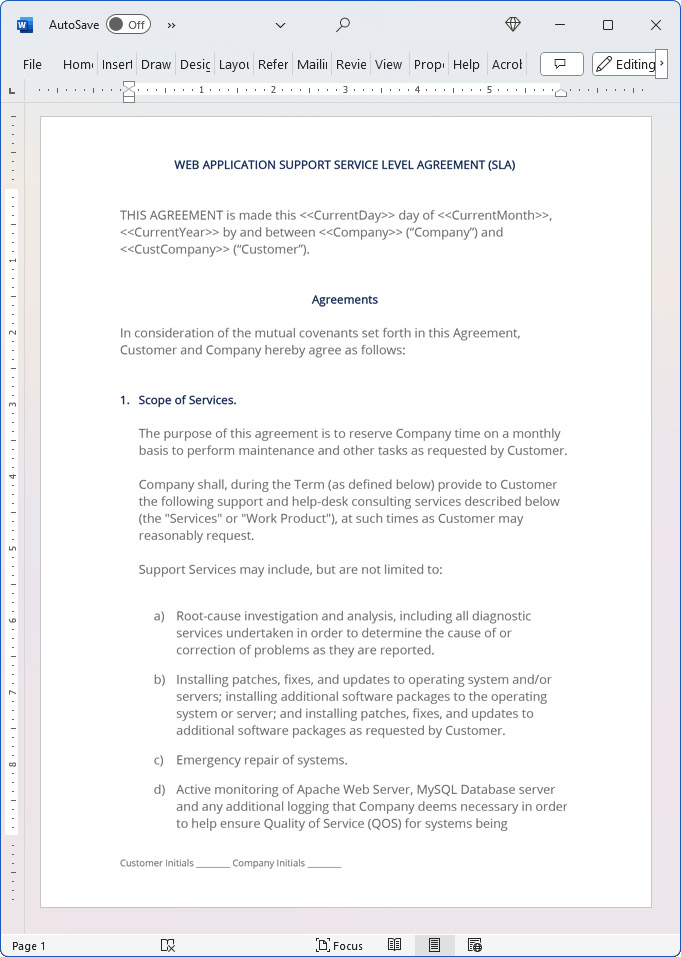
We include this 7 page template with IT/Software/Hardware Contract Pack and the Proposal Kit Professional. You will get more content and software automation for data merging, managing client documents, and creating proposals with line item quoting with a Contract Pack or the Professional.
 DOWNLOADABLE, ONE-TIME COST, NO SUBSCRIPTION FEES
 What Our Clients Say
Our best response to your tools, is when a client comments on how unique our proposal or contract document looked to them from the competition, especially when we win the contract."
1. Get IT/Software/Hardware Contract Pack or the single template that includes this business contract document.
We include this contract in editable Word format that can be customized using your office software.
2. Download and install after ordering.
Once you have ordered and downloaded your template or pack, you will have all the content you need to get started.
3. Customize the contract template with your information.
You can customize the contract document as much as you need. If you get a Contract Pack or Professional Bundle, you can also use the included Wizard software to automate name/address data merging.
Use cases for this template
Ava and NorthPeak Digital secure retail uptime before Black Friday
The Challenge
Ava Moreno at Luminex Apparel was days from peak season with a new web storefront and no formal support commitments; outages during Black Friday would be catastrophic, and she needed clear service desk hours, response targets, and a fair credits-for-downtime model without derailing launch.
The Solution
She engaged NorthPeak Digital to finalize a support SLA defining issue levels, exclusions, notice and cure period, governing law, and limitation of liability, while using Proposal Kit to create supporting documents-a rollout communications plan, escalation matrix, and maintenance window calendar-plus AI Writer-generated status report templates; automated line-item quoting priced optional after-hours coverage and out-of-contract repair rates.
The Implementation
Workshops mapped ticket intake via email and a customer portal, set usage rules aligned to the licensor's standard EULA, and documented export compliance language; Proposal Kit's document assembly produced a service tracking playbook, knowledge base outline, and vendor performance tracking report to monitor response and resolution times.
The Outcome
Black Friday traffic surged without incident, the mean time to resolve dropped by 28%, and the clear renewal eligibility path let Ava renew support services confidently with transparent pricing and fees; the organization gained faster incident communications and predictable change control.
Dr. Chen modernizes analytics support at Veridian Health Insights.
The Challenge
Dr. Maya Chen needed to onboard a hospital network to Veridian's analytics platform under tight timelines, but prior engagements suffered from unclear escalation, overlapping feature requests, and inconsistent post-incident reviews that eroded trust.
The Solution
She finalized a concise SLA distinguishing bug fixes from enhancements, defining jurisdiction and venue, warranty disclaimer, and export restrictions, then used Proposal Kit to build a disaster recovery plan, KPI dashboard specs, and training and certification outlines for administrators; AI Writer produced post-incident review and maintenance notification templates, and line-item quoting modeled optional premium support tiers.
The Implementation
The team published a support library, codified service desk hours across time zones, and configured the customer portal to capture case information and retention periods; Proposal Kit's document assembly ensured consistent language across reports and a procurement guide-style briefing for the hospital's contract managers.
The Outcome
Service reliability improved, reopen rates fell, and the hospital approved a multi-year renewal; both sides benefited from clearer usage rules under a custom EULA and a predictable cadence of planned maintenance communications.
Elaine guides a public-sector rollout at Evergreen Family Services
The Challenge
Elaine Brooks was tasked with stabilizing a child support web application used for paternity establishment, subject to statewide contracts and strict procurement resources requirements, yet prior vendors lacked measurable commitments or transparent renewals.
The Solution
She negotiated an SLA aligned to state contracts with defined escalation, credits for downtime, governing jurisdiction, and export compliance, and used Proposal Kit to assemble a procurement justification, vendor resources packet, and a performance reporting plan; AI Writer generated stakeholder briefings and risk registers, while line-item quoting scoped optional audit reporting and capacity testing.
The Implementation
The agency implemented a knowledge base, formalized service tracking metrics, and configured the customer service portal to show ticket status and permitted payment histories; Proposal Kit standardized quarterly vendor performance tracking summaries and an implementation schedule that included a notice and cure period.
The Outcome
Uptime and response targets were met, audits passed with fewer findings, and the agency renewed support services with clear pricing and fees, improving accountability while accelerating delivery of enhancements through well-scoped contract opportunities.
Abstract
A web application supports SLA, which sets expectations for how a provider will maintain and support a live system once it's in production. Introduced at the end of negotiations, it clarifies scope, service desk hours, ticket submission methods, response times by priority, and remedies when service levels are missed. The agreement commonly addresses pricing and fees, renewal eligibility, and subscription management, so customers know when and how they can renew support services. It also distinguishes bug fixes from feature requests to prevent scope creep and explains how to apply for support via a customer portal or email, how case information is tracked, and when credits for downtime are issued.
Operational sections define issue levels (high, moderate, low), the process for service tracking, and exclusions such as client-side errors or third-party failures. Cancellation conditions often include a notice and cure period and steps for transition or out-of-contract repair. Many teams augment the SLA with a knowledge base and support library to speed resolution, along with a customer service portal to display payment histories and open cases.
Risk and compliance terms round out the framework. An indemnification clause allocates liability for failures tied to the provider's services. Companies frequently pair the SLA with an end-user license agreement, either a standard EULA or a custom EULA from the licensor, to cover usage rules, reverse engineering prohibitions, warranty disclaimer, limitation of liability, export compliance, and export restrictions. Governance language typically specifies governing law, governing jurisdiction, and jurisdiction and venue.
Public-sector buyers may align this agreement with statewide contracts or other state contracts. Contract managers use procurement resources, a procurement guide, and vendor resources to evaluate contract opportunities, set pricing, and perform vendor performance tracking. Training and certification requirements for administrators can be included to support quality delivery.
Common use cases include launching a new web application, upgrading an existing platform, outsourcing maintenance, and establishing disaster recovery obligations. Industries from e-commerce to healthcare analytics to government child support systems involved in paternity establishment rely on clear SLAs to protect uptime and accountability.
Proposal Kit helps organizations create these documents efficiently through document assembly, automated line-item quoting, an AI Writer that can build supporting documents, and an extensive template library. Its ease of use enables teams to produce consistent, customizable SLAs and related materials that align with business requirements and procurement processes.
Beyond defining response times and uptime credits, a strong support SLA should manage the full lifecycle of a production system. That includes onboarding, change control for enhancements, and a clear renewal path. Spell out subscription management, renewal eligibility, pricing and fees, and how to renew support services without gaps.
Include a notice and cure period before termination, plus a process for out-of-contract repair so critical fixes aren't delayed by paperwork. Detail what the customer portal will display: how to apply for support, what case information is retained, and whether payment histories are visible. Pair the SLA with an end-user license agreement from the licensor, either a standard EULA or a custom EULA, to lock in usage rules, limits on reverse engineering, a warranty disclaimer, limitation of liability, and export compliance and export restrictions. Name the governing law, governing jurisdiction, and jurisdiction and venue to reduce litigation ambiguity.
For buyers in the public sector, aligning SLA terms to statewide contracts or other state contracts helps contract managers leverage procurement resources, a procurement guide, and vendor resources. This preserves audit trails and supports vendor performance tracking and service tracking against agreed metrics. Organizations can also include training and certification expectations for administrators and build a support library and knowledge base references into service desk hours and workflows to improve first-contact resolution.
Proposal Kit helps teams operationalize these goals with document assembly, automated line-item quoting, an AI Writer for supporting documents, and an extensive template library that makes it easy to standardize clauses across contract opportunities. Use cases range from upgrading an e-commerce platform to establishing long-term maintenance for regulated systems, including government solutions that interface with sensitive programs such as paternity establishment, where clarity and compliance are important.
Broaden your SLA to cover how service quality is measured and improved over time. Define operational metrics beyond uptime, such as first-response time, mean time to acknowledge, mean time to resolve, reopen rates, and SLA attainment. Specify maintenance windows, blackout periods around peak events, and advance notice requirements for planned changes. Add an escalation ladder with named roles, communication intervals during major incidents, and post-incident reviews that document root cause, corrective actions, and service tracking improvements.
Clarify data handling in support workflows. State what case information the customer portal retains, how long records are stored, and how audit logs support vendor performance tracking and procurement resources' needs. Describe how the knowledge base and support library feed faster resolution and how service desk hours align with customer geographies. If you operate in regulated or public-sector environments, map reporting to statewide contracts and state contracts so contract managers can align to a procurement guide, vendor resources, and contract opportunities.
Address environment changes and capacity. Include thresholds for scaling, rollback criteria, and change control for high-risk releases. Document how third-party dependencies affect commitments and what happens when components are deprecated. Provide a transition plan for continuity, including notice and cure period details and limited out-of-contract repair options for emergencies.
Keep your commercial and legal controls tight. Outline subscription management rules for renewals, renewal eligibility, and pricing and fees adjustments. Pair the SLA with an end-user license agreement from the licensor-standard EULA or custom EULA covering usage rules, reverse engineering prohibitions, warranty disclaimer, limitation of liability, export compliance, and export restrictions, along with governing law, governing jurisdiction, and jurisdiction and venue.
Proposal Kit can streamline this work by assembling consistent SLAs plus appendices like escalation matrices, maintenance calendars, and reporting templates using document assembly, automated line-item quoting, an AI Writer for supporting documents, and an extensive template library. Teams gain faster turnaround and clearer deliverables without sacrificing rigor.
How do you write a Web Application Support Services Contract document? - The Narrative
Writing Your Web Application Support Service Level Agreement (SLA) with Proposal Kit
Maintaining web-based applications is crucial for businesses across all industries. A Web Application Support Service Level Agreement (SLA) becomes indispensable in outlining the scope of maintenance and support services a client can expect. But what exactly is a web application support service level agreement, and at what stage of a project or negotiation is it most effectively used?
Understanding the Web Application Support SLA
A web application support SLA is a contract that specifies the maintenance and support services a provider will offer to ensure the optimal functioning of a web-based application. This agreement details the scope of services, response times, and remedies for service failures, providing a clear framework for both parties.
The Ideal Stage for an SLA
The SLA is typically introduced at the final stages of negotiation, just before the project kick-off. It serves as a final agreement on the support service level the client will receive, solidifying the expectations during the negotiation phase.
Crafting an SLA with Proposal Kit
Proposal Kit offers an ideal starting point for those seeking a quick, cost-effective solution to draft a web application support SLA. The SLA template provided by Proposal Kit is designed to be easily customizable, allowing end-users to tailor the document to their specific needs. The software's data merging feature further streamlines the customization process, enabling the efficient creation of personalized documents for multiple clients.
When to Use a Web Application Support SLA
This type of agreement is used in various situations, including but not limited to:
- Launching a new web application.
- Updating or upgrading existing web applications.
- Outsourcing web application maintenance to a third-party provider.
- Establishing long-term support for an application.
- Clarifying the responsibilities of each party in application support.
- Setting clear expectations for application uptime and issue resolution times.
- Detailing the process for reporting and resolving issues.
- Specifying the terms for renewal and termination of support services.
- Agreeing on security standards and compliance requirements.
- Laying out the framework for emergency support and disaster recovery.
Are you in a situation where such an SLA could protect your business interests and clarify maintenance responsibilities? There are many topics to consider in your SLA.
Ticket Submission Methods
Establishing clear and accessible ticket submission methods is critical for efficient customer support operations. By offering multiple channels such as email, phone, or specialized ticketing systems, businesses can accommodate user preferences and ensure that seeking support is as straightforward as possible. Email allows for detailed issue descriptions and attachments, phone support provides immediate personal interaction for urgent or complex issues, and ticketing systems offer a structured approach to streamline issue tracking and resolution processes. Implementing diverse submission methods enables users to report problems conveniently, enhancing the overall customer service experience.
Service Level Response Times
Defining service level response times is crucial for setting realistic expectations and maintaining user trust. By establishing clear response time frames based on the severity of reported issues, companies can prioritize support efforts effectively. For instance, high-priority issues warrant a response within an hour, while lower-priority concerns could have a longer window, such as 24 to 48 hours. Transparency in these expectations ensures that customers understand how quickly they should anticipate a response, helping to manage anxiety during critical moments and build confidence in the support process.
Issue Levels and Definitions
Correctly categorizing issues by priority level - such as High, Moderate, or Low - facilitates efficient support triage and appropriately allocates resources. High-priority issues might include system outages or security breaches that require immediate attention, moderate-priority issues could involve functional problems impacting user operations, and low-priority concerns might consist of minor bugs or feature requests. By defining these categories clearly, both support teams and customers have a mutual understanding of the urgency and importance of each issue type. This categorization helps streamline the resolution process, ensuring that critical problems are addressed swiftly while managing less urgent requests effectively.
Distinction Between Bugs and Features
Within a Service Level Agreement (SLA) framework, it is essential to establish a clear demarcation between bug fixes and introducing new features or enhancements. Bug fixes pertain to correcting errors within the existing codebase that hinder the application's intended functionality. These are issues that detract from the user's experience or the application's performance, necessitating immediate attention under the support services outlined in the SLA. Conversely, requests for new features or enhancements involve adding new functionality or modifying existing features to extend or improve the application. This type of work goes beyond the scope of standard support services and typically requires separate planning, development, and budgeting processes. Distinguishing between these two aspects within an SLA ensures that the service provider and the client have aligned expectations regarding what is covered under support services and what constitutes additional, billable development work.
Credits for Downtime
Implementing a credit system within an SLA as compensation for service downtimes that exceed predefined thresholds is a proactive approach to underscore the service provider's commitment to reliability and high uptime standards. This mechanism works by offering the client service credits or refunds that correlate with the extent and severity of the downtime experienced beyond the acceptable levels agreed upon in the SLA. Such a system provides a form of reassurance to the client about the seriousness with which the provider treats service uptime and establishes a financial accountability framework for the provider. This accountability incentivizes maintaining optimal service levels and fosters trust in the service provider's capability to deliver reliable services.
Exclusions
Articulating the exclusions within an SLA is critical to setting the correct boundaries around the support services' scope. This section should detail the types of services, situations, or issues that fall outside the purview of the SLA, including but not limited to problems arising from third-party services, client-side errors, or circumstances beyond the control of the service provider, such as natural disasters or acts of third parties. By specifying these exclusions, both parties can avoid potential misunderstandings and disputes over what is and is not covered under the agreement. It ensures that the client has realistic expectations about the support services and understands the limits of the service provider's responsibilities, contributing to a more transparent and effective partnership.
Cancellation Conditions
Establishing clear cancellation conditions within a Service Level Agreement (SLA) is pivotal to ensuring that the service provider and the client are on the same page regarding how and under what circumstances the agreement can be terminated. These conditions serve as a mutual understanding of the grounds upon which either party can decide to end the service relationship, such as breach of contract, failure to meet agreed-upon service levels, or even changes in business needs or capabilities. Including specific terms for notice periods, such as requiring 30 or 90 days notice before termination and detailing any financial obligations or settlements upon termination, helps prevent abrupt service discontinuation and allows both parties to prepare for a transition. Clearly, articulated cancellation conditions protect both parties by providing a structured and predictable process for ending the service agreement, minimizing potential disputes, and ensuring a professional conclusion to the service relationship.
Indemnification Clause
Including an indemnification clause in an SLA is a critical component that outlines the vendor's obligation to assume responsibility for certain legal liabilities that the client may incur as a direct result of the vendor failing to fulfill their commitments per the SLA terms. Essentially, this clause safeguards the client, ensuring that they are compensated for any legal costs, damages, or liabilities arising from the vendor's negligence, errors, or omissions in service delivery. For example, if a data breach occurs due to the vendor's failure to secure the web application properly, the indemnification clause would require the vendor to cover the resulting legal expenses and any damages awarded to affected parties. By clearly specifying the scope of indemnification, including any limitations or caps on financial liability, the vendor and the client can mitigate risks associated with potential legal actions, making the indemnification clause a key element in protecting the interests of both parties involved in the SLA.
Success Stories
Elena's Challenge: Securing Online Success
When Elena decided to expand her business online, she knew she needed a solid foundation to ensure her e-commerce platform could handle the demands of online shoppers. Understanding the technicalities of web application maintenance was outside her expertise, creating a significant challenge in her business expansion. Turning to the Proposal Kit, Elena found a straightforward solution. The SLA template provided her with a structured outline that she could quickly adapt to fit her needs. It covered essential maintenance aspects such as regular updates to keep the platform running smoothly, emergency support for unexpected issues, and precise service response times. This comprehensive SLA ensured that Elena's online storefront remained operational, secure, and responsive to her customers' needs. With this agreement, Elena could focus on growing her online business, confident that her web application was in good hands.
Max's Deadline: Delivering Under Pressure
Max, tasked with creating an SLA on a tight deadline, was under significant pressure. The acquisition of a new client was a crucial opportunity for his tech firm to prove its value and expand its portfolio. The challenge was the tight deadline and the need to produce a document that met all client expectations and detailed the specific services and response times promised. Proposal Kit's SLA template was a game-changer for Max. With its comprehensive structure and the ability to merge client-specific data into the document, Max could tailor the SLA to the client's needs without starting from scratch. This efficiency allowed him to deliver the SLA ahead of schedule. The client was impressed with the agreement's level of detail and professionalism, solidifying the new partnership and elevating Max's reputation within his firm.
Sophia's Strategic Shift: Navigating New Healthcare Frontiers
Sophia's role in her healthcare analytics company required foresight and strategic planning, especially as the company ventured into new web application offerings. The healthcare industry's stringent requirements for data security and regulatory compliance added layers of complexity to their service level agreements. Sophia needed an SLA that covered the standard scope of maintenance services and addressed these critical industry-specific concerns. The Proposal Kit enabled Sophia to craft an SLA that met these needs precisely. The template's adaptability allowed her to include provisions for data protection, compliance with healthcare regulations, and the flexibility to adapt to changing laws. This SLA became the cornerstone of her company's partnership with a third-party maintenance provider, ensuring that the new web applications would be reliable, secure, and compliant, thereby supporting the company's strategic growth.
Conclusion
These situations highlight the versatility and effectiveness of the Proposal Kit in addressing diverse and complex needs for web application support service level agreements. Each successfully leveraged Proposal Kit's templates and features to create tailored, professional SLAs that met their unique business requirements. Whether it was securing the operational integrity of an e-commerce platform, meeting a critical deadline for a new client, or navigating the stringent regulations of the healthcare industry, Proposal Kit provided the necessary tools and guidance to achieve their goals. These stories underscore the value of having a reliable resource like Proposal Kit for creating detailed, customized service agreements that protect business interests and foster successful partnerships.
While Proposal Kit templates offer a solid foundation for drafting web application support SLAs and various other contracts, they are for informational purposes only and not a substitute for legal advice. Always have any legal documents reviewed by a competent attorney in your jurisdiction to ensure local laws and regulations compliance.
20% Off Discount
 Add To Cart This Word Template Only
 Add To Cart IT/Software/Hardware Contract Pack
 Add To Cart Proposal Kit Professional Bundle
 4.7 stars, based on 850 reviews
Alternate Documents
Related Documents
- Web Development Contract (Developer Centered)
- Web Development Contract (Client Centered)
- Exhibit A (Payment Terms)
- Exhibit B (Specifications)
- Exhibit C (Developer Materials)
- Exhibit D (Addresses)
- Exhibit E (Additional Services)
- Exhibit F (Project Change Form)
- Exhibit G (Business Requirements)
- Contract Milestones Checklist
How to Build a Legal Contract with Proposal Kit
This video illustrates how to create a legal contract using the Proposal Pack Wizard software. It also shows how to create a proposal with an invoice and contract at the same time.
Frequently Asked Questions
How do I customize this contract to fit my business needs?
Customizing this contract involves editing the document to include your business details, terms, and conditions. The templates are designed to be flexible, allowing you to insert your company's name, address, and other relevant information. You can modify clauses to reflect your unique business practices and legal requirements.
Is this contract compliant with laws and regulations?
The legal contract templates are written by legal professionals and designed to comply with current laws and regulations at the time of their writing. However, laws can vary by jurisdiction and change over time, so it's recommended to have your contract reviewed by a local attorney to ensure it meets all legal requirements specific to your region and industry. Templates are licensed as self-help information and not as legal advice.
Can I use the same contract for different clients or projects?
You can use the same contract for different clients or projects. The templates are versatile and easily adapted for various scenarios. You will need to update specific details such as client names, project descriptions, and any unique terms for each new agreement to ensure that each contract accurately reflects the particulars of the individual client or project.
What should I do if I encounter a clause or term I don't understand?
If you encounter a clause or term in the contract that you need help understanding, you can refer to guidance notes explaining each section's purpose and use. For more complex or unclear terms, it's advisable to consult with a legal professional who can explain the clause and help you determine if any modifications are necessary to suit your specific needs.
How do I ensure that the contract is legally binding and enforceable?
To ensure that the contract is legally binding and enforceable, follow these steps:
- Complete all relevant sections: Make sure all blanks are filled in with accurate information.
- Include all necessary terms and conditions: Ensure that all essential elements, such as payment terms, deliverables, timelines, and responsibilities, are clearly defined.
- Signatures: Both parties must sign the contract, and it is often recommended that the contract be witnessed or notarized, depending on the legal requirements in your jurisdiction.
- Consult a legal professional: Before finalizing the contract, have it reviewed by an attorney to ensure it complies with applicable laws and protects your interests.
 Published by Proposal Kit, Inc.
Disclaimers
Proposal Kit, Inc. makes no warranty and accepts no responsibility for the suitability of any materials to the licensee's business. Proposal Kit, Inc. assumes no responsibility or liability for errors or inaccuracies. Licensee accepts all responsibility for the results obtained. The information included is not legal advice. Names in use cases have been fictionalized. Your use of the contract template and any purchased packages constitutes acceptance and understanding of these disclaimers and terms and conditions.
 Facebook
 YouTube
 Bluesky
 Search Site