

 Cart
Cart
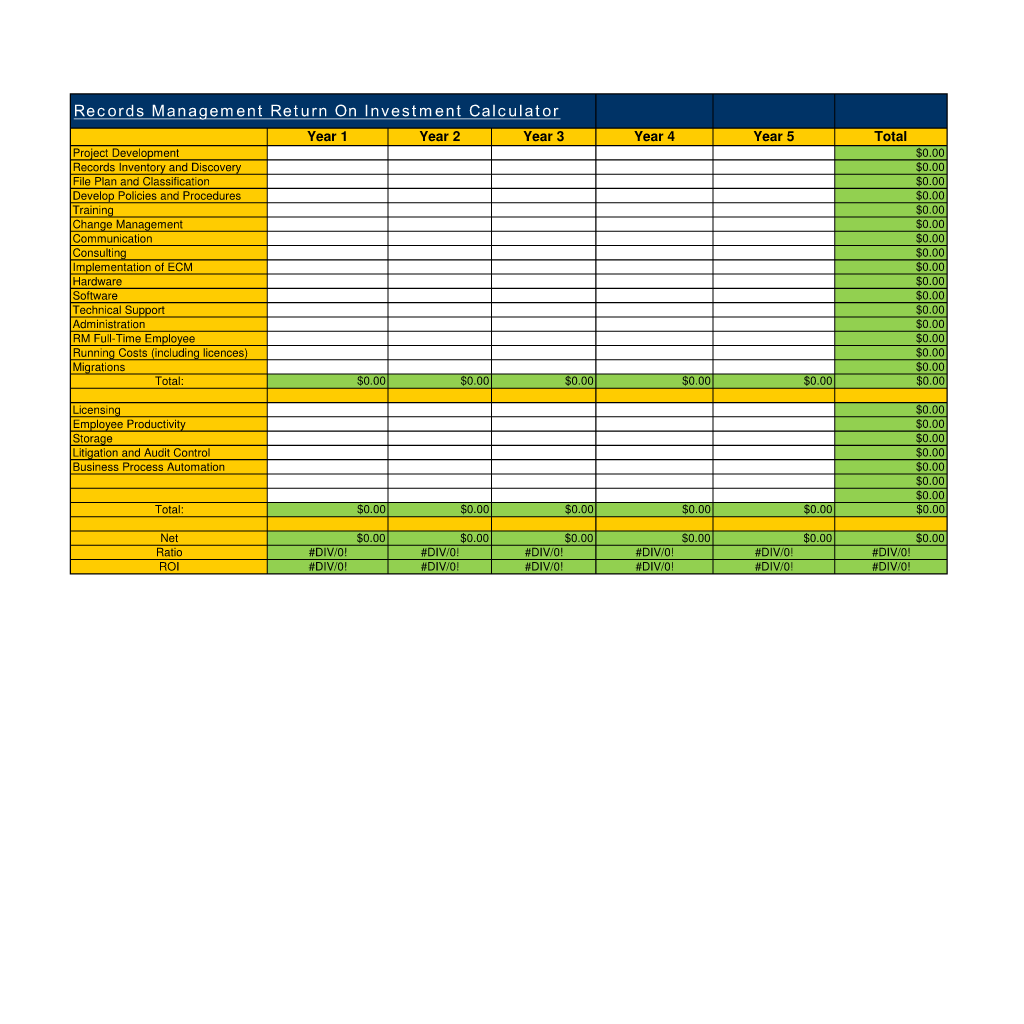
Records Management Return On Investment Calculator
 Get 20% off ordering today: Click here for the code
Proposal Kit Professional adds business proposals, all six Contract Packs,
Project Management Pack library, and Expert Edition software.
We include this editable document in the Proposal Kit Professional. Order and download it for $199. Follow these steps to get started.
 DOWNLOADABLE, ONE-TIME COST, NO SUBSCRIPTION FEES
Key Takeaways
- One-time License, No Subscriptions: Pay once and use Proposal Kit forever-no monthly fees or per-use charges.
- Built for Business Projects: Start with a proven Records Management Return On Investment Calculator and tailor sections, fields, and branding for your day-to-day project work.
- Instant Access: Download immediately and open the document right away-no waiting, no onboarding delay.
- Project-Ready Structure: Use a ready, professional layout for real-world project tasks (checklists, forms, analysis pages) so teams can execute consistently.
- Fully Editable in Word: Edit everything in Microsoft Word-swap text, add/remove sections, and apply your logo/colors without special skills.
- Step-by-Step Wizard Help: The Proposal Pack Wizard guides you with training/help and keeps you moving-no getting stuck on formatting or assembly steps.
- Wizard Data Merge & Project Management: Let the Wizard manage projects and merge recurring data (company/client names, addresses, dates) across your project documents.
- Included in Proposal Kit Professional: Available exclusively in the Proposal Kit Professional bundle.
 What Our Clients Say
Not only is Proposal Kit user friendly, but it has relevant templates for most every need. I highly recommend this product."
1. Get Proposal Kit Professional that includes this business document.
We include this Records Management Return On Investment Calculator in an editable format that you can customize for your needs.
2. Download and install after ordering.
Once you have ordered and downloaded your Proposal Kit Professional, you will have all the content you need to get started with your project management.
3. Customize the project template with your information.
You can customize the project document as much as you need. You can also use the included Wizard software to automate name/address data merging.
Use cases for this document
Greenfield Medical's paper-to-cloud turnaround
The Challenge
Greenfield Medical Group relied on a paper-based system with high physical costs, including the cost of printing, filing cabinets, and off-site storage, leading to misfiled documents, human error, a long time to retrieve records, and growing compliance risk with regulators as audit trails and version control were impossible to maintain consistently.
The Solution
The team used a records ROI calculation to calculate the roi, comparing investment cost to investment return for a cloud-native DMS with strong data security, access controls, encryption, and retention policies; Proposal Kit's software produced supporting documents-the business proposal, risk assessment, and training plan-using document creation tools, the AI Writer for narratives, the RFP Analyzer to compare vendor bids, and line-item quoting for clear project cost and maintenance costs.
The Implementation
They ran scenario testing with real-time results to evaluate a range of outcomes and usage-based pricing, exported a PDF for senior management review, and phased a migration plan to electronic storage with document processing, metadata, intelligent search, workflow automation, and a centralized location for a central repository; training and support reduced disruption and ensured regulatory compliance.
The Outcome
Within two quarters, the initiative showed a positive roi with higher return percentage and percentage roi, weekly cost savings from time saved in search and access, fewer compliance violations, faster responses to customer inquiries, and a defensible financial valuation that demonstrated improved productivity and reduced risk exposure.
ForgeTek Manufacturing modernizes specs and quality records
The Challenge
ForgeTek's legacy systems made specification management and quality management error-prone, with version control gaps, slow document workflows, and integration challenges that hurt productivity, increased operating expenses, and raised compliance risk during audits.
The Solution
Using the ROI model, leaders compared initial investment and ongoing costs against investment return from efficiency, reduced labor costs, and fewer defects; Proposal Kit's AI Writer created a change-management plan, compliance study, and stakeholder report while the RFP Analyzer distilled vendor requirements and line-item quoting, mapped hardware, software, and integration costs to a clear return percentage.
The Implementation
A hybrid EDMS was deployed with API integration to ERP, access controls with granular permissions, audit trails, intelligent search, and document search across electronic documents; training and support reinforced document control, and installation and configuration included off-site backup and disaster recovery to reduce data loss risks.
The Outcome
Anticipated vs actual ROI tracked in real-time results showed a swift break-even, fewer errors and rework, shorter time to retrieve specs, improved collaboration across teams, and a measurable increase in revenue from faster product releases while maintaining regulatory compliance with fewer findings from regulators.
NorthRiver Capital scales securely while cutting retrieval time
The Challenge
As NorthRiver Capital grew, customer inquiries surged, and regulatory requirements tightened, but their mix of paper documents and scattered files led to slow search and retrieval, data security concerns, and rising maintenance costs with no clear view of financial performance.
The Solution
They applied an ROI analysis to calculate the roi for a cloud-based DMS, emphasizing encryption, access controls, and audit trails, and used Proposal Kit to assemble the investor briefing, a board-ready ROI report, and a data privacy plan. AI Writer drafted the narratives, the RFP Analyzer structured vendor comparisons, and line-item quoting clarified expected costs versus profit generated.
The Implementation
The team migrated in phases to cloud-native electronic storage with document processing, metadata-driven search tools, workflow automation, and mobile accessibility; scenario testing modeled usage-based pricing and final return, and PDF export summaries informed decision makers, while training and support reduced compliance violations risk.
The Outcome
NorthRiver realized a positive roi within six months, with percentage roi tied to time saved, weekly cost savings from faster search and access, fewer compliance gaps, improved productivity across remote teams, and stronger responses to regulators backed by clear audit trails and enforced retention policies.
Abstract
This ROI calculator for records management helps decision makers evaluate the financial value of moving from paper-based processes to a modern document management system. It guides senior management through roi analysis for a project proposal, aligning business value with allocation of resources and investment decisions. Using a clear roi formula, teams can calculate roi based on initial investment, ongoing costs, and expected revenues to judge investment profitability and percentage return, revealing whether anticipated ROI is likely positive or negative and when the initiative may break even.
The tool frames project cost comprehensively: initial cost, operating expenses versus capital expenses, training for employees, installation and configuration, software updates, hardware maintenance, and integration challenges, including API integration and AI integration. It compares these to financial benefits such as cost savings, time savings, improved collaboration, operational efficiency, increased revenue, reduced risk, and better customer service. With straightforward financial metrics-expected costs, estimated costs, estimated revenues, final revenue, total expenses, profit generated, net profit, and final return- the calculator supports measuring ROI and anticipated vs actual ROI over time.
For document management, the calculator highlights the cost of investment in an EDMS/DMS against the pain of paper documents: printing costs, paper forms, labor costs, filing cabinets, offsite storage, misfiled documents, lost documents, and long search and retrieval time. It factors efficiency gains from electronic documents, electronic forms, a centralized location and central repository, document control, version control, audit trails and versions, access control with granular permissions, encryption, retention policies, and compliance management to enforce compliance with regulatory requirements and data privacy. It also addresses security and risk management, including disaster recovery, offsite backup, data loss, data breaches, data residency, and data sovereignty.
Use cases include migrating from a legacy system to a cloud-based, on-premises, or hybrid EDMS; replacing manual document workflows with workflow automation; improving search tools, intelligent search, metadata, search and categorization, search capabilities, and document search to streamline processes and reduce costs; and strengthening quality management and specification management. The calculator supports cost justification when evaluating scalability, integration, mobile accessibility, performance degradation risks, compliance gaps, and security vulnerabilities.
Proposal Kit can help you build the accompanying project proposal and ROI narrative with document assembly, automated line-item quoting, and an AI Writer that can create supporting documents using an extensive template library. These tools make it easier to organize assumptions, compare situations, and produce clear, professional deliverables.
Expanding on the ROI perspective, a robust roi calculation should calculate the roi by comparing investment cost to investment return and expressing both return percentage and percentage roi. Teams can run scenario testing with real-time results to analyze a range of outcomes, revealing where a project yields positive roi or risks negative roi and identifying when it will break even. The model should capture physical costs such as the cost of printing and storage from a paper-based system, along with maintenance costs, training and support, and usage-based pricing. Results can be summarized for PDF export and presented as a financial valuation tied to overall financial performance.
When organizations migrate from legacy systems to a cloud-native DMS, electronic storage and automated document processing reduce human error, shorten time to retrieve records, and improve search and access. These gains translate into time saved, weekly cost savings, higher productivity, and the potential to increase revenue. Strong data security and access controls lower risk exposure and compliance risk, helping prevent compliance violations while supporting regulatory compliance and faster responses to customer inquiries. Capturing these effects in the ROI model helps decision makers weigh operational benefits against costs and ensure resources go to the highest-value initiatives.
Proposal Kit can help teams assemble the full project package that accompanies the calculator: a concise plan, cost justification, and supporting analyses. Using document assembly, automated line-item quoting, an AI Writer, and an extensive template library, teams can build professional documents that explain assumptions, model anticipated outcomes, and communicate the case for a DMS upgrade or a migration plan from paper-based workflows to a modern, cloud-native approach.
Beyond cost comparisons, strong ROI planning should define operational KPIs and a cadence to validate anticipated vs actual ROI. Track cycle times for document processing, error rates, time to retrieve, customer response metrics, and compliance findings. Link these to revenue enablement and cost avoidance so leaders see how streamlined workflows improve productivity alongside financial performance.
Build an adoption plan with change management, role-based access controls, and phased rollouts to reduce disruption. Establish governance that maps retention policies and audit trails to regulatory requirements, making it easier to demonstrate control effectiveness to regulators during audits and inquiries.
In practice, service teams can cut average handle time by surfacing the right record on first search, field staff can resolve cases faster with secure mobile access, and finance or quality teams can meet deadlines with fewer handoffs. These gains lower rework, minimize escalations, and reduce the chance of sanctions, while creating a durable record that supports future funding requests. Proposal Kit can help organize the supporting documentation, assumptions, KPI definitions, phased budgets, and comparison scenarios, so stakeholders receive a coherent package that clarifies value, risks, and milestones without adding administrative overhead.
Writing the Records Management Return On Investment Calculator document
business,project,records,management,toolkit,information,documents,templates,boilerplate,form,outline,textThe editable Records Management Return On Investment Calculator document - complete with the actual formatting and layout is available in the retail Proposal Kit Professional.
20% Off Discount
 4.7 stars, based on 850 reviews
Related Documents
 Published by Proposal Kit, Inc.
We include a library of documents you can use based on your needs. All projects are different and have different needs and goals. Pick the documents from our collection, such as the Records Management Return On Investment Calculator, and use them as needed for your project.
 Facebook
 YouTube
 Bluesky
 Search Site
© 1997 - 2026, Proposal Kit, Inc. All rights reserved. Privacy Policy