

 Cart
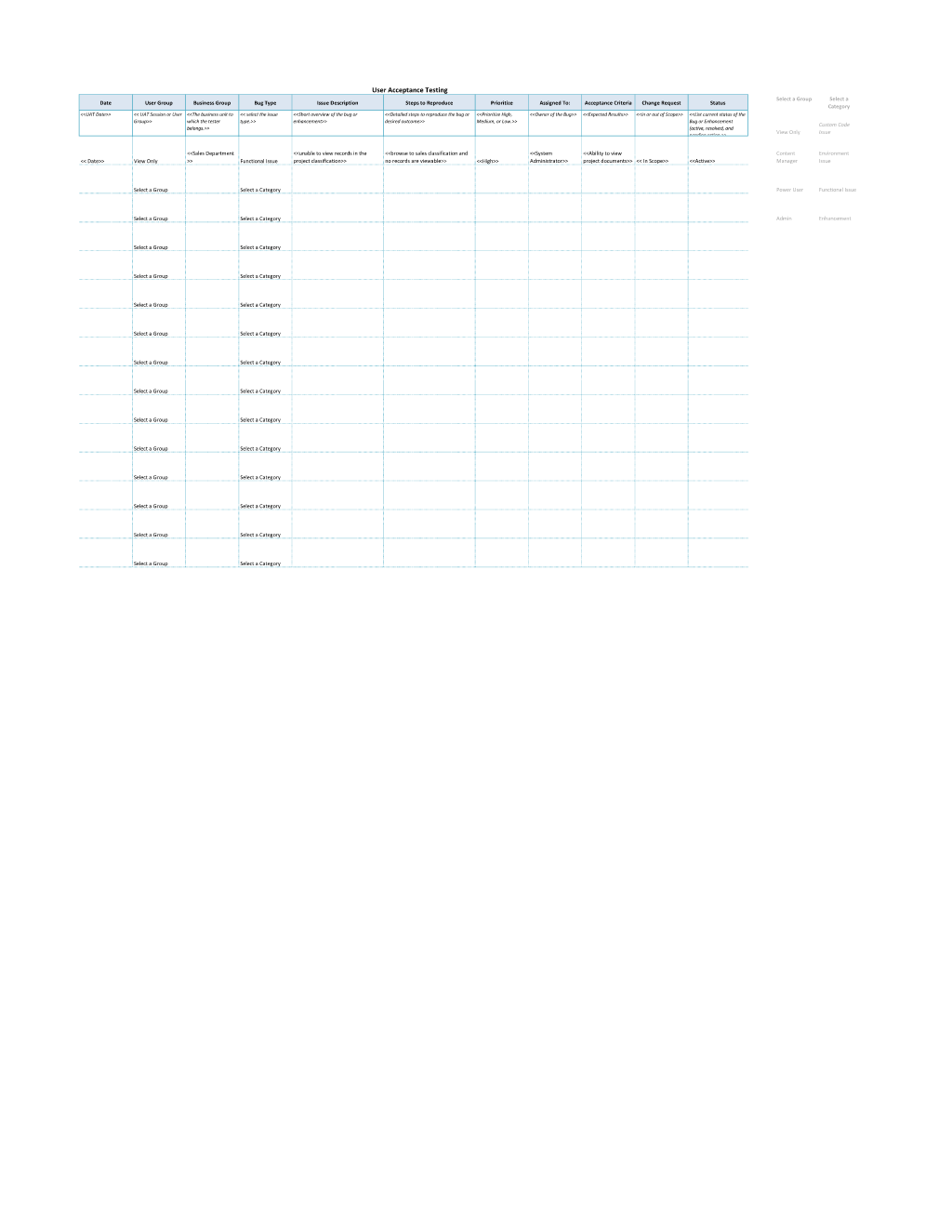
CartUser Acceptance Testing (UAT) Enhancements and Bug Tracker - Downloadable
%20Enhancements%20and%20Bug%20Tracker%20-%20Use%20the%20User%20Acceptance%20Testing%20(UAT)%20Enhancements%20and%20Bug%20Tracker%20to%20track%20issues%20with%20the%20program.%20Hundreds%20of%20project%20management%20documents%20available%20from%20ProposalKit.com. "Pin this User Acceptance Testing (UAT) Enhancements and Bug Tracker")
User Acceptance Testing (UAT) Enhancements and Bug Tracker
 Get 20% off ordering today: Click here for the code
Proposal Kit Professional adds business proposals, all six Contract Packs,
Project Management Pack library, and Expert Edition software.
We include this editable document in the Proposal Kit Professional. Order and download it for $199. Follow these steps to get started.
 DOWNLOADABLE, ONE-TIME COST, NO SUBSCRIPTION FEES
Key Takeaways
- One-time License, No Subscriptions: Pay once and use Proposal Kit forever-no monthly fees or per-use charges.
- Built for Business Projects: Start with a proven User Acceptance Testing (UAT) Enhancements and Bug Tracker and tailor sections, fields, and branding for your day-to-day project work.
- Instant Access: Download immediately and open the document right away-no waiting, no onboarding delay.
- Project-Ready Structure: Use a ready, professional layout for real-world project tasks (checklists, forms, analysis pages) so teams can execute consistently.
- Fully Editable in Word: Edit everything in Microsoft Word-swap text, add/remove sections, and apply your logo/colors without special skills.
- Step-by-Step Wizard Help: The Proposal Pack Wizard guides you with training/help and keeps you moving-no getting stuck on formatting or assembly steps.
- Wizard Data Merge & Project Management: Let the Wizard manage projects and merge recurring data (company/client names, addresses, dates) across your project documents.
- Included in Proposal Kit Professional: Available exclusively in the Proposal Kit Professional bundle.
 What Our Clients Say
Easy to use with integrations to software I already have in place (MS-Office and QuoteWerks). I’ve always struggled with formatting my quotes in addition to content, but Proposal Kit makes that a snap, I more or less just need to worry about the details and not the layout. When prospects ask me for general information, I’m able to pull a few pages from the master quote I created without the need to have a brochure or similar. The content of the proposals has also been helping me in my company’s website content. The staff are extremely helpful and quick to respond!"
Polarverse IT Services
1. Get Proposal Kit Professional that includes this business document.
We include this User Acceptance Testing (UAT) Enhancements and Bug Tracker in an editable format that you can customize for your needs.
2. Download and install after ordering.
Once you have ordered and downloaded your Proposal Kit Professional, you will have all the content you need to get started with your project management.
3. Customize the project template with your information.
You can customize the project document as much as you need. You can also use the included Wizard software to automate name/address data merging.
Use cases for this document
Meditalis Research accelerates a complex eCOA UAT for Northfield Pharma
The Challenge
A sponsor or designee at Northfield Pharma asked Meditalis Research and BluePine CRO to ready an eCOA system for a clinical study with BYOD and provisioned integrated devices across Android/iOS, while meeting system validation, usability testing, and SOP expectations across development, test, UAT, and production environments. Defects were scattered on a paper list, pass/fail calls lacked consistency, and the study team faced a rate-limiting step in aligning internet browser requirements, minimum operating system needs, and interfaces to EDC and IRT with regulatory expectations and ePRO Consortium practices.
The Solution
Meditalis introduced a disciplined UAT conduct with UAT scripts, a UAT test plan, and an Excel tracker with a comments column, findings log, and a pass/fail matrix stored in SharePoint for assignment tracking and progress reporting. Proposal Kit supported the effort by assembling the surrounding documents-monitoring plans, data management plan, site monitoring procedures, UAT summary report, and sponsor approval memo-while the AI Writer produced a usability testing summary and a study participants communication brief; RFP Analyzer helped craft a device provisioning proposal with line-item quoting.
The Implementation
A dedicated team of QA, subject matter experts, and business users executed rounds of testing and retesting, logged bugs and enhancements, and held a debrief meeting to agree on action plan items in TFS/MTM and the UAT findings log. They verified requirements were communicated and traced to system requirements, validated data transfers, and confirmed customization features worked across hosting environments before final approvals.
The Outcome
The sponsor approval and UAT sign off arrived on schedule, defects trended down, and the go-live proceeded with documented evidence and post go-live monitoring. Operational efficiency improved, and the clinical study was launched with confidence in data quality and environmental stability.
IronWave Logistics tames analytics UAT across Cognos, Tableau, and HANA
The Challenge
IronWave's B2B platform relied on analytics packages where report developers struggled with fields and aggregations, backend databases, time travel tests, and data loading across QA, UAT, and production, resulting in unclear ownership and unresolved issues. Business users lacked requirements traceability, and bugs, script errors, and enhancement requests piled up without a clear UAT timeline.
The Solution
The product owner formed a dedicated UAT team and standardized UAT stages with test scripts, a pass/fail matrix, and a categorized Excel tracker (application bug, software bug, system issue) in a UAT folder, shared with customers via SharePoint and synchronized to TFS/MTM. Proposal Kit generated supporting documents-a change management plan, communication plan, executive summaries, and test reporting templates-while the AI Writer drafted training guides; RFP Analyzer aligned a response to a client's requirements document with line-item quoting for phased implementation.
The Implementation
Teams worked through development, QA environment, and UAT environment with assignment tracking, progress reporting, and debrief meetings to prioritize findings and schedule bug fixes and retesting. Requirements were communicated early, and usability testing validated dashboard behavior for different screen sizes and browsers before production release.
The Outcome
IronWave achieved timely sign-off, reduced rework, and higher data quality, with measurable improvements in cycle times and fewer defects escaping to production. Stakeholders gained confidence through transparent UAT documentation and consistent test reporting.
AuroraPay delivers a merchant portal upgrade without derailing the release window
The Challenge
Fintech firm AuroraPay planned an application-based portal upgrade with customization features for enterprise merchants using bring your own device across Android/iOS, but the UAT timeline slipped due to scattered UAT findings and unclear technical functional ownership. Internet browser requirements, minimum operating system checks, and environment differences created defects that threatened the release.
The Solution
AuroraPay reset the UAT process with acceptance criteria, UAT scripts, and a structured Excel tracker featuring a comments column, findings log, and pass/fail outcomes, plus a debrief cadence to prioritize items. Proposal Kit produced the surrounding collateral-a business case, SOP addendum, stakeholder communication brief, and a post go-live monitoring plan-while the AI Writer created customer FAQs; RFP Analyzer supported a hosting RFP with line-item quoting for environments and support tiers.
The Implementation
A dedicated team spanning QA, subject matter experts, and developers coordinated system validation and usability testing across the development environment, test environment, UAT environment, and the production environment, with a dry run, tracking bugs, design changes, and enhancement requests to closure. Each debrief ended with an agreement on an action plan step and documented evidence of retesting and error correction.
The Outcome
AuroraPay secured UAT sign-off from its enterprise client, met the release date, and reduced production issues through clearer roles and responsibilities and reliable requirements traceability. The upgrade went live smoothly, and post-go-live monitoring confirmed stable performance and satisfied users.
Abstract
This concise user acceptance testing tracker focuses on what teams need most during UAT sessions: who tested (user group and business unit), what they found (bugs or enhancement requests), how to reproduce it, priority (High/Medium/Low), and current status (active, resolved, pending). Used as a UAT tracking sheet or findings log, it supports pass/fail outcomes, a comments column for context, and a simple pass fail matrix so sponsors and product owners can see progress quickly and prepare for formal acceptance and sign-off.
Within the SDLC, including a waterfall SDLC, this artifact fits the UAT stages alongside a UAT test plan, test scripts, acceptance criteria, and UAT documentation. It helps maintain requirements traceability back to the requirements document and system requirements, showing that the system design conforms to requirements. After rounds of testing, teams schedule a debrief meeting, prioritize findings, agree on an action plan, and capture documented evidence before UAT approval and final approval for go-live and post go-live monitoring.
Best practice recommendations include clear roles and responsibilities across the UAT team, QA team, business users, and a product owner. Categorize issues as application bug, software bug, system issue, script error, design change, or enhancement request; label in progress; track bugs and enhancements through error correction and retesting; and report timeline and progress reporting. Many groups implement an Excel tracker stored in SharePoint or a UAT folder in TFS/MTM.
An Excel-based dynamic tool with locked fields to prevent copy/reformat errors is low/no cost, needs minimal training, and is easy to share with customers. Include assignment tracking, a UAT summary report, and a UAT kick-off with training testers, a communication plan, change management, and phased implementation.
Use cases span regulated and enterprise contexts: clinical outcome assessment using an eCOA system with BYOD or provisioned devices (Android/iOS), internet browser, and screen size device requirements, study protocol, and study-specific requirements, site testing, and risk-based approaches to software validation aligned with regulatory authorities and FDA guidance by a study sponsor, CRO, or designee. For analytics, report developers validate fields and aggregations in Cognos, Tableau, or HANA QA against data source and backend databases, including time travel and data loading tests for study dashboards, team content, and a study portal across development, test, UAT, and production environments (QA and prod environment).
Proposal Kit can help assemble the surrounding UAT plan, test plan, and scripts, summary reports, and related documents. Its document assembly, automated line-item quoting, AI Writer for supporting materials, and extensive template library make it fast to produce consistent UAT packages that improve data quality and operational efficiency with ease of use.
Beyond identifying bugs and enhancements, effective UAT conducts scenarios of how workflows flow through hosting environments and the project lifecycle. Teams structure the UAT process so requirements are communicated early, then verified through system validation and usability testing in a development environment, test environment, QA environment, and a controlled UAT environment before any production environment release. A dedicated UAT team partners with quality assurance, a subject matter expert, and a product owner to balance technical and functional checks with the day-to-day job of business users.
They execute UAT scripts, record defects and UAT findings in a UAT findings log and an enhancements log, run test reporting, track bug fixes, and manage a clear UAT timeline. Formal steps include a UAT debrief to remove rate-limiting step constraints, agree on action plan items, and document sponsor approval and UAT sign off per SOP and process.
In regulated programs, such as a clinical study, a sponsor or designee, and the study team often apply a risk-based approach. When an eCOA program aligns with ePRO Consortium practices, bring your own device, and provisioned integrated devices are validated against minimum operating system and internet browser requirements. Interfaces to EDC and IRT, plus data transfers with analytics packages, require data management reviews, site monitoring, and study site monitoring against monitoring plans.
For application-based solutions on a B2B platform, teams verify customization features used by study participants in the UAT environment before go-live. Replacing a paper list with a structured tracker reduces rework and supports consistent UAT findings across environments.
Proposal Kit helps organizations assemble the surrounding document set-UAT plan, UAT scripts, UAT findings log, enhancements log, SOPs, monitoring plans, and approval summaries- so dedicated teams can produce consistent packages quickly. Document assembly, automated line-item quoting, an AI Writer for supporting materials, and an extensive template library streamline preparation for sign-offs while improving clarity and consistency.
Organizations gain additional value when a dedicated team coordinates technical functional validation with business workflows. Establishing measurable acceptance criteria up front reduces ambiguity in pass/fail calls and accelerates triage. Calibrating testers with short dry runs improves consistency across user groups, and lightweight metrics, such as defect aging, retest turnaround, and pass rates by script, keep leadership focused on where help is needed.
Decision rights for prioritization (who can approve a design change versus a bug fix) shorten feedback loops and protect the UAT timeline. Clear handoffs between discovery, fix, retesting, and final verification reduce idle time and keep UAT stages aligned with release windows.
Stakeholders benefit from concise communication cadences. A daily 15-minute stand-up for blockers, a mid-cycle checkpoint for scope shifts, and a final readiness review before sign-off provide predictable touchpoints without burdening the day-to-day job. For distributed teams, a simple taxonomy for findings-user-facing, data, integration, environment, or training helps route items to the right owner and prevents rework. Post go-live, a brief hypercare window with pre-agreed response targets builds confidence and protects operational efficiency.
Proposal Kit can further streamline this by giving teams consistent document shells for decision logs, RACI-style roles summaries, UAT debrief notes, and concise executive summaries alongside the core UAT plan and scripts. Its document assembly, AI-assisted writing for supporting materials, and template library help a dedicated team communicate clearly, capture decisions, and prepare leadership for timely sign-off.
How do you write a User Acceptance Testing (UAT) Enhancements and Bug Tracker document?
business,project,records,management,toolkit,information,documents,templates,boilerplate,form,outline,textThe editable User Acceptance Testing (UAT) Enhancements and Bug Tracker document - complete with the actual formatting and layout is available in the retail Proposal Kit Professional.
20% Off Discount
 4.7 stars, based on 850 reviews
Related Documents
- Records Inventory Worksheet Questionnaire for Business Units
- Records Management Pre-Inventory Survey
- Records Survey and Inventory Analysis
- Business Case for Records Management
- Records Management Program Analysis Document
- Records Management Policies and Procedures
- Physical Content Management Box Label
- Records Access Security Plan
- Records Access Security Plan (Expanded)
- Records Management Metadata Model
- Records Management Governance Plan
- Records Management Topic Template
- Records Management Taxonomy Topic Template
- Records Management File Plan Template
- Records Management Expanded File Plan Template
- Application for Records Retention Form
- Authorization for Records Destruction Form
- Formal Record Hold Investigation Form
- Formal Record Hold Notice Form
- Release of Legal Hold Notice Form
- Record Retention Schedule Change Form
- Legal Hold and Discovery Log
- Records Disposition Log
- Stakeholder Concerns Log
- Communication Plan
- RACI Matrix Worksheet
- User Acceptance Testing (UAT) Schedule
- Risk Mitigation Plan
- Records Inventory Worksheet
- Records Management Return On Investment Calculator
 Published by Proposal Kit, Inc.
We include a library of documents you can use based on your needs. All projects are different and have different needs and goals. Pick the documents from our collection, such as the User Acceptance Testing (UAT) Enhancements and Bug Tracker, and use them as needed for your project.
 Facebook
 YouTube
 Bluesky
 Search Site
© 1997 - 2026, Proposal Kit, Inc. All rights reserved. Privacy Policy