

 Cart
Cart
Risk Mitigation Plan
 Get 20% off ordering today: Click here for the code
Proposal Kit Professional adds business proposals, all six Contract Packs,
Project Management Pack library, and Expert Edition software.
We include this editable document in the Proposal Kit Professional. Order and download it for $199. Follow these steps to get started.
 DOWNLOADABLE, ONE-TIME COST, NO SUBSCRIPTION FEES
Key Takeaways
- One-time License, No Subscriptions: Pay once and use Proposal Kit forever-no monthly fees or per-use charges.
- Built for Business Projects: Start with a proven Risk Mitigation Plan and tailor sections, fields, and branding for your day-to-day project work.
- Instant Access: Download immediately and open the document right away-no waiting, no onboarding delay.
- Project-Ready Structure: Use a ready, professional layout for real-world project tasks (checklists, forms, analysis pages) so teams can execute consistently.
- Fully Editable in Word: Edit everything in Microsoft Word-swap text, add/remove sections, and apply your logo/colors without special skills.
- Step-by-Step Wizard Help: The Proposal Pack Wizard guides you with training/help and keeps you moving-no getting stuck on formatting or assembly steps.
- Wizard Data Merge & Project Management: Let the Wizard manage projects and merge recurring data (company/client names, addresses, dates) across your project documents.
- Included in Proposal Kit Professional: Available exclusively in the Proposal Kit Professional bundle.
 What Our Clients Say
So, I have been using Proposal Kit for at least five or six years already. As a professional coach, LinkedIn lead generation expert writing proposals is just part of my weekly routine. I try to coach all my clients that they must have systems for everything, Proposal Kit is one of my secret weapons I use. It just makes the process so much easier by doing about 75% of the work for you initially. I just love it and will recommend it to anybody who wants to have a real system of writing proposals, that would normally take hours, now can take 30-40 mins max."
Executive Edge
1. Get Proposal Kit Professional that includes this business document.
We include this Risk Mitigation Plan in an editable format that you can customize for your needs.
2. Download and install after ordering.
Once you have ordered and downloaded your Proposal Kit Professional, you will have all the content you need to get started with your project management.
3. Customize the project template with your information.
You can customize the project document as much as you need. You can also use the included Wizard software to automate name/address data merging.
Use cases for this document
AegisSec Solutions pursues a credit-union SOC contract while tightening its own cyber risk controls
The Challenge
After a regional data breach rattled the market, Northstar Credit Union's RFP demanded rigorous governance, incident response, and proof of ongoing risk monitoring; AegisSec Solutions needed to show disciplined project risk management while coordinating a fast-moving team across compliance, engineering, and client services.
The Solution
The PM, Lena Ortiz, stood up a shared risk register using the project management template to track issues by impact area, owners, and mitigation plans, then used Proposal Kit to create supporting documents: AI Writer drafted an incident response synopsis and a governance overview, the RFP Analyzer mapped Northstar's requirements to the proposal outline, and line-item quoting priced mitigation measures such as MFA rollout, log retention upgrades, and tabletop exercises.
The Implementation
Lena formed a cross-functional risk mitigation team, assigned risk owners, and scheduled weekly check-ins to monitor and evaluate status; meanwhile, Proposal Kit assembled a polished proposal package plus a companion risk assessment report and vendor due diligence summary, each linked back to items in the register for traceability and stakeholder clarity.
The Outcome
AegisSec delivered a compliant, costed proposal with crisp evidence of risk identification, mitigation, and reporting; the customer shortlisted them, internal controls improved ahead of schedule, and leadership gained a repeatable playbook for future bids.
Highland Home Goods stabilizes a new product launch amid supply chain turbulence
The Challenge
A late-stage component shortage threatened Highland's spring cookware launch and its retail partner commitment with MetroMart, risking reputational damage and margin erosion if delays cascaded across marketing and store resets.
The Solution
Operations lead Marcus Bell captured supply, logistics, and quality risks in the project management register, then used Proposal Kit to generate supporting materials: AI Writer produced a supplier contingency brief and customer communication plan, the RFP Analyzer aligned Highland's response to MetroMart's packaging and compliance specs, and line-item quoting budgeted expedited freight, alternate molds, and additional QA sampling.
The Implementation
The team assigned owners per risk, set trigger points, and ran daily stand-ups to monitor and evaluate progress; Proposal Kit assembled a business continuity addendum and revised service level agreements for third-party manufacturers, keeping leadership and the retailer synchronized on options and costs.
The Outcome
Highland shipped on time to priority regions, preserved shelf space, and recovered costs through negotiated terms; the structured documentation improved stakeholder confidence and became the template for future seasonal launches.
BlueQuill Analytics migrates to the cloud and wins an enterprise contract
The Challenge
To land Trident Manufacturing as a flagship customer, BlueQuill needed to complete a cloud migration while proving security, privacy, and uptime commitments, all under tight procurement scrutiny.
The Solution
CTO Priya Nandakumar used the project management template to track technical, compliance, and operational risks, and leveraged Proposal Kit for auxiliary documentation: AI Writer drafted a data protection impact summary, a security policy digest, and an executive risk report; the RFP Analyzer broke down Trident's questionnaire into a response matrix; line-item quoting costed controls like encryption key management and backup retention.
The Implementation
BlueQuill assigned risk owners by domain, linked mitigations to milestones, and held biweekly reviews to monitor and evaluate residual risk; Proposal Kit assembled the final proposal package, plus a customer-facing uptime and incident communication plan that referenced the internal register without exposing sensitive details.
The Outcome
The migration closed without material incidents, the proposal met every mandatory requirement, and BlueQuill secured a multi-year deal; the combined discipline of the register and supporting documents shortened sales cycles and tightened engineering-practice consistency.
Abstract
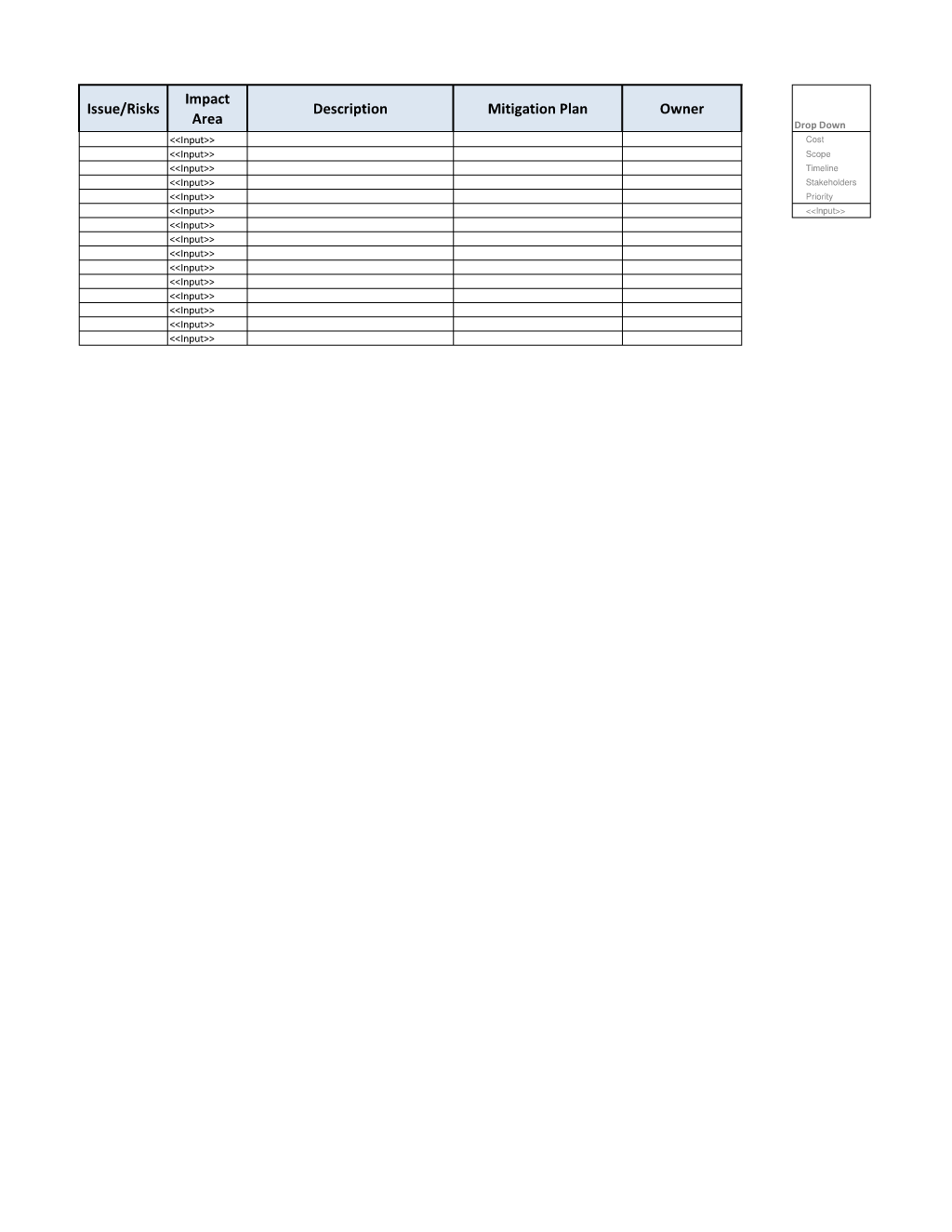
This concise document functions as a structured risk register entry. Its fields-Issue/Risks, Impact Area, Description, Mitigation Plan, and Owner-guide a complete risk management process from risk identification through risk monitoring and risk reporting. Project managers and the project team use these fields to document potential threats, quantify risk, and link each item to business objectives and business goals.
The Impact Area clarifies risk categories such as operational risk, compliance risk, legal risk, reputational risk, and financial risk, aligning each to business operations and business strategy. The Description should capture likelihood and impact, probability of risk, risk severity, and risk quantification using a risk assessment matrix or risk matrix. This supports risk analysis, risk prioritization, and defining an acceptable level of risk consistent with risk appetite, risk tolerance, and the organization's risk threshold.
The Mitigation Plan field records mitigation strategies and controls and measures, including risk avoidance strategy, risk reduction strategy, risk transfer strategy, and risk acceptance strategy. It can detail mitigation activities, mitigating controls, contingency plans, and incident response steps. Examples include cyber risk mitigation for cybersecurity and data breach events; governance risk and compliance measures for regulatory compliance; insurance policy and service level agreements with third-party vendors and cloud service providers; and business continuity plan topics to sustain business continuity across the organization during supply chain disruptions, market volatility, or economic downturns.
Assigning a risk owner via the Owner field ensures accountability for mitigation plan implementation, monitoring, and metrics, and communication and collaboration with stakeholders. Risk owners can monitor the plan, monitor risks, monitor progress, and adjust based on monitoring and evaluation results. Training, education, and continuous improvement strengthen the risk profile over time.
The document supports enterprise risk management, project risk management, and a project risk management plan by providing clear risk documentation, enabling resource allocation, and improving decision-making. It also fits alongside risk management software to report on risks, allocate resources, and prioritize risks to acceptable risk levels.
Use cases: a project risk assessment for a product launch; a risk response plan for a data breach; contingency plan updates for supply chain disruptions; or risk reduction measures to meet regulatory and compliance rules.
Proposal Kit can help teams assemble this document quickly, tie it to related templates, produce automated line-item quoting where budgets intersect mitigation measures, and use its AI Writer to build supporting documents. Its extensive template library and ease of use streamline project risk mitigation steps from writing to execution.
Building on the core fields, teams gain more value by defining governance around how these entries are created, reviewed, and updated. Establish a cross-functional risk mitigation team to own the cadence, set the taxonomy for each risk category, and align entries to the organization's risk appetite. Use a simple playbook so the team can select the right risk mitigation strategy for different types of risk and document the triggers for escalation. This improves risk mitigation planning and ensures the project team can communicate with stakeholders early enough to prevent or limit negative impact.
Practical routines matter. Schedule regular checkpoints to monitor and evaluate the status of each item, verify completion of actions, and log outcomes. Apply lightweight risk monitoring and evaluation metrics-such as control implementation rate, incident counts, and time-to-mitigation- to show progress and guide resource allocation. Tie each entry to a decision record so leaders can see why a chosen strategy-avoidance, reduction, transfer, or acceptance-fits the stated likelihood and impact.
Consider two brief examples. During a cloud migration, classify issues under the cybersecurity risk category, define controls for third-party access, and monitor and evaluate results after each release. In a brand launch, track reputational and compliance items, prepare messaging contingencies, and rehearse response steps to limit any negative impact from public feedback.
Proposal Kit can streamline these activities by assembling consistent registers, capturing risk category definitions, and connecting related templates for response plans and costed controls. Teams can use automated line-item quoting to budget mitigation steps, and rely on the AI Writer to write supporting narratives that help the risk mitigation team communicate with stakeholders clearly and keep the plan actionable.
Extend the single-page register by adding structure around roles, scoring, and timing. Standardize the Owner drop-down with named roles and alternates so risk owners are clear, coverage gaps are avoided, and handoffs are faster. Add a simple scoring model that quantifies likelihood and impact, rolls up to risk severity, and ties to a risk threshold. Use key risk indicators as early warnings so the project team can act before a negative impact spreads across business operations.
Create a lightweight project risk mitigation plan that links each entry to specific controls and measures, budget, and due dates. Define when to use a risk avoidance approach versus a risk reduction, risk transfer, or risk acceptance decision, and record the rationale. Build contingency plans next to each mitigation, including incident response steps and business continuity actions. This helps align the register with enterprise risk management and governance risk and compliance practices while staying practical for day-to-day project risk.
Improve cadence and visibility. Hold short reviews where risk owners report on risks, monitor progress, and monitor the plan against milestones. Use monitoring and metrics (dates met, cost variance, residual risk) to monitor risks and to communicate with stakeholders.
The risk mitigation team should prioritize risks by risk category and acceptable risk, allocate resources to the highest risk severity items, and continuously monitor and evaluate results. Periodic risk monitoring and evaluation sessions support continuous improvement and faster decision-making as the team learns.
Proposal Kit can streamline this discipline by assembling consistent risk documentation, connecting related templates such as a risk assessment matrix, incident response, and business continuity plan content, and generating automated line-item quoting for mitigation activities. Its AI Writer can help write clear mitigation strategies and updates, making it easier to coordinate across stakeholders and keep risk mitigation planning actionable.
How do you write a Risk Mitigation Plan document?
business,project,records,management,toolkit,information,documents,templates,boilerplate,form,outline,textThe editable Risk Mitigation Plan document - complete with the actual formatting and layout is available in the retail Proposal Kit Professional.
20% Off Discount
 4.7 stars, based on 850 reviews
Related Documents
- Records Inventory Worksheet Questionnaire for Business Units
- Records Management Pre-Inventory Survey
- Records Survey and Inventory Analysis
- Business Case for Records Management
- Records Management Program Analysis Document
- Records Management Policies and Procedures
- Physical Content Management Box Label
- Records Access Security Plan
- Records Access Security Plan (Expanded)
- Records Management Metadata Model
- Records Management Governance Plan
- Records Management Topic Template
- Records Management Taxonomy Topic Template
- Records Management File Plan Template
- Records Management Expanded File Plan Template
- Application for Records Retention Form
- Authorization for Records Destruction Form
- Formal Record Hold Investigation Form
- Formal Record Hold Notice Form
- Release of Legal Hold Notice Form
- Record Retention Schedule Change Form
- Legal Hold and Discovery Log
- Records Disposition Log
- Stakeholder Concerns Log
- RACI Matrix Worksheet
- Records Inventory Worksheet
- Records Management Return On Investment Calculator
- Communication Plan
- User Acceptance Testing (UAT) Schedule
- User Acceptance Testing (UAT) Enhancements and Bug Tracker
 Published by Proposal Kit, Inc.
We include a library of documents you can use based on your needs. All projects are different and have different needs and goals. Pick the documents from our collection, such as the Risk Mitigation Plan, and use them as needed for your project.
 Facebook
 YouTube
 Bluesky
 Search Site
© 1997 - 2026, Proposal Kit, Inc. All rights reserved. Privacy Policy