

 Cart
Cart
Web Development Worksheet Overview
 Get 20% off ordering today: Click here for the code
Proposal Kit Professional adds business proposals, all six Contract Packs,
Project Management Pack library, and Expert Edition software.
We include this editable document in the Proposal Kit Professional. Order and download it for $199. Follow these steps to get started.
 DOWNLOADABLE, ONE-TIME COST, NO SUBSCRIPTION FEES
Key Takeaways
- One-time License, No Subscriptions: Pay once and use Proposal Kit forever-no monthly fees or per-use charges.
- Built for Business Projects: Start with a proven Web Development Worksheet Overview and tailor sections, fields, and branding for your day-to-day project work.
- Instant Access: Download immediately and open the document right away-no waiting, no onboarding delay.
- Project-Ready Structure: Use a ready, professional layout for real-world project tasks (checklists, forms, analysis pages) so teams can execute consistently.
- Fully Editable in Word: Edit everything in Microsoft Word-swap text, add/remove sections, and apply your logo/colors without special skills.
- Step-by-Step Wizard Help: The Proposal Pack Wizard guides you with training/help and keeps you moving-no getting stuck on formatting or assembly steps.
- Wizard Data Merge & Project Management: Let the Wizard manage projects and merge recurring data (company/client names, addresses, dates) across your project documents.
- Included in Proposal Kit Professional: Available exclusively in the Proposal Kit Professional bundle.
 What Our Clients Say
My dad would say, ’a one-two punch!’ I’ve had this product since 2013 and i use it for my consulting business. This product has allowed me to meticulously and effectively create distinctive proposals for different types of services and different industries. With step-by-step guidance, it’s easy to create professional proposals that are saved in numerous different formats. LOVE IT!!"
Erestar Inc.
1. Get Proposal Kit Professional that includes this business document.
We include this Web Development Worksheet Overview in an editable format that you can customize for your needs.
2. Download and install after ordering.
Once you have ordered and downloaded your Proposal Kit Professional, you will have all the content you need to get started with your project management.
3. Customize the project template with your information.
You can customize the project document as much as you need. You can also use the included Wizard software to automate name/address data merging.
Use cases for this document
Brookvale Planning launches a modern development review portal
The Challenge
Dana Ortiz at the City of Brookvale needed a clear, citizen-friendly portal for permit application steps spanning site plan checklist items, drainage plan submittal, erosion control standards, and subdivision plan guidance, but content was scattered across handouts and application materials with inconsistent references to minimum requirements.
The Solution
Using the web project management worksheets, her team captured site-wide standards and page templates, then turned to Proposal Kit to create supporting documents: a permitting guidance handbook, SEPA checklist explainer, operations and maintenance overview for construction stormwater BMPs, and a consolidated application packet; Proposal Kit's AI Writer drafted these guides, while its RFP Analyzer helped the IT team respond to a hosting RFP and line-item quoting priced content preparation services.
The Implementation
Templates organized pages for right-of-way use permit, conditional use permit, floodplain development permit, and water/sewer availability, while Proposal Kit's document creation assembled matching PDFs and transmittal forms; the AI Writer produced a concise BMP library summary and a user manual for applicants without altering the worksheets themselves, and line-item quoting clarified costs for add-ons like a density worksheet and title history worksheet.
The Outcome
Residents now follow a consistent path from concept plan to final site plan, complete application materials correctly on the first try, and submit fewer corrections; staff spend less time fielding calls, RFP responses went out faster, and fee transparency improved thanks to standardized quotes.
BlueHarbor Engineering builds a subdivision hub for Seaview Communities
The Challenge
Project manager Eli Raines needed a client-facing portal that explained plat sequencing, boundary line adjustment options, legal lot status, and storm drainage system expectations, while also surfacing wetland and FEMA elevation certificate requirements tied to a floodplain development permit.
The Solution
The team used the worksheets to map site-wide elements and page relationships, then leveraged Proposal Kit to produce companion documents: a stormwater pollution prevention plan summary, a drainage review user guide, and operations and maintenance checklists for bioretention areas, permeable pavement, and rain gardens; the AI Writer drafted these reports, the RFP Analyzer parsed a county on-call services RFP, and line-item quoting packaged optional content such as green roof FAQs.
The Implementation
Templates covered site plan requirements, electronic plan requirements, and a design checklist, while Proposal Kit's document creation assembled matching handouts and a review tool overview; AI Writer generated case studies and permit-ready narratives without modifying the project worksheets, and quotes itemized extras like a wetland delineation checklist and critical areas compliance affidavit pages.
The Outcome
Seaview's stakeholders navigated clearly from site plan submittal to approvals, submittals were complete and timely, and BlueHarbor won the county contract using a sharper RFP response and transparent pricing.
Redstone University Facilities upgrades its contractor information site
The Challenge
Facilities director Mariah Chen needed to replace a patchwork site with a structured experience covering site plan requirements, energy code worksheets, electronic plan requirements, and campus right-of-way details while reducing back-and-forth on drainage review and erosion control.
The Solution
The worksheets established consistent templates for permit forms and checklists, and Proposal Kit supplied supporting materials: an operations and maintenance field guide for contractors, a drainage manual overview, and a permitting guidance roadmap; the AI Writer produced studies and how-to reports, the RFP Analyzer improved a grant application strategy, and line-item quoting scoped add-ons like a site areas worksheet and landscape bond quantity worksheet.
The Implementation
Pages were organized around minimum requirements for drainage plan submittal, sewer and water availability, and a streamlined transmittal form, while Proposal Kit's document creation delivered matching PDFs for application packets; AI Writer created training materials, leaving the worksheets intact, and quotes aligned budgets to each content package.
The Outcome
Contractors now self-serve with fewer emails, submittals meet standards on the first pass, and the university secured funding for further improvements after submitting a polished, data-backed proposal.
Abstract
This worksheet package gives teams a simple way to define website requirements early, so projects run faster and cost less. It starts with site-wide reference sheets that capture global features and standards your site should follow. Instead of repeating common needs on every page, you record them once and reuse them. The approach improves clarity between stakeholders and sets a baseline for scope, quality, and schedule.
After the site-wide sections, you define templates- the core page types your site will include. Templates outline layout, navigation, and shared topics. With templates established, you can plan individual pages and the relationships between them.
Treat this as a flexible tool, not an assignment. Use it as a user guide or user manual for consistent decision-making across the project.
This structure works for many organizations. For example, a city or utility building a development review portal can map content such as application forms, permit forms, a site plan checklist, design checklist, and site plan submittal steps. Teams can organize handouts, an application packet, and permit application guidance for land use, subdivision, short subdivision, plat, rezones, boundary line adjustment, and legal lot status.
You can plan sections for site plan requirements, drainage review requirements, drainage review, storm drainage system, construction stormwater, erosion and sediment control, stormwater pollution prevention, best management practices (BMP), a BMP library, stormwater manual, drainage manual, coastal stormwater supplement, and operations & maintenance guidance. Pages may cover right-of-way use permit, shoreline permit, floodplain development permit, fire permit, zoning code variance, conditional use permit, and adequate public facilities. Environmental resources could include the SEPA checklist, the wetland delineation checklist, the flood hazard certification, the FEMA elevation certificate, the critical areas compliance affidavit, and the affidavit of correction. Digital design details can reference a CAD template, electronic plan requirements, site areas worksheet, landscape bond quantity worksheet, and energy code worksheets or energy worksheets. Content might also include sewer availability, water availability, water service requirements, MS4 permittees information, green roof, permeable pavement, bioretention area, infiltration practice, rain garden, wetland, concept plan, final site plan, a site planning & design worksheet, a site development review tool, and a transmittal form or development review transmittal.
Proposal Kit complements this worksheet-driven method with document assembly, automated line-item quoting, an AI Writer to build supporting documents, and an extensive template library, helping teams produce coherent content and streamline delivery with ease of use.
Expanding on the worksheet's value, teams can use it to map regulatory touchpoints alongside content planning, so web sections align with permitting guidance and clearly show minimum requirements for each process. This is especially useful when organizing application materials for a subdivision plan, where visitors expect clear steps, a title history worksheet, a density worksheet, and a drainage plan submittal checklist. The same structure supports public works and environmental pages that explain erosion control standards, operations, and maintenance expectations, and who to contact for follow-up. By capturing these needs in site-wide references and templates, you reduce revision cycles, keep messaging consistent, and help users complete tasks on the first try.
Proposal Kit can accelerate this work by assembling consistent pages and documents from templates, auto-generating line-item quotes for related services, and using its AI Writer to write supporting content such as operations and maintenance sections or how-to guides for application materials. Teams can quickly clone patterns for different permit types, ensure checklists reflect minimum requirements, and maintain a uniform voice across the site. Whether you are a municipal agency publishing subdivision plan resources or a consulting firm building client portals for drainage plan submittal and erosion control documentation, this approach improves clarity, reduces back-and-forth, and shortens time to launch.
Further, the worksheet's structure supports governance and risk control. By first capturing site-wide standards, then defining templates, and finally detailing page relationships, teams create traceability from requirements to deliverables. This reduces scope creep, simplifies change requests, and clarifies acceptance criteria before design or development starts. It also improves findability and consistency for users, because common topics such as handouts, application materials, and permit forms are organized the same way across the site, functioning like a practical user manual.
Agencies can map the full lifecycle of a site plan: concept plan, site plan, site plan submittal, and final site plan, with clear links to minimum requirements, permitting guidance, and a review tool or site development review tool. This same flow can present steps for drainage plan submittal, erosion control, construction stormwater, and operations and maintenance after approval. Public-facing pages can group content by process-subdivision plan, plat, rezones, right-of-way items, while connecting to a title history worksheet, a density worksheet, and related checklists. The site can also streamline how a customer finds a sewer availability or water availability notice, understands electronic plan requirements, and accesses a transmittal form when sending in materials.
Consultants and developers benefit as well. The worksheets help align internal teams on digital design details, coordinate CAD template standards, and standardize the path from design checklist to site plan requirements. Clear navigation reduces support calls and accelerates development review by presenting what staff expect to see in one place.
Proposal Kit can reinforce this approach by assembling consistent sections from its template library, automating line-item quoting for scoped web work, and using its AI Writer to create supporting pages, so teams deliver a cohesive, easy-to-navigate information hub with less rework.
How to write my Web Development Worksheet Overview document
Worksheet Overview
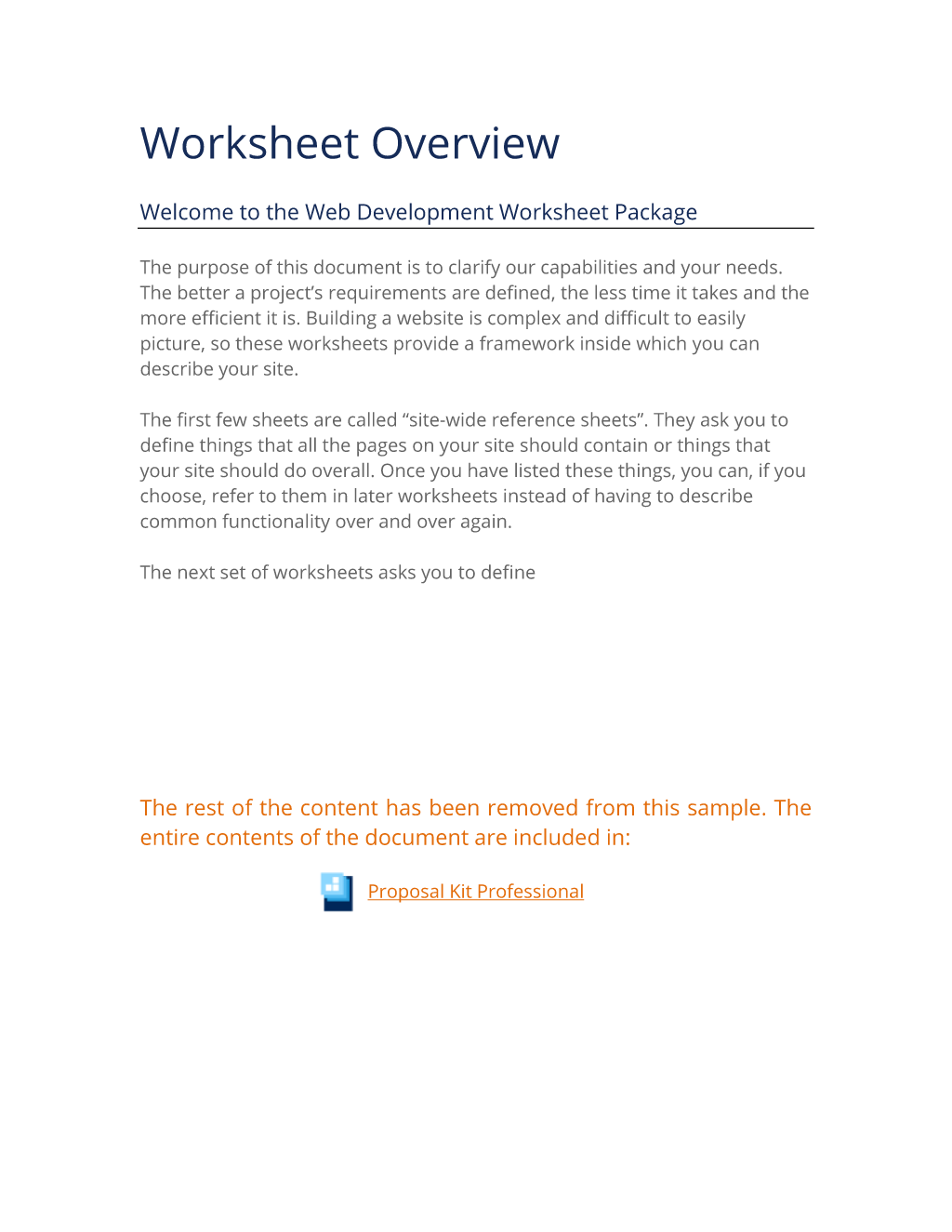
Welcome to the Web Development Worksheet Package. The purpose of this document is to clarify our capabilities and your needs. The better a project’s requirements are defined, the less time it takes and the more efficient it is.
Building a website is complex and difficult to easily picture, so these worksheets provide a framework inside which you can describe your site. The first few sheets are called "site-wide reference sheets". They ask you to define things that all the pages on your site should contain or things that your site should do overall.
Once you have listed these things, you can, if you choose, refer to them in later worksheets instead of having to describe common functionality over and over again. The next set of worksheets asks you to define templates, or the basic types of page your site will contain. You may refer to the site-wide reference sheets when constructing the templates if you wish.
The templates will provide a basic idea of what your site should look like. Once these sheets are complete, you can use further sheets in this set to define individual pages or relationships between them. This set of sheets is a tool and not an assignment. We have designed it because we feel it aids everybody involved with the process.
Use it however you feel is appropriate.
The editable Web Development Worksheet Overview document - complete with the actual formatting and layout is available in the retail Proposal Kit Professional.
20% Off Discount
 4.7 stars, based on 850 reviews
Alternate Documents
Related Documents
 Published by Proposal Kit, Inc.
We include a library of documents you can use based on your needs. All projects are different and have different needs and goals. Pick the documents from our collection, such as the Web Development Worksheet Overview, and use them as needed for your project.
 Facebook
 YouTube
 Bluesky
 Search Site
© 1997 - 2026, Proposal Kit, Inc. All rights reserved. Privacy Policy