

 Cart
Cart
Records Management Pre-Inventory Survey
 Get 20% off ordering today: Click here for the code
Proposal Kit Professional adds business proposals, all six Contract Packs,
Project Management Pack library, and Expert Edition software.
We include this editable document in the Proposal Kit Professional. Order and download it for $199. Follow these steps to get started.
 DOWNLOADABLE, ONE-TIME COST, NO SUBSCRIPTION FEES
Key Takeaways
- One-time License, No Subscriptions: Pay once and use Proposal Kit forever-no monthly fees or per-use charges.
- Built for Business Projects: Start with a proven Records Management Pre-Inventory Survey and tailor sections, fields, and branding for your day-to-day project work.
- Instant Access: Download immediately and open the document right away-no waiting, no onboarding delay.
- Project-Ready Structure: Use a ready, professional layout for real-world project tasks (checklists, forms, analysis pages) so teams can execute consistently.
- Fully Editable in Word: Edit everything in Microsoft Word-swap text, add/remove sections, and apply your logo/colors without special skills.
- Step-by-Step Wizard Help: The Proposal Pack Wizard guides you with training/help and keeps you moving-no getting stuck on formatting or assembly steps.
- Wizard Data Merge & Project Management: Let the Wizard manage projects and merge recurring data (company/client names, addresses, dates) across your project documents.
- Included in Proposal Kit Professional: Available exclusively in the Proposal Kit Professional bundle.
 What Our Clients Say
I have been continuously using this product since 2014 and I have honestly closed million dollar contracts utilizing the plethora of forms available."
Culbert Health
1. Get Proposal Kit Professional that includes this business document.
We include this Records Management Pre-Inventory Survey in an editable format that you can customize for your needs.
2. Download and install after ordering.
Once you have ordered and downloaded your Proposal Kit Professional, you will have all the content you need to get started with your project management.
3. Customize the project template with your information.
You can customize the project document as much as you need. You can also use the included Wizard software to automate name/address data merging.
Use cases for this document
IronPeak Fabrication rebuilds records governance before a surprise audit
The Challenge
When a supplier dispute triggered a surprise records audit, IronPeak Fabrication's COO, Lena Ortiz, discovered scattered physical records, uncontrolled electronic records, and no unified retention period or access control, leaving the inventory team unsure how to reconcile overages and shortages before inspectors arrived.
The Solution
They adopted the Records Pre-Inventory Survey to organize responsibilities, set a pre-inventory meeting cadence, and map storage locations, while using Proposal Kit to create supporting documents: a funding proposal with automated line-item quoting for scanning and indexing, a reconciliation process plan drafted with the AI Writer, and a vendor comparison brief produced with the RFP Analyzer to evaluate digitization providers.
The Implementation
An accountable property officer and a custodial officer led a preliminary inventory of property records and work orders, logging restricted areas, then assembled an inventory report and inventory control reports; Proposal Kit's document creation tools generated a training plan, an inventory schedule, and a quality assurance protocol addendum without touching the project management template content.
The Outcome
IronPeak achieved audit readiness in four weeks, completed certification of inventory, reduced unrecorded items by half through inventory reconciliation, and presented a legally defensible trail of survey records and records availability during inspection that satisfied auditors and cut storage costs by 18%.
Riverbend Utilities restores order after the Cedar Flood
The Challenge
After a major storm, CIO Marcus Kim of Riverbend Utilities faced displaced property, damaged substations, and inconsistent generator inventory lists with missing nameplate capacity, blocking public assistance requests and delaying initial damage assessment and joint PDA scheduling.
The Solution
The team used the Pre-Inventory Survey to structure data collection across field crews and depots, while Proposal Kit produced the supporting playbook: an emergency funding proposal with line-item quoting for field tablets and scanning, an after-action study drafted with the AI Writer, and a response package tuned by the RFP Analyzer to align with state and FEMA guidance.
The Implementation
Crews captured survey records in a monthly survey cycle and logged assets via Survey123 on the ArcGIS platform, while the back office generated inventory coverage reports, displaced property reports, and a property disposal authorization matrix using Proposal Kit's document creation to keep artifacts consistent and separate from the core project templates.
The Outcome
Riverbend secured individual assistance and public assistance approvals, reconciled loss or damage within two weeks, and produced inspection-ready inventory control reports and a clear inventory schedule that accelerated repairs and improved record accuracy for future events.
Cobalt Genomics scales for inspection without slowing research
The Challenge
As Cobalt Genomics prepared for a license conditions inspection, COO Priya Nayar found radiological records, instrument calibration logs, and authorization records split across labs and restricted areas, risking lapses in records organization and inspection readiness.
The Solution
They executed the Pre-Inventory Survey to align roles and retention requirements, while Proposal Kit supported the effort with auxiliary documents: a compliance roadmap and training syllabus written with the AI Writer, a partner-response brief refined by the RFP Analyzer, and a budget appendix using automated line-item quoting for secure storage and digitization.
The Implementation
A principal custodial officer coordinated a preliminary inventory, verified that quality control records were legible and complete in chronological order, and issued an inventory report; Proposal Kit's document creation assembled SOP addenda, a records notebook outline, and a risk register to track employee liability exposures, all kept distinct from the project management templates.
The Outcome
Cobalt passed inspection on the first visit, documented certification of inventory, improved records availability for inspection across physical and electronic records, and unlocked a new pharma partnership by demonstrating mature inventory control and legally defensible records.
Abstract
This pre-inventory survey provides a structured way for departments to prepare for an organization-wide records inventory. It frames the pre-inventory phase around clear inventory requirements, audit readiness, and compliance goals. The questions prompt each business unit to define functions, programs, policy roles, and a liaison, laying the groundwork for records governance across physical records and electronic records. By asking where documents are stored and who manages content, the survey supports access control, records availability for inspection, and protection against loss.
Department-focused prompts help form an inventory team, plan a pre-inventory meeting, and set an inventory schedule. Clarifying duties and standardized terms improves record organization, so materials are legible, complete, and maintained in chronological order. Organizational questions about the document management system and security practices reinforce inspection readiness and record accuracy, including handling restricted areas. For specialized environments, the survey can be extended to include authorization records, quality assurance protocol, quality control records, and records notebook practices for restricted area operations.
Regulatory questions guide departments to identify external agencies, audits, and records retention requirements. They encourage a classification or file plan, a retention period for each record series, and training records to document accountability. These steps support legally defensible records, record processing discipline, and record availability during inspection. The same framework can feed a records audit and inspection by producing an inventory report and related inventory control artifacts.
Organizations managing property records can adapt this survey to physical inventory planning and inventory reconciliation. It can reference an integrated logistics management system and roles such as accountable property officer, principal custodial officer, and custodial officer. Optional topics include inventory control reports, inventory coverage reports, unrecorded property reports, displaced property reports, and analysis of overages and shortages. Add a reconciliation process, certification of inventory, property disposal authorization, and procedures for loss or damage, lost or damaged property, employee liability, and escalation to a property survey board.
Emergency and utility programs can use the survey for data collection, survey templates, and monthly survey cycles, including preliminary inventory and inventory estimates. Use cases include initial damage assessment, joint pda for public assistance and individual assistance, generator inventory with nameplate capacity, and geospatial workflows using the ArcGIS platform and Survey123. Highly regulated operations can incorporate radiological records, instrument calibration, and license conditions.
Proposal Kit can streamline this effort with document assembly, an extensive template library, and an AI Writer that helps build supporting materials. Teams can also prepare cost proposals with automated line-item quoting to budget inventory work, making the process easier to plan and execute.
Beyond establishing questions, this instrument helps leaders shape an operating model for records governance. Executives can set access control standards, define roles for the accountable property officer and custodial officer, and approve a cadence for a preliminary inventory, monthly survey checkpoints, and a final certification of inventory. Treating survey records as formal evidence supports audit readiness and inspection readiness, because teams can show legible and complete responses, standardized terms, and chronological order when auditors request records availability for inspection.
The same discipline reduces risk from overages and shortages, unrecorded items, and loss or damage by linking inventory control to a reconciliation process and, when needed, a property survey board and property disposal authorization. Leaders also gain better resource planning: inventory estimates guide staffing for the inventory team, targeted training records, and focused inspections in restricted areas.
Proposal Kit can accelerate this effort by assembling consistent questionnaires, inventory report outlines, and inventory control reports from its template library, then using its AI Writer to write supporting procedures, quality assurance protocol summaries, and checklists tailored to business units. Teams can scope budgets with automated line-item quoting for scanning, data collection, and records processing tasks. Use cases include onboarding a new principal custodial officer, standing up an integrated logistics management system for property records, preparing a records audit ahead of a regulator visit, or documenting radiological records and instrument calibration against license conditions. The result is clearer policies, faster document readiness, and a legally defensible trail of survey records that improves compliance without adding unnecessary complexity.
To turn this survey into operational results, establish measurable targets that guide each unit from preliminary inventory to certification of inventory. Define key indicators such as record accuracy rates, percentage of records with an assigned retention period, time to reconcile overages and shortages, and records availability during inspection within agreed service levels. Use a sampling plan for quality control records and survey records to validate that files are legible and complete, in standardized terms, and organized in chronological order.
Map access control to roles and restricted areas, and document exceptions and remediation in an inventory coverage report and inventory control reports. Pair the inventory schedule with a short risk register that flags loss or damage exposure, unrecorded items, employee liability triggers, and authorization records requiring review.
Make governance tangible by aligning the classification plan with business processes. Link property records and physical inventory checkpoints to lifecycle milestones, from acquisition through property disposal authorization. Build a lightweight reconciliation process that feeds an inventory report and an unrecorded property report or displaced property report when needed, where radiological records or license conditions apply, schedule instrument calibration verification, and maintain a records notebook that demonstrates compliance between inspections.
Practical use cases include M&A consolidation of physical records and electronic records, facility move or closure, system migrations to an integrated logistics management system, and audit readiness sprints before regulator visits. Emergency programs can phase data collection in a monthly survey cadence, using inventory estimates to deploy the inventory team and focus inspection resources in restricted areas.
Proposal Kit can help teams stand up this framework quickly. Use its document assembly to generate consistent survey templates, policies, and reconciliation checklists; apply automated line-item quoting to budget scanning, indexing, and records processing; and leverage the AI Writer to write procedures, training outlines, and status updates that keep the effort coordinated across departments.
How do you write a Records Management Pre-Inventory Survey document?
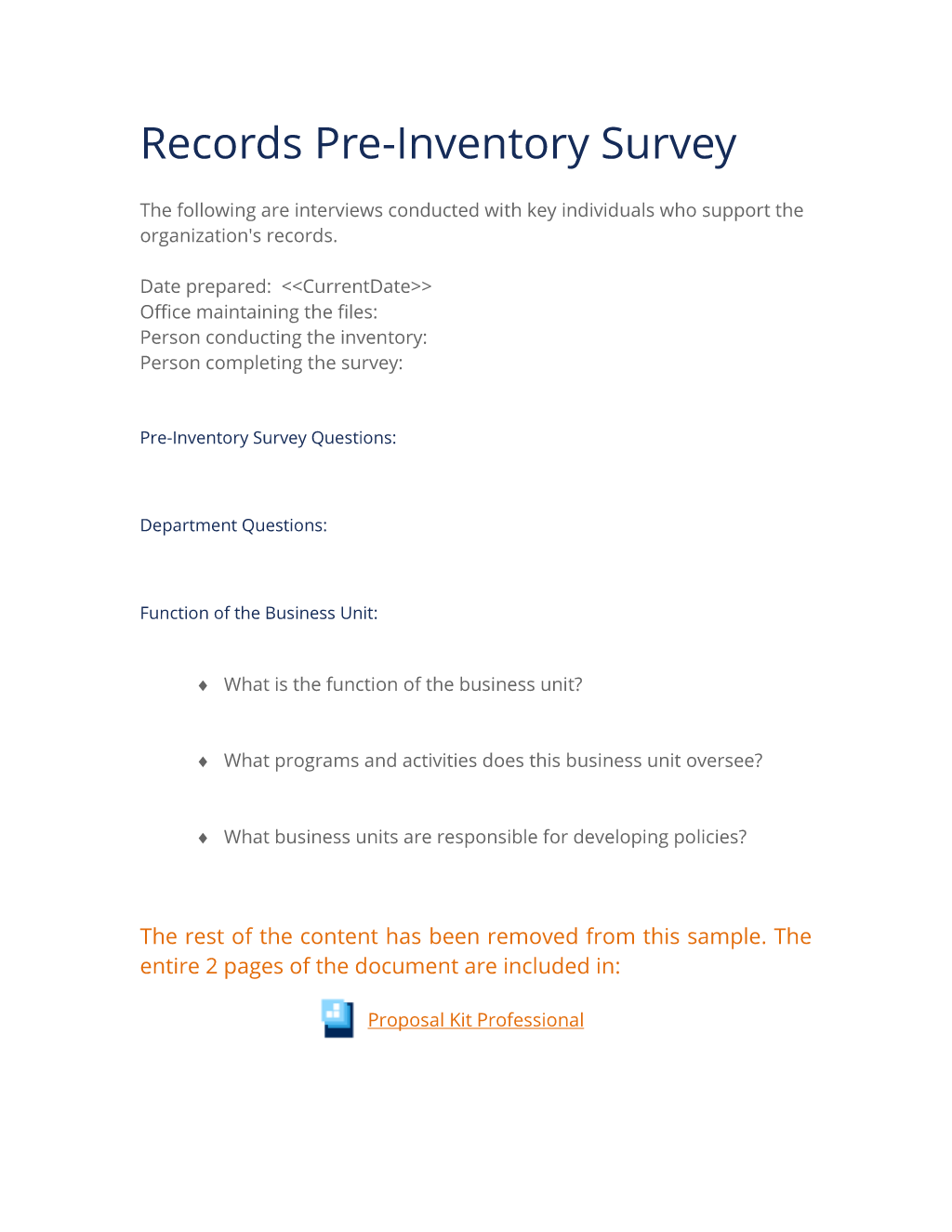
Records Pre-Inventory Survey
The following are interviews conducted with key individuals who support the organization's records.
Date prepared: Current Date
Office maintaining the files:
Person conducting the inventory:
Person completing the survey:
Pre-Inventory Survey Questions:
Department Questions:
Function of the Business Unit:
What is the function of the business unit? What programs and activities does this business unit oversee? What business units are responsible for developing policies?
Who will be the department liaison for the records inventory? What are the duties of staff activities?
Organizational Questions:
Where are most documents stored? What policies or individuals are tasked with managing content for this unit? Are policies and procedures current?
Is there a document management system used by the department? Are records secure from loss?
Regulatory Questions:
Are there external agencies that provide guidelines and feedback for regulations related to records? Are there any legislative requirements for creating or maintaining records? Are there guidelines for destroying records?
Is the department subject to audits? Does the department have existing records management policies? Is there a departmental records retention schedule?
Does the department have a classification or file plan? Does the department provide training to employees on record creation? What is the level of understanding for individual responsibilities regarding records management?
The editable Records Management Pre-Inventory Survey document - complete with the actual formatting and layout is available in the retail Proposal Kit Professional.
20% Off Discount
 4.7 stars, based on 850 reviews
Related Documents
- Records Inventory Worksheet Questionnaire for Business Units
- Records Survey and Inventory Analysis
- Business Case for Records Management
- Records Management Program Analysis Document
- Records Management Policies and Procedures
- Physical Content Management Box Label
- Records Access Security Plan
- Records Management File Plan Template
- Records Management Expanded File Plan Template
- Records Access Security Plan (Expanded)
- Communication Plan
- RACI Matrix Worksheet
- User Acceptance Testing (UAT) Schedule
- User Acceptance Testing (UAT) Enhancements and Bug Tracker
- Risk Mitigation Plan
 Published by Proposal Kit, Inc.
We include a library of documents you can use based on your needs. All projects are different and have different needs and goals. Pick the documents from our collection, such as the Records Management Pre-Inventory Survey, and use them as needed for your project.
 Facebook
 YouTube
 Bluesky
 Search Site
© 1997 - 2026, Proposal Kit, Inc. All rights reserved. Privacy Policy