

 Cart
Cart
Records Access Security Plan
 Get 20% off ordering today: Click here for the code
Proposal Kit Professional adds business proposals, all six Contract Packs,
Project Management Pack library, and Expert Edition software.
We include this editable document in the Proposal Kit Professional. Order and download it for $199. Follow these steps to get started.
 DOWNLOADABLE, ONE-TIME COST, NO SUBSCRIPTION FEES
Key Takeaways
- One-time License, No Subscriptions: Pay once and use Proposal Kit forever-no monthly fees or per-use charges.
- Built for Business Projects: Start with a proven Records Access Security Plan and tailor sections, fields, and branding for your day-to-day project work.
- Instant Access: Download immediately and open the document right away-no waiting, no onboarding delay.
- Project-Ready Structure: Use a ready, professional layout for real-world project tasks (checklists, forms, analysis pages) so teams can execute consistently.
- Fully Editable in Word: Edit everything in Microsoft Word-swap text, add/remove sections, and apply your logo/colors without special skills.
- Step-by-Step Wizard Help: The Proposal Pack Wizard guides you with training/help and keeps you moving-no getting stuck on formatting or assembly steps.
- Wizard Data Merge & Project Management: Let the Wizard manage projects and merge recurring data (company/client names, addresses, dates) across your project documents.
- Included in Proposal Kit Professional: Available exclusively in the Proposal Kit Professional bundle.
 What Our Clients Say
Integration to QuoteWerks, the pre-formatted office documents are fantastic and makes an impressive looking proposal and variety of styles and templates is awesome! I like that the templates are editable using standard Microsoft Office products. Not only has Proposal Kit helped me to automate some of my quoting processes but the finished proposals make me stand out from my competitors and have won me a number of bids. Often have received comments from clients on how thorough my analysis of their systems are compared to other companies they have engaged."
Polarverse
1. Get Proposal Kit Professional that includes this business document.
We include this Records Access Security Plan in an editable format that you can customize for your needs.
2. Download and install after ordering.
Once you have ordered and downloaded your Proposal Kit Professional, you will have all the content you need to get started with your project management.
3. Customize the project template with your information.
You can customize the project document as much as you need. You can also use the included Wizard software to automate name/address data merging.
Use cases for this document
Harbor Ridge Clinics secures patient records across sprawling systems
The Challenge
Harbor Ridge Clinics, led by CISO Nina Park, struggled to align dozens of information systems with consistent record-level privileges, causing delays and audit findings when clinicians and contractors needed precise access verbs- create, read, write, delete, assign, share, and append without overexposure of sensitive data.
The Solution
They used the project management security plan to map roles and tables, then supported it with Proposal Kit's document creation to publish onboarding guides, its AI Writer to draft an incident response playbook focused on detecting preventing and responding, its RFP Analyzer to compare bids for security hardware and software, and its line-item quoting to budget cameras, door controllers, and encryption add-ons.
The Implementation
IT cataloged content types and users, HR added a contractor employee reference step to provisioning, and security tuned permission settings while Proposal Kit produced a procurement brief, a training syllabus on security and privacy, and a quarterly audit report that tied privileges to business workflows across clinics.
The Outcome
Clinicians received right-sized access within hours, audit exceptions dropped, vendor selection accelerated with defensible comparisons, and leadership saw measurable risk reduction without slowing care.
Northgate Port Authority modernizes facility access and incident readiness
The Challenge
After a near-miss involving unauthorized entry, Northgate Port Authority faced fragmented badge logs, inconsistent passwords, and gaps in emergency communication across its information systems and physical gates.
The Solution
The team formalized the project management access model and used Proposal Kit's document creation to issue a port-wide access control handbook, its AI Writer to generate a business continuity supplement, its RFP Analyzer to extract mandatory clauses from camera and sensor vendor RFQs, and its line-item quoting to price upgrades to security hardware and software.
The Implementation
Operations defined team privileges and task-based approvals for create, read, write, delete, assign, share, append on access records, HR enforced background checks with contractor employee reference verification, and security ran tabletop drills for detecting, preventing, and responding, while Proposal Kit produced after-action reports and vendor comparison matrices.
The Outcome
Unauthorized access attempts were contained, response times improved, procurement cycles shortened, and the board received clear evidence that security and privacy controls now matched operational needs.
Redstone University research lab protects data without slowing innovation
The Challenge
Redstone's robotics lab expanded rapidly, adding graduate students and third-party engineers, but lacked a coherent model for segregating prototypes and grant data while allowing collaborators timely privileges.
The Solution
The lab anchored its project management security plan in an access control matrix and used Proposal Kit's document creation to publish a contributor charter, its AI Writer to draft a data classification brief and privacy statement, its RFP Analyzer to evaluate cloud providers' terms, and its line-item quoting to estimate secure storage and monitoring tools.
The Implementation
Admins set organization-owned tables with record-level rules for create, read, write, delete, assign, share, and append. PI-led reviews recertified users quarterly, and onboarding required a confidentiality form plus contractor employee reference checks, while Proposal Kit produced progress reports and a funding addendum aligning security and privacy with sponsor expectations.
The Outcome
Collaboration accelerated with fewer access bottlenecks, sponsors praised the lab's rigor, and incidents dropped as teams practiced detecting, preventing, and responding with playbooks tailored to research information systems.
Abstract
This access security plan template helps organizations structure how they protect people, facilities, and records across information technology systems. It guides teams to define security categories, document needs and risks, and set requests or recommendations for security protocols. It also prompts you to address public records that include security-related information, such as alarm and security systems, architectural and engineering designs, emergency response plans, security cameras and security camera footage, facilities and parking access records, and travel plans for high-profile individuals.
Many jurisdictions restrict disclosure of such items (for example, exemptions like Iowa Code 22 7(50)), so planning should involve a transparency officer and the office of legal counsel.
The template supports varied use cases. A city agency can safeguard law enforcement equipment, threat assessment teams' materials, and LEEP brochure awareness material while managing audit logging and record retention policy GA-11. A university can protect student records, sensitive research projects, hazardous materials, and cash equivalents, supported by a privacy statement and data classification.
A financial firm can align covered data records with the Gramm-Leach-Bliley Act GLBA Safeguards Rule. Agencies handling FBI CJIS data can map controls to the CJIS security policy, prepare for a CJIS technical audit, and develop an agency corrective action plan.
Access control is central. Define content types, groups, and security levels with clear users and permissions. Use an access control matrix and system access chart to specify table privileges, team privileges, and record-level privileges.
Spell out task-based privileges and privacy-related privileges, including create, read, write, delete, assign, share, and append. If you use platforms like the Power Platform admin center and Dataverse tables, leverage predefined security roles (such as a basic user role), organization-owned tables, permission settings, and the members page to add users, remove users, and copy table permissions.
The plan also calls for responsible parties, such as a plan officer, chief technology officer CTO, or certified information security analyst CISA), to lead risk assessments, an annual review, and a penetration test. Reference an information security plan, NIST access control policy, NIST incident response policy, NIST risk assessment policy, NIST configuration management policy, and NIST media protection policy. Include passwords, encryption using Advanced Encryption Standard AES, incident response, disaster recovery, configuration management, auditing and accountability, system and communications protection, and system and services acquisition. Address acceptable use policy GA-31, background checks, confidentiality statement, training and awareness (such as a cybersecurity course), network diagrams, media protection, and contracts and procurement with third-party service providers using a security addendum or a state supplement, such as a Texas security policy supplement.
The Proposal Kit can streamline the production of this plan and related materials. Its document assembly, automated line-item quoting, AI Writer for supporting documents, and extensive template library help teams quickly build an access control policy, system access procedures, and vendor requirements, accelerating adoption while keeping the process easy to use.
Beyond the core categories, the plan helps leaders align security and privacy with day-to-day operations in information systems. It clarifies how frontline staff, records managers, and IT coordinate when deploying security hardware and software, and how those controls map to real permissions across content types. Defining the exact verbs of access clarifies accountability: create, read, write, delete, assign, share, and append.
This specificity reduces confusion during audits and improves handoffs when projects transition between teams or vendors. It also supports workforce management by documenting role expectations, background checks, and contractor employee reference verification, ensuring third parties understand policies before receiving system access.
The template encourages a lifecycle approach to risk-detecting, preventing, and responding, so teams move from reactive fixes to measurable control maturity. That includes documenting how physical safeguards, encryption standards, and monitoring tools work together, and how incident escalation ties to business continuity goals. Executives gain clearer visibility into resource needs, while line managers can pace change with training and awareness plans.
Proposal Kit can further accelerate this effort by assembling consistent project management documents from a library of templates, linking access control narratives to related procedures and vendor requirements, and using its AI Writer to write supporting sections that capture roles, privileges, and change management steps. The result is faster production of clear, usable plans that fit your environment and are easier for stakeholders to adopt.
A practical addition to the plan is a governance layer that ties daily operations to measurable outcomes. Establish a cadence for reviews where the plan officer, CTO, and CISA evaluate metrics such as time-to-provision, time-to-revoke, and audit exceptions. Use a system access chart and an access control matrix to drive joiner-mover-leaver processes, ensuring users and permissions remain current when teams change.
Recertify privileges quarterly, focusing on record-level privileges and task-based privileges that grant create, read, write, delete, assign, share, and append across content types. For platforms that use Dataverse tables, document how predefined security roles, the basic user role, permission settings, and organization-owned tables are managed in the Power Platform admin center, including how administrators add users, remove users, and copy table permissions from the members page without over-privileging accounts.
Operational readiness benefits from scripted exercises. Run tabletop sessions for detecting, preventing, and responding to incidents that span information systems and facilities, validating that audit logging, password policies, encryption, and system and communications protection work as designed. Link findings to configuration management updates, disaster recovery improvements, and training and awareness refreshers. Integrate procurement checkpoints so third-party service providers and contractors complete background checks, a confidentiality statement, and contractor employee reference verification before system access is granted, supported by a clear security addendum in contracts and procurement.
Proposal Kit can help teams assemble these topics quickly. Use its document assembly to generate consistent procedures, matrices, and appendices; automated line-item quoting to estimate security hardware and software; the AI Writer to write role definitions and review agendas; and its template library to align related policies for security and privacy across the information lifecycle.
How to write my Records Access Security Plan document
Access Security Plan
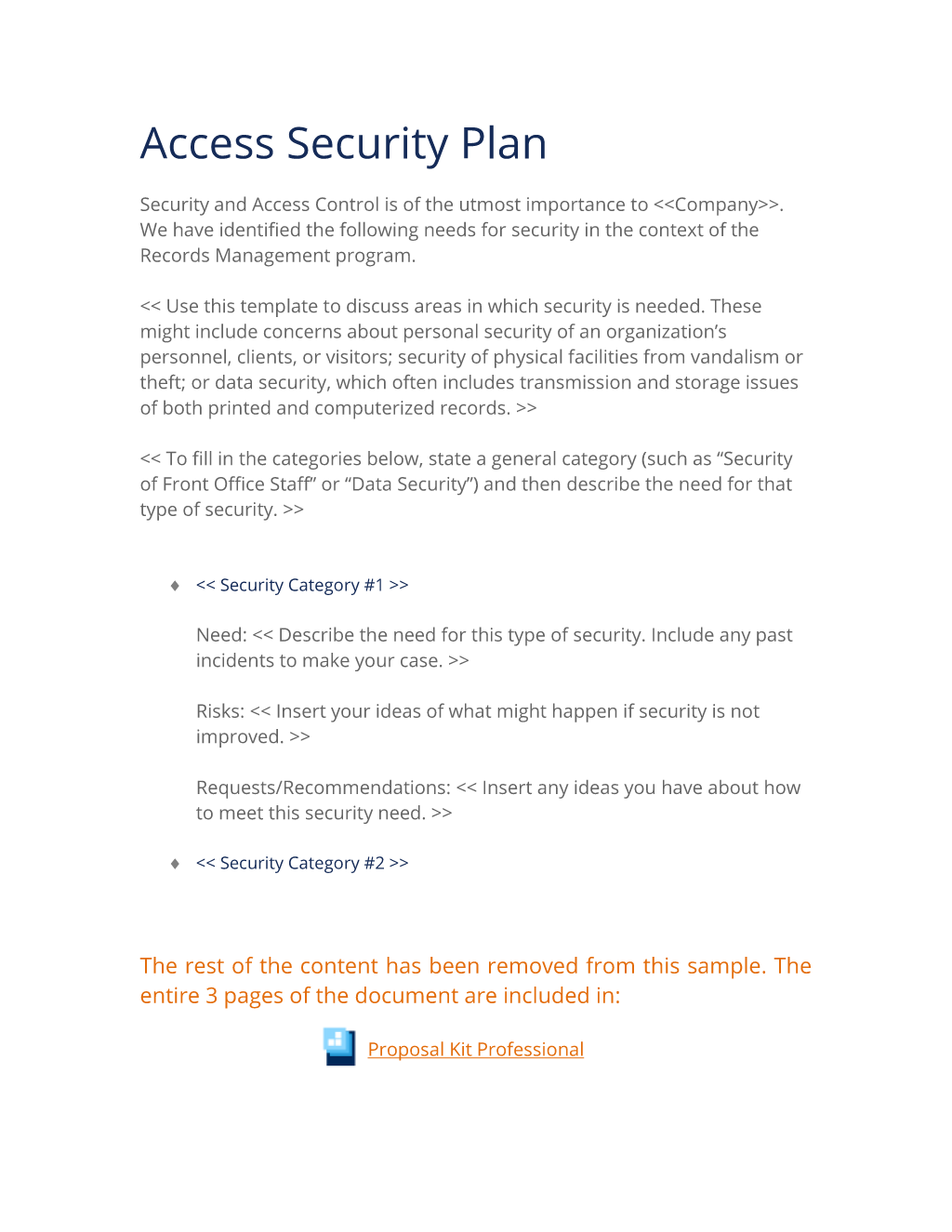
Security and Access Control is of the utmost importance to Company Name. We have identified the following needs for security in the context of the Records Management program. Use this template to discuss areas in which security is needed.
These might include concerns about personal security of an organization's personnel, clients, or visitors; security of physical facilities from vandalism or theft; or data security, which often includes transmission and storage issues of both printed and computerized records. To fill in the categories below, state a general category (such as " Security of Front Office Staff" or " Data Security" ) and then describe the need for that type of security.
Security Category #1
Need: Describe the need for this type of security. Include any past incidents to make your case. Risks: Insert your ideas of what might happen if security is not improved.
Requests/Recommendations: Insert any ideas you have about how to meet this security need.
Security Category #2
Need: Describe the need for this type of security. Include any past incidents to make your case. Risks: Insert your ideas of what might happen if security is not improved.
Requests/Recommendations: Insert any ideas you have about how to meet this security need.
Security Category #3
Need: Describe the need for this type of security. Include any past incidents to make your case. Risks: Insert your ideas of what might happen if security is not improved. Requests/Recommendations: Insert any ideas you have about how to meet this security need.
The Records Management program will require varied levels of access controls to allow different users and groups access to different portions of the content or to allow different privileges of access, such as contributions, edits, annotations, and deletions. Types of access include: View Only, Contributor, Super User, Administrator, and so on. Content Type: List applications or records categories. Groups: List groups or communities that have access to the content.
Description: Describe the access level and security role, and activities that can be performed. Security Level: Define the level of access. Content Type: List applications or records categories. Groups: List groups or communities that have access to the content.
Description: Describe the access level and security role, and activities that can be performed. Security Level: Define the level of access. Content Type: List applications or records categories.
Groups: List groups or communities that have access to the content. Description: Describe the access level and security role, and activities that can be performed. Security Level: Define the level of access.
The Records Management program will require the following security measures to be implemented and maintained. Responsible Party: Who is responsible? Description of security issue, areas impacted, vulnerability assessment. Specify how compliance is met and maintained in an action plan and how security measures will be adopted.
Responsible Party: Who is responsible? Description of security issue, areas impacted, vulnerability assessment. Specify how compliance is met and maintained in an action plan and how security measures will be adopted. Responsible Party: Who is responsible?
Description of security issue, areas impacted, vulnerability assessment. Specify how compliance is met and maintained in an action plan and how security measures will be adopted.
The editable Records Access Security Plan document - complete with the actual formatting and layout is available in the retail Proposal Kit Professional.
20% Off Discount
 4.7 stars, based on 850 reviews
Alternate Documents
Related Documents
- Records Inventory Worksheet Questionnaire for Business Units
- Records Management Pre-Inventory Survey
- Records Survey and Inventory Analysis
- Business Case for Records Management
- Records Management Program Analysis Document
- Records Management Policies and Procedures
- Physical Content Management Box Label
- Records Management File Plan Template
- Records Management Expanded File Plan Template
- Application for Records Retention Form
- Authorization for Records Destruction Form
- Formal Record Hold Investigation Form
- Formal Record Hold Notice Form
- Release of Legal Hold Notice Form
- Record Retention Schedule Change Form
- Legal Hold and Discovery Log
- Records Disposition Log
- Records Access Security Plan (Expanded)
- Communication Plan
- RACI Matrix Worksheet
- User Acceptance Testing (UAT) Schedule
- User Acceptance Testing (UAT) Enhancements and Bug Tracker
- Risk Mitigation Plan
 Published by Proposal Kit, Inc.
We include a library of documents you can use based on your needs. All projects are different and have different needs and goals. Pick the documents from our collection, such as the Records Access Security Plan, and use them as needed for your project.
 Facebook
 YouTube
 Bluesky
 Search Site
© 1997 - 2026, Proposal Kit, Inc. All rights reserved. Privacy Policy