

 Cart
Cart
Records Survey and Inventory Analysis
 Get 20% off ordering today: Click here for the code
Proposal Kit Professional adds business proposals, all six Contract Packs,
Project Management Pack library, and Expert Edition software.
We include this editable document in the Proposal Kit Professional. Order and download it for $199. Follow these steps to get started.
 DOWNLOADABLE, ONE-TIME COST, NO SUBSCRIPTION FEES
Key Takeaways
- One-time License, No Subscriptions: Pay once and use Proposal Kit forever-no monthly fees or per-use charges.
- Built for Business Projects: Start with a proven Records Survey and Inventory Analysis and tailor sections, fields, and branding for your day-to-day project work.
- Instant Access: Download immediately and open the document right away-no waiting, no onboarding delay.
- Project-Ready Structure: Use a ready, professional layout for real-world project tasks (checklists, forms, analysis pages) so teams can execute consistently.
- Fully Editable in Word: Edit everything in Microsoft Word-swap text, add/remove sections, and apply your logo/colors without special skills.
- Step-by-Step Wizard Help: The Proposal Pack Wizard guides you with training/help and keeps you moving-no getting stuck on formatting or assembly steps.
- Wizard Data Merge & Project Management: Let the Wizard manage projects and merge recurring data (company/client names, addresses, dates) across your project documents.
- Included in Proposal Kit Professional: Available exclusively in the Proposal Kit Professional bundle.
 What Our Clients Say
I purchased Proposal Kit Professional 3-4 years ago when establishing my own marketing consultancy. The software was highly user-friendly and allowed me to quickly create and provide professional documents to potential clients. Recently, I decided to re-establish my business, and I looked for other proposal software but none could compare to the Proposal Kit Professional’s offering. I could not imagine an easier and faster way to do business, and simply had to upgrade to a new version!"
1. Get Proposal Kit Professional that includes this business document.
We include this Records Survey and Inventory Analysis in an editable format that you can customize for your needs.
2. Download and install after ordering.
Once you have ordered and downloaded your Proposal Kit Professional, you will have all the content you need to get started with your project management.
3. Customize the project template with your information.
You can customize the project document as much as you need. You can also use the included Wizard software to automate name/address data merging.
Use cases for this document
Greening Pinebrook: An Urban Forest Inventory Comes Together
The Challenge
GreenSpan Urban Forestry LLC was hired by the City of Pinebrook to run an urban forest inventory, but field data lived in scattered spreadsheets, photographs were unlabeled, and departments disagreed on scope, timelines, and how sampling design and estimation procedures should be documented for carbon monitoring and land use decisions.
The Solution
GreenSpan used the Records Survey and Inventory Analysis document to define goals, scope, business unit surveys, and location mapping, then used Proposal Kit separately to create supporting deliverables: a council-ready proposal with line-item quoting for field activities, a technical study explaining methodology and metadata standards, and an executive business report; the AI Writer drafted background information and a glossary and user guide, while the RFP Analyzer matched a grant's requirements to the team's plan.
The Implementation
Field workers collected tree attributes across permanent plots, organized images and annotated maps, and the team produced a volume summary, storage forecasts, governance and security controls, and a QA protocol; in parallel, Proposal Kit assembled a strategic plan, public web brief, and a data tools appendix to explain data download and web applications access without altering the core project management document.
The Outcome
Pinebrook delivered a defensible urban inventory program aligned with nationwide forest inventory practices, reported carbon stocks and fluxes for contributions to national reporting, and secured grant funding, while stakeholders praised the clear proposals, studies, and guides produced with the Proposal Kit.
Mapping Magnolia County's Past: A Preservation Drive Gains Momentum
The Challenge
HeritageMosaic Consulting partnered with Magnolia County Historical Society to survey its built environment for a heritage register nomination, but volunteers lacked survey tips, data standards, and forms to capture architectural description, building material, and distinctive features needed for intensive and reconnaissance documentation under federal and state statutes.
The Solution
The team anchored its work in the Records Survey and Inventory Analysis plan to set scope, identify vital records, and define security and access, then used Proposal Kit to create supplemental documents: a preservation planning proposal with line-item quoting, a field handbook with an architectural style guide and architectural description form, and a background report modeled after Virginia historical inventory practices; the AI Writer drafted architect biographies and a context paper tying sites to local genealogy.
The Implementation
Field workers photographed wooden frame buildings and stone houses, compiled annotated maps, and organized survey reports and interviews, while Proposal Kit's RFP Analyzer aligned a state grant's standards for cultural resource reporting with the team's outputs, and the document assembly produced a report home page and database user guide for the Society's public database.
The Outcome
Magnolia County submitted complete National Register of Historic Places nominations with consistent inventory packets, improved quality assurance, and faster reviews, supported by polished supporting reports and training materials produced outside the project management template using Proposal Kit.
Meridian Biopharma Puts Its House in Order: Records Modernization Underway
The Challenge
Meridian Biopharma Inc. faced audit risk as departments stored records in siloed drives with unclear retention, weak metadata, and no unified view of volume, storage forecasts, or access controls for sensitive files.
The Solution
Guided by the Records Survey and Inventory Analysis framework, Meridian defined the enterprise scope, executed business unit surveys, and mapped locations of physical and digital records, then leveraged Proposal Kit to produce complementary documents: a board-facing strategic plan and business report, a training guide on identification and auditing, and a vendor evaluation proposal with line-item quoting; the AI Writer generated a study summarizing governance options, and the RFP Analyzer organized requirements for a content platform RFP response.
The Implementation
The records team executed interviews and questionnaires, verified results, and documented governance, security, and access requirements, document sets, and vital records; parallel work with Proposal Kit assembled the executive narrative, a change-management plan, and a glossary standard terminology to keep database users aligned, created to support, not replace, the core project management document.
The Outcome
Meridian reduced audit findings, improved standardization across databases and web applications, and secured budget approval, aided by persuasive proposals, plans, and reports built with Proposal Kit that clarified scope, costs, and milestones for leadership.
Abstract
This records survey and inventory framework guides organizations in building an Information Management Policy and governing the records life cycle. It asks teams to define goals such as consolidating stores, migrating content, preparing for media conversion, and resolving records management problems. The scope clarifies whether the effort covers a department or enterprise and whether it includes all materials or only records managed for disposition.
A business unit survey outlines data to collect, resources to use, and whether field activities will rely on interviews, questionnaires, or both. Location work identifies where files reside physically and organizationally. Results feed analysis for volume summaries, storage forecasts, governance, security and access, document sets, content types, metadata, vital records, auditing, and program objectives.
The approach supports standardization, quality assurance, documentation, and training. Teams use data management systems, databases, and web applications to store survey reports, inventory forms, annotated maps, photographs, sketches, and reports. A glossary and user guide reinforce standard terminology.
Data analysis tools, sampling design, sampling and estimation, and small area estimation improve accuracy. When applicable, remote sensing and a structured workflow across information management, analysis, techniques research, and data acquisition bands help integrate diverse sources. Search tips such as boolean operators, wildcards, subject headings, record number, images filter, photographer name, and even legacy references like microfilm reel improve retrieval. Data consultations and requests, user notifications and bulletins, and quality assurance and protocols sustain operations.
Use cases span natural resources and cultural resources. An urban forest inventory aligned with forest inventory and analysis methods, permanent plots, and national resource use monitoring can inform land use and land cover, biomass and carbon accounting, carbon monitoring, and land management decisions, contributing to national reporting under the Resources Planning Act, the national report on sustainable forests, global forest resources assessment, greenhouse gas inventories, and the North American Forest Database, with data download via public databases and tools like a land resources explorer. For historic preservation and cultural resource management, a historic building survey or archaeology site inventory (including WISAARD-style workflows) can follow survey classifications for intensive survey and reconnaissance survey, meet identification standards and NPS best practices, and support the National Register of Historic Places and national heritage registers.
Records may include architectural description forms, architectural history and style, architect & builder biographies, property types from wooden buildings and stone houses to log buildings and slave quarters, cemeteries with cemetery preservation guidance, plats and deeds, court records, oral histories, interviews with residents, folklore, genealogical tables, and topics such as Civil War, African American history, Native American sites, plantations, and Virginia Writers Project and Works Progress Administration materials. Such programs benefit from national program coordination, research stations, user group meetings, and science symposiums.
Proposal Kit can streamline delivery by assembling business and organizational documents, producing a clear business report and plan, automating line-item quoting, and using the AI Writer to build supporting sections. Its extensive template library and ease of use help teams deliver consistent, standards-based inventories across sectors.
Expanding on the framework, organizations gain a structured pipeline that moves work from a data acquisition band to an information management band, then through an analysis band and a techniques research band. This supports field workers gathering background information and history, while managers coordinate deliverables and quality controls. Clear roles help consultants and planners, tribal governments, and database users align workflows with preservation research and environmental assessments.
In natural resource programs, the same survey discipline aligns with the national woodland owner survey, a nationwide forest inventory, and urban forests. Estimation procedures and sound sampling improve measures of carbon stocks and fluxes and inform land use management and growth management planning. Standardized outputs speed contributions to national reporting and help prioritize actions such as applying a master invasive species list or scoping an urban inventory program. Data tools and web applications enable secure sharing of survey reports and dashboards across teams.
For cultural resources, the approach mirrors practices seen in the Virginia Historical Inventory, integrating genealogy, oral histories, and built environment attributes. Teams follow an architectural style guide, compile architect biographies, and apply standards for cultural resource reporting. Inventory packets include an architectural description form, survey tips, and checklists for building material and distinctive features in wooden frame buildings, stone or log structures, and related historic archaeological sites.
Intensive and reconnaissance documentation supports a heritage register submission and compliance with federal and state statutes. Projects may also capture tombstone information, maps, and context for site nominations, aiding preservation planning and related preservation topics.
To keep outputs usable, define search terms, organize a report home page, and distribute a database user guide and a glossary of standard terminology. Ongoing user group meeting sessions and an occasional science symposium help refine methods and tools.
Proposal Kit can accelerate this work by assembling business reports and plans, producing consistent inventory and assessment sections, automating line-item quoting for scoped tasks, and using the AI Writer to write background narratives and forms. Its template library and ease of use support repeatable proposals for forestry, cultural resources, and compliance-focused inventories.
Further strengthening the survey and inventory approach, leaders should set governance and change-control routines that connect retention schedules, disposition, and audit readiness to day-to-day field activities. Define roles for data stewards and custodians, and align security classifications with access policies in databases and web applications. Establish KPIs for volume trends, storage forecasting, and quality assurance and protocols, then publish a report home page with a glossary, standard terminology, a database user guide, and user notifications and bulletins so every database user works from the same playbook. Search optimization matters: curate subject headings, search terms, and record number conventions, and enable image filtering by photographer name to speed retrieval of photographs, annotated maps, and survey reports.
Natural resource teams can synchronize local projects with a nationwide forest inventory and the national woodland owner survey while coordinating research stations. Combining remote sensing with field workers and permanent plots inside a data acquisition band, information management band, analysis band, and techniques research band improves estimation procedures for biomass and carbon, carbon stocks and fluxes, and land use and land cover. Results flow to public databases for data download, web application access, and contributions to national reporting.
Cultural resource teams can tie preservation planning to architectural history using survey classifications and inventory forms. Apply an architectural style guide, architect biographies, and an architectural description form to document building material and distinctive features across wooden frame buildings, log buildings, stone houses, cemeteries, and historic archaeological sites. Intensive and reconnaissance methods help meet standards for cultural resource reporting and support heritage register submissions under federal and state statutes, aided by survey tips and clear cross-references to preservation topics.
Proposal Kit helps teams assemble business reports and plans for these efforts, generate consistent inventory packets and background information and history, and produce line-item quotes for consultants and planners or tribal governments. Its AI Writer and template library streamline supporting documents for urban forests, land use management, growth management planning, and preservation research without complicating workflows.
Writing the Records Survey and Inventory Analysis document
Records Survey and Inventory Analysis
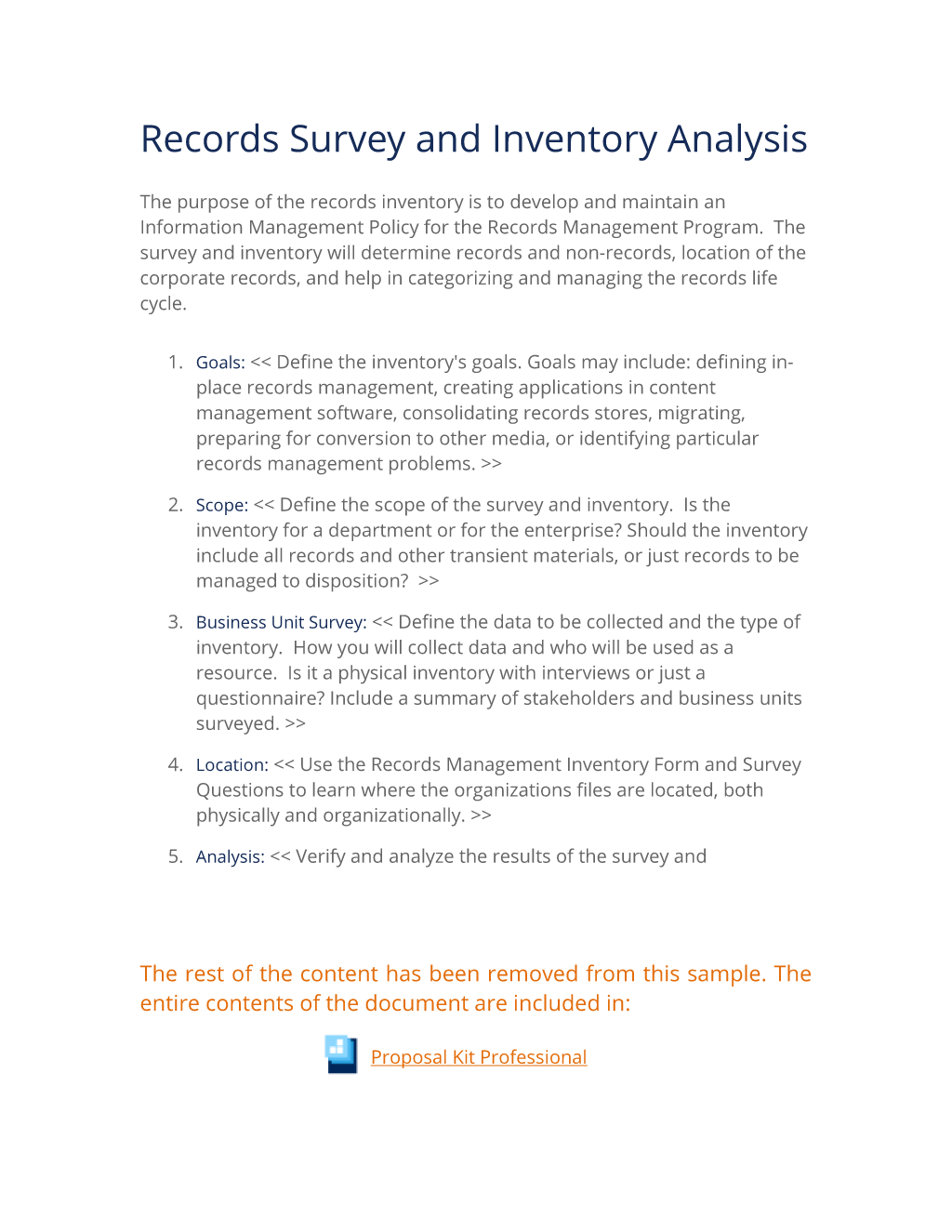
The purpose of the records inventory is to develop and maintain an Information Management Policy for the Records Management Program. The survey and inventory will determine records and non-records, location of the corporate records, and help in categorizing and managing the records life cycle. Goals: Define the inventory's goals. Goals may include: defining in-place records management, creating applications in content management software, consolidating records stores, migrating, preparing for conversion to other media, or identifying particular records management problems.
Scope: Define the scope of the survey and inventory. Is the inventory for a department or for the enterprise? Should the inventory include all records and other transient materials, or just records to be managed to disposition? Business Unit Survey: Define the data to be collected and the type of inventory. How you will collect data and who will be used as a resource.
Is it a physical inventory with interviews or just a questionnaire? Include a summary of stakeholders and business units surveyed. Location: Use the Records Management Inventory Form and Survey Questions to learn where the organizations files are located, both physically and organizationally. Analysis: Verify and analyze the results of the survey and inventory.
- Volume summary
- Forecast storage estimates
- Assessment of records management governance
- Security and access requirements
- Document sets, content types, and metadata
- Identify vital records and management
- Auditing
- Objectives for the records management program
The editable Records Survey and Inventory Analysis document - complete with the actual formatting and layout is available in the retail Proposal Kit Professional.
20% Off Discount
 4.7 stars, based on 850 reviews
Related Documents
- Records Inventory Worksheet Questionnaire for Business Units
- Records Management Pre-Inventory Survey
- Business Case for Records Management
- Records Management Program Analysis Document
- Records Management Policies and Procedures
- Physical Content Management Box Label
- Records Access Security Plan
- Records Management Metadata Model
- Records Management File Plan Template
- Records Management Expanded File Plan Template
- Sample Records Survey and Inventory Analysis
- Records Access Security Plan (Expanded)
- Communication Plan
- RACI Matrix Worksheet
- User Acceptance Testing (UAT) Schedule
- User Acceptance Testing (UAT) Enhancements and Bug Tracker
- Risk Mitigation Plan
 Published by Proposal Kit, Inc.
We include a library of documents you can use based on your needs. All projects are different and have different needs and goals. Pick the documents from our collection, such as the Records Survey and Inventory Analysis, and use them as needed for your project.
 Facebook
 YouTube
 Bluesky
 Search Site
© 1997 - 2026, Proposal Kit, Inc. All rights reserved. Privacy Policy