

 Cart
Cart
Records Management File Plan Template
 Get 20% off ordering today: Click here for the code
Proposal Kit Professional adds business proposals, all six Contract Packs,
Project Management Pack library, and Expert Edition software.
We include this editable document in the Proposal Kit Professional. Order and download it for $199. Follow these steps to get started.
 DOWNLOADABLE, ONE-TIME COST, NO SUBSCRIPTION FEES
Key Takeaways
- One-time License, No Subscriptions: Pay once and use Proposal Kit forever-no monthly fees or per-use charges.
- Built for Business Projects: Start with a proven Records Management File Plan Template and tailor sections, fields, and branding for your day-to-day project work.
- Instant Access: Download immediately and open the document right away-no waiting, no onboarding delay.
- Project-Ready Structure: Use a ready, professional layout for real-world project tasks (checklists, forms, analysis pages) so teams can execute consistently.
- Fully Editable in Word: Edit everything in Microsoft Word-swap text, add/remove sections, and apply your logo/colors without special skills.
- Step-by-Step Wizard Help: The Proposal Pack Wizard guides you with training/help and keeps you moving-no getting stuck on formatting or assembly steps.
- Wizard Data Merge & Project Management: Let the Wizard manage projects and merge recurring data (company/client names, addresses, dates) across your project documents.
- Included in Proposal Kit Professional: Available exclusively in the Proposal Kit Professional bundle.
 What Our Clients Say
The large variety of templates are very easy to utilize and are formatted to streamline multiple projects which greatly helps with our deadlines for clients in the procurement industry as well as with educating and training our client teams. This has been an irreplaceable resource and we have found none like it! We have reduced our internal training time as well as response times for RFP’s and accompanying documentation with the utilization of Proposal Kit."
Brightwell Dynamics Forward Progression
1. Get Proposal Kit Professional that includes this business document.
We include this Records Management File Plan Template in an editable format that you can customize for your needs.
2. Download and install after ordering.
Once you have ordered and downloaded your Proposal Kit Professional, you will have all the content you need to get started with your project management.
3. Customize the project template with your information.
You can customize the project document as much as you need. You can also use the included Wizard software to automate name/address data merging.
Use cases for this document
Healthcare network unifies retention across clinics
The Challenge
Blue Ridge Health's CIO, Maya Chen, inherited mismatched retention rules and duplicate archives across eight clinics, leaving audits stalled, eDiscovery slow, and staff unsure when to start cutoffs or archive records.
The Solution
The compliance team built a standardized file plan and retention schedule, then used Proposal Kit to create executive proposals, a training program, and a budget brief; the AI Writer produced policy FAQs and a rollout plan, the RFP Analyzer compared migration vendors, and line-item quoting framed phased costs for scanning, metadata cleanup, and training.
The Implementation
They piloted the plan in HR and Finance, documented label policies and event-based triggers in a governance playbook written with Proposal Kit, and issued a board-ready progress report and clinic-level checklists so file plans tell staff exactly how to classify, cut off, and escalate questions to records liaisons.
The Outcome
Within two quarters, audit exceptions dropped, storage costs declined through defensible culling, and staff adoption rose thanks to the concise Proposal Kit training materials and clear budget visibility from line-item quoting.
Manufacturer streamlines legacy archives after acquisitions
The Challenge
Orion Toolworks absorbed three plants and was drowning in paper boxes and ad hoc SharePoint libraries; permanent drawings needed careful retention while temporary procurement files created risk and retrieval delays.
The Solution
A cross-functional team created a file plan aligned to general records schedules and drafted a records disposition manual; Proposal Kit produced the executive business case, a phased scanning SOW, and ROI analysis, while the AI Writer generated a change management plan, and the RFP Analyzer scored imaging vendors against quality, turnaround, and cost.
The Implementation
They mapped series to standard file codes, scheduled cutoffs for inactive jobs, and documented transfer procedures for permanent records; Proposal Kit assembled plant-specific playbooks, vendor comparison reports, and training guides so supervisors could apply schedules consistently on day one.
The Outcome
Engineering retrieved certified drawings in minutes instead of hours, compliance closed an audit without findings, and leadership approved the next phase using the Proposal Kit budget package built with line-item quoting.
SaaS startup shortens enterprise security reviews
The Challenge
Lumenlytics, led by CISO Arjun Patel, faced long sales cycles as prospects demanded clear retention practices, defensible deletion, and eDiscovery readiness across product telemetry and customer support data.
The Solution
The team formalized a file plan with event-based retention for customer offboarding and incident closure; Proposal Kit produced a client-facing data retention whitepaper, a security program overview, and a quarterly compliance report, with the AI Writer drafting FAQs and the RFP Analyzer evaluating legal hold service providers.
The Implementation
They created role-based playbooks for product, support, and legal, and used Proposal Kit to assemble sales-ready exhibits, internal SOPs, and training modules that explained classification, cutoffs, and escalation paths without changing the underlying project management documents.
The Outcome
Security reviews sped up, two enterprise contracts closed on schedule, and the company maintained consistent messaging across proposals and reports generated through Proposal Kit's document creation and line-item quoting capabilities.
Abstract
This records management planning document defines a basic and expanded file plan to support data lifecycle management at the departmental level. The basic version groups document sets into a record category or record series with a file code, description, medium, and retention period (for example, retention x years, disposition none, destroy archive). The expanded file plan adds file plan descriptors such as record title, series or system title, department, vital or historical status, cutoff instructions, regulatory reference or provision citation, storage medium, records location, and a contact or primary records manager. These topics help identify kinds of records, categorize the records, and give file plans that tell staff and records management liaisons how to apply schedules across an electronic recordkeeping system.
Organizations can use the expanded model to manage personnel records, legal contracts, finance files, or training materials. Admin roles and a records liaison in each department can coordinate disposition review, culling records, access restrictions, and privacy act restrictions. The plan supports applying aggregate item schedules, including when disposition instructions expire, when superseded authorities require a relabel to a new label name, or when emergency destruction is necessary.
It also anticipates NARA-approved transfers, including the transfer of permanent records and the transfer to NARA, as guided by general records schedules, records disposition authorities, a records disposition manual, a records management directive, and records disposition requirements. Use the contact field to route records disposition issuance decisions.
Mapped into records management applications such as SharePoint or Microsoft Purview, the plan translates into retention labels and a retention policy. Label policies can publish labels, auto-apply label rules, and support event-based retention. Teams can export retention labels, import retention labels, and bulk import a label set with a CSV template, then export to CSV for audits; if validation fails, the CSV highlights issues so admins can correct label status. These practices keep the label taxonomy aligned with the file plan's cutoff instructions and apply aggregate item schedules consistently.
Common use cases include onboarding personnel records with event-based retention, archiving completed projects, donating temporary records as allowed, or moving legacy content to the archive after a disposition review.
Proposal Kit can help teams produce a records management plan template, file plan drafts, and related supporting documents through document assembly, an extensive template library, and an AI Writer. Its ease of use and automated line-item quoting streamline building repeatable records management plan topics and training materials.
Beyond categorizing records and setting retention, a mature records management plan aligns people and processes. Clear procedures, checklists, and training ensure file plans tell staff when to classify content, when to start a cutoff, and how to route questions to a primary records manager or records management liaisons. This reduces uncertainty during audits, acquisitions, or system migrations by giving departments a consistent playbook for disposition review and defensible destruction.
Leaders gain faster response times for eDiscovery, fewer storage costs through culling records, and better oversight of privacy act restrictions and access restrictions. Use cases include onboarding new business units after a merger, standardizing project archives for remote teams, or accelerating the retirement of legacy shared drives as content moves into an electronic recordkeeping system.
Proposal Kit can accelerate this work by assembling a records management plan and file plan variants from a rims template-style structure. Teams can produce department-level schedules, role descriptions, and training materials quickly, then iterate as regulations or systems change. The AI Writer helps write supporting narratives, while document assembly and an extensive template library keep terminology and file code references consistent across deliverables. Automated line-item quoting can scope departmental rollouts or content inventory phases, helping executives budget staged improvements without slowing implementation.
Further strengthen the program by defining governance rhythms and measurable checkpoints. Establish quarterly disposition review meetings where admin roles and records management liaisons confirm label status coverage, check exceptions, and issue a records disposition issuance summary. Track KPIs such as percent of content with retention labels, percent auto-apply label matches, and items approaching cutoff instructions.
When exceptions occur, such as litigation holds, reconcile them against the retention policy and label policies so you pause or relabel to a new label name as needed. For accuracy at scale, bulk import or import retention labels with a CSV template, test in a sandbox, and fix any validation fails before you publish labels. Export retention labels and export to CSV to provide auditors with evidence that the applied schedules and aggregate item schedules are working.
Plan the rollout in phases at the departmental level. Start with one high-value area, map legacy file code to the new record category and series or system title, capture records location, and migrate to SharePoint or Microsoft Purview. Use file plan descriptors to mark event-based retention triggers, define disposition none destroy archive choices, and schedule when disposition instructions expire.
Document pathways for transferring permanent records and transferring to NARA when NARA approves, as well as guardrails for emergency destruction, culling records, and donating temporary records under access restrictions and the Privacy Act restrictions. Ensure file plans tell staff who the primary records manager is and how to escalate through the records liaison network.
Proposal Kit can streamline these steps by assembling a records management planning document set from a records management plan template or a RIMS template, including a records management directive, a records disposition manual, and training materials. Its document assembly, AI Writer, and extensive template library help create consistent records management plan topics, while automated line-item quoting supports scoping phased rollouts.
How to write my Records Management File Plan Template document
File Plan
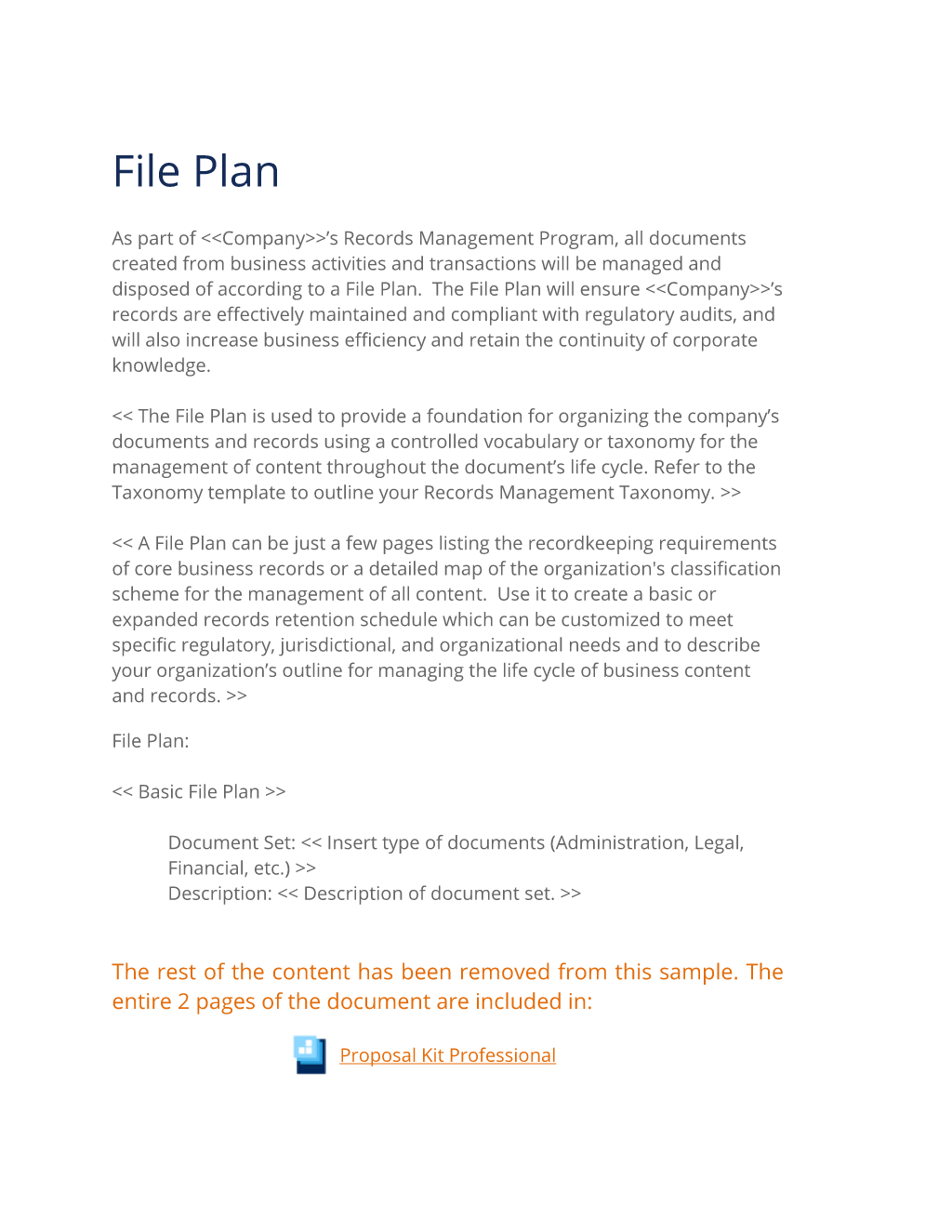
As part of Company Name's Records Management Program, all documents created from business activities and transactions will be managed and disposed of according to a File Plan. The File Plan will ensure Company Name's records are effectively maintained and compliant with regulatory audits, and will also increase business efficiency and retain the continuity of corporate knowledge. The File Plan is used to provide a foundation for organizing the company's documents and records using a controlled vocabulary or taxonomy for the management of content throughout the document's life cycle. Refer to the Taxonomy template to outline your Records Management Taxonomy.
A File Plan can be just a few pages listing the recordkeeping requirements of core business records or a detailed map of the organization's classification scheme for the management of all content. Use it to create a basic or expanded records retention schedule which can be customized to meet specific regulatory, jurisdictional, and organizational needs and to describe your organization's outline for managing the life cycle of business content and records.
File Plan:
Basic File Plan
Document Set: Insert type of documents (Administration, Legal, Financial, etc). Description: Description of document set. Medium: Storage medium used, such as electronic, paper, etc.
Retention Period: How long must this document set be stored. Document Set: Insert type of documents (Administration, Legal, Financial, etc). Description: Description of document set.
Medium: Storage medium used, such as electronic, paper, etc. Retention Period: How long must this document set be stored. The Basic File Plan retention schedule categorizes documents and records into Record Series that group together documents by common functions and activities.
The Description is the activity or transaction source of the document. The Medium is the physical attribute of the document, and Retention Period is the suggested time to keep the record before disposal.
Expanded File Plan
Record Title: Title of the document or document set. Description: Description of document set. Department: The department the document is for (admin, HR, accounting, etc).
Vital Record: Y/N
Historic Record: Y/N
Cut-Off: Cut-off date that counts down to disposal. Retention Period : How long must this document set be stored. Regulatory Reference: Who sets the regulations for this particular document. Storage Medium: Storage medium used, such as electronic, paper, etc.
Contact: Who to contact regarding this record. Record Title: Title of the document or document set. Description: Description of document set. Department: The department the document is for (admin, HR, accounting, etc).
Vital Record: Y/N
Historic Record: Y/N
Cut-Off: Cut-off date that counts down to disposal. Retention Period : How long must this document set be stored. Regulatory Reference: Who sets the regulations for this particular document.
Storage Medium: Storage medium used, such as electronic, paper, etc. Contact: Who to contact regarding this record. The Expanded File Plan categorizes the record's metadata in a scheme for increased accuracy and control.
The metadata fields for vital or historical records, location of content, and identifying the owner of records improves governance and demonstrates compliance with regulatory audits and controls. Organizations with high risk of litigation and large volumes of content should use the Expanded File Plan. Vital records require special protection, such as redundant backups, and refer to the set of records that are critical to the organization's existence. Historical records may have great importance in the future and may need to be retained indefinitely.
The Cut-Off field is the condition that triggers the countdown for Disposal. Defining the location of stored content across the enterprise will direct the disposal authority or researcher to the location of the object for disposal or discovery. Cataloging the personnel responsible for the authorization of the disposal of the content demonstrates that the organization's Records Management Program is managing the complete lifecycle from creation to destruction.
The editable Records Management File Plan Template document - complete with the actual formatting and layout is available in the retail Proposal Kit Professional.
20% Off Discount
 4.7 stars, based on 850 reviews
Alternate Documents
Related Documents
- Records Inventory Worksheet Questionnaire for Business Units
- Records Management Pre-Inventory Survey
- Records Survey and Inventory Analysis
- Business Case for Records Management
- Records Management Program Analysis Document
- Records Management Policies and Procedures
- Physical Content Management Box Label
- Records Access Security Plan
- Records Management Metadata Model
- Records Management Governance Plan
- Records Management Topic Template
- Records Management Taxonomy Topic Template
- Application for Records Retention Form
- Authorization for Records Destruction Form
- Formal Record Hold Investigation Form
- Formal Record Hold Notice Form
- Release of Legal Hold Notice Form
- Record Retention Schedule Change Form
- Legal Hold and Discovery Log
- Records Disposition Log
- Records Inventory Worksheet
- Records Access Security Plan (Expanded)
- Communication Plan
- RACI Matrix Worksheet
- User Acceptance Testing (UAT) Schedule
- User Acceptance Testing (UAT) Enhancements and Bug Tracker
- Risk Mitigation Plan
 Published by Proposal Kit, Inc.
We include a library of documents you can use based on your needs. All projects are different and have different needs and goals. Pick the documents from our collection, such as the Records Management File Plan Template, and use them as needed for your project.
 Facebook
 YouTube
 Bluesky
 Search Site
© 1997 - 2026, Proposal Kit, Inc. All rights reserved. Privacy Policy