

 Cart
Cart
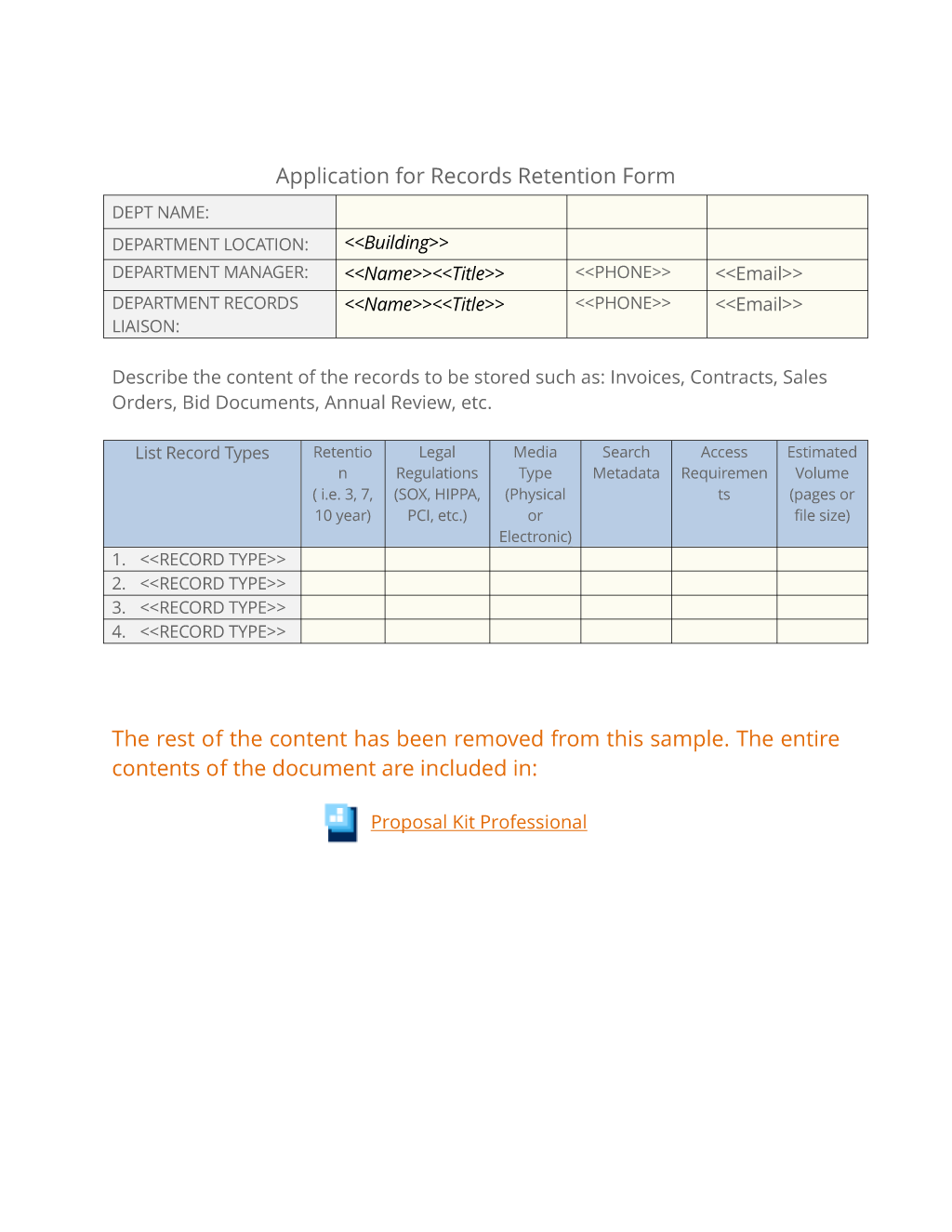
Application for Records Retention Form
 Get 20% off ordering today: Click here for the code
Proposal Kit Professional adds business proposals, all six Contract Packs,
Project Management Pack library, and Expert Edition software.
We include this editable document in the Proposal Kit Professional. Order and download it for $199. Follow these steps to get started.
 DOWNLOADABLE, ONE-TIME COST, NO SUBSCRIPTION FEES
Key Takeaways
- One-time License, No Subscriptions: Pay once and use Proposal Kit forever-no monthly fees or per-use charges.
- Built for Business Projects: Start with a proven Application for Records Retention Form and tailor sections, fields, and branding for your day-to-day project work.
- Instant Access: Download immediately and open the document right away-no waiting, no onboarding delay.
- Project-Ready Structure: Use a ready, professional layout for real-world project tasks (checklists, forms, analysis pages) so teams can execute consistently.
- Fully Editable in Word: Edit everything in Microsoft Word-swap text, add/remove sections, and apply your logo/colors without special skills.
- Step-by-Step Wizard Help: The Proposal Pack Wizard guides you with training/help and keeps you moving-no getting stuck on formatting or assembly steps.
- Wizard Data Merge & Project Management: Let the Wizard manage projects and merge recurring data (company/client names, addresses, dates) across your project documents.
- Included in Proposal Kit Professional: Available exclusively in the Proposal Kit Professional bundle.
 What Our Clients Say
I have been using Proposal Kit for close to 7 years now. It has been very valuable in my business dealing and projects awarded to us."
CEO
DKL Consulting
1. Get Proposal Kit Professional that includes this business document.
We include this Application for Records Retention Form in an editable format that you can customize for your needs.
2. Download and install after ordering.
Once you have ordered and downloaded your Proposal Kit Professional, you will have all the content you need to get started with your project management.
3. Customize the project template with your information.
You can customize the project document as much as you need. You can also use the included Wizard software to automate name/address data merging.
Use cases for this document
City of Maple Ridge tames public records backlog with structured retention
The Challenge
City Records Officer Linda Cruz inherited a pile of unscheduled public records, an outdated records retention schedule, slow responses to records request inquiries, and no clear records officer designation or central file maintained by the records commission, risking unauthorized disposal and missed transfers to archives.
The Solution
Using Proposal Kit for document creation, the team assembled a records management inventory form, records series inventory, records retention schedule form (RC-2) for retention schedule approval, one-time disposal of obsolete records packet (RC-1), certificate of records disposal (RC-3), a records officer designation policy, transmittal of records and packing list templates, and plain-language guides on how to request court records and copy and authentication fees; the AI Writer produced supplemental training and disaster preparedness materials, and the RFP Analyzer helped craft a proposal to secure archives services support.
The Implementation
Cruz led a records inventory, mapped record series, flagged records retained permanently versus temporary, prepared RC-2 updates that supersede previous versions, submitted RC-1 and RC-3 after approval, and scheduled transfer permanent records to the state archives via archives transmittal, while Proposal Kit's line-item quoting built cost models for boxing, imaging, and authorized destruction, and its templates generated request for reference service forms and disposition notifications.
The Outcome
The city achieved records retention schedule approval, cleared the backlog with authorized destruction documented by certificates of records destruction, sped fulfillment of closed archived records requests, and established a repeatable update cycle so the records schedule must be updated on time, and records to be destroyed must be covered by the schedule.
Northwind Medical Group modernizes retention and imaging after a storm
The Challenge
After a flood damaged charts, Northwind's CIO, Daniel Park, faced gaps in disaster preparation and recovery, unclear temporary record versus permanent record rules, and no electronic records conversion agreement to govern scanning, digital imaging guidelines, or eye-readable backup for permanent maintenance of records.
The Solution
Proposal Kit's document creation tools assembled an electronic records conversion agreement, guidelines for managing email, digital imaging and microfilm procedures, a role designation form for records designation roles coordinators, and updated records retention schedule (RC-2) packets; the AI Writer produced a risk assessment report and staff quick-starts, while line-item quoting modeled scanning, microfilm, and destruction vendor costs, and the RFP Analyzer helped evaluate service proposals.
The Implementation
Park built a records series list, completed a records series inventory, separated records kept under law from those eligible for disposal of records, routed RC-2 for retention schedule approval, then used RC-1 and RC-3 to submit disposal form packages for authorized destruction, created transmittal of records to the state records center for archival records, and published a records management key terms glossary.
The Outcome
Northwind restored compliance, documented certificates of records destruction (RM-3) post-approval, protected records of historical value, embedded a cadence where the records retention schedule must be updated, and improved resilience for future incidents involving records damaged in a disaster.
Redbridge Construction aligns projects to court-ready retention
The Challenge
Facing audit and litigation over judgment liens and requests for archived divorce cases and adoption records tied to subcontractor background checks, Redbridge lacked a current RC-2, had unscheduled records, and struggled to request court records correctly, including managing plain copy, sealed copies, exemplification, and superior court seal requirements.
The Solution
With Proposal Kit, Records Officer Maya Thompson used document creation to assemble a records management program setup, records officer/cardholder form, records designation form, RC-2 update, RC-1 and RC-3 packets, and a practical "how to request court records" guide with legal citations; the AI Writer produced a litigation readiness plan and social media tip-sheet, and the RFP Analyzer supported a bid response emphasizing records retention requirements compliance, while line-item quoting estimated storage, imaging, and destruction services.
The Implementation
Thompson completed a records management inventory form, secured records retention schedule approval so the retention schedule supersedes previous versions, implemented a submit disposal form workflow for authorized destruction, coordinated with records destruction vendors, and published procedures for the judiciary electronic document system and SCCO-style requests.
The Outcome
Redbridge met deadlines, reduced risk, documented certificate of records disposal and retention of permanent records, improved responsiveness to requests for court records, and institutionalized a governance rhythm where the records schedule must be updated and records retained permanently are transferred on schedule.
Abstract
This records retention intake form provides a structured way to capture what an organization keeps, for how long, and in what format. It asks for the content of the records (invoices, contracts, sales orders, bid documents, annual reviews), the retention period by record types, relevant legal regulations (SOX, HIPAA, PCI), media type (physical or electronic), search metadata, access requirements, estimated volume, and page or file size, followed by an authorized signature. Used by a records officer, it becomes the foundation of a records management program, linking records series to retention schedules and disposal.
By documenting record series titles and retention periods, the form supports retention schedule development, approval prior to destruction, and the authority to destroy records when the retention period expires. It aligns with records retention and disposition schedules, general schedules, and specific schedules, and helps ensure that records to be destroyed are covered by the schedule, reducing the risk of unauthorized disposal or unscheduled records. Many agencies map this intake to RC-1 (one-time disposal of obsolete records), RC-2 (records retention schedule), and RC-3 (certificate of records disposal) processes under statutes such as the Ohio Revised Code. It also supports the issuance of a certificate of records destruction or certificate of destruction form and disposition notification, and helps a records commission maintain a central file.
For public records and local government agencies, the form helps separate temporary records from permanent records, identify records of historical value, and plan transfer records to a state archives or state records center via records transmittal and archives transmittal form. It aids archives appraisal, archival records decisions, and coordination with a state archivist or records analyst. Court offices can connect the intake to a retention schedule for court records, closed records, and archived records while meeting records request needs such as a court records request form, certified copy, exemplified copy, apostille, and court authentication from a superior court clerk's office.
The media type prompts electronic imaging, digital imaging guidelines, guidelines for managing email, databases as public records, social media tip-sheet, and converting paper records to electronic planning, including microfilm, eye-readable backup, and American National Standards Institute considerations. It supports disaster preparedness, disaster preparation and recovery, handling damaged records, and coordination with records destruction vendors.
Use cases include state agency records setup, local government records retention compliance, retention schedule update when a retention schedule must be updated or supersedes previous versions, records transmittal to a state records center, and a disposal request form submission with disposal request approval. Organizations can also maintain a listserv for records management training and electronic records resources.
Proposal Kit can streamline this workflow with document assembly to produce records management forms, retention schedules, transmittals, and records request forms, automated line-item quoting for related services, an AI Writer to build supporting documents, and an extensive template library that is easy to use across your records scheduling and disposition needs.
Expanding on the intake form's value, organizations should start with a records inventory and a records series inventory that feeds a records retention schedule form. This supports records retention schedule development and an approval process that documents authorized destruction. Where RC and RM practices are used, teams often align one-time disposal of obsolete records (RC-1 form), the records retention schedule (RC-2 form), and the certificate of records disposal (RC-3 form), along with RM-25 form and RM-3 form steps that culminate in a certificate of records destruction (rm-3).
A records retention schedule must be updated on a routine cycle; many programs state a records retention schedule must be updated every 5 years, and that a retention schedule supersedes previous versions once retention schedule approval is granted. Throughout, records to be destroyed must be covered by a schedule, records kept under law need permanent maintenance of records, and the records commission should maintain a central file.
Clear roles matter. A records officer designation and responsibilities policy, supported by a records designation form, role designation form, and records officer/cardholder form, ensures accountability. A records management inventory form and a records series list help classify each temporary record and permanent record across the records lifecycle, improving records retention requirements compliance and readiness for audit and litigation.
Operations extend to the transmittal of records with a packing list, archives services, and the transfer of permanent records to a repository when records retention schedules have been issued. Agencies may use a request for reference service form and a records request system for closed, archived records. Court-oriented offices, including SCCO environments, handle judgment liens, divorce records, archived divorce cases, adoption records, and closed records; staff must know how to request court records via a judiciary electronic document system, applicable copy and authentication fees, and when plain copy, sealed copies, a superior court seal, exemplification, or legal citations are required. Programs should also plan for records damaged in a disaster and, when appropriate, use an electronic records conversion agreement.
Proposal Kit can help teams assemble this documentation: set-records retention schedule (rc-2), rc-1, rc-3, records designation forms, transmittals, and request forms, using document assembly, automated line-item quoting for services, an AI Writer to write supporting materials, and an extensive, easy-to-use template library that accelerates records management program setup and retention schedule approval.
Further strengthening the intake process, organizations should publish a concise glossary of records management key terms so staff can classify materials consistently and avoid ambiguity in audits. Establish governance that requires periodic review-your records schedule must be updated whenever laws, systems, or business processes change, not just at cycle end. Use a formal gate for records retention schedule approval so business owners, legal, and the records officer sign off before implementation.
For end-of-life, require teams to submit disposal form packets that document the authorized disposal of records, ensuring the records to be destroyed match the approved schedule and that the chain-of-custody is clear. Identify exceptions early: some records retained permanently should be flagged for archival transfer and ongoing preservation controls.
Clarity in roles accelerates compliance. Assign records designation roles coordinators within each department to liaise with the records officer, monitor local inventories, and shepherd requests through the approval workflow. This reduces cycle time, prevents hold violations, and improves defensibility during discovery and audits. Proposal Kit can support these governance practices by assembling the required forms, approval summaries, and role documentation quickly, using its template library, AI Writer for supporting materials, and line-item quoting for related services, helping teams maintain accurate schedules and consistent disposition documentation.
How to write my Application for Records Retention Form document
Application for Records Retention Form
Describe the content of the records to be stored such as: Invoices, Contracts, Sales Orders, Bid Documents, Annual Review, etc. List Record Types Retention: ( i.e. 3, 7, 10 year) Legal Regulations. SOX, HIPPA, PCI, etc. Media Type: (Physical or Electronic) Search Metadata Access Requirements Estimated Volume.
Pages or file size. PRINTED NAME AUTHORIZED SIGNATURE DATE.
The editable Application for Records Retention Form document - complete with the actual formatting and layout is available in the retail Proposal Kit Professional.
20% Off Discount
 4.7 stars, based on 850 reviews
Related Documents
- Records Management Policies and Procedures
- Records Access Security Plan
- Records Management Governance Plan
- Records Management File Plan Template
- Records Management Expanded File Plan Template
- Authorization for Records Destruction Form
- Formal Record Hold Investigation Form
- Formal Record Hold Notice Form
- Release of Legal Hold Notice Form
- Record Retention Schedule Change Form
- Legal Hold and Discovery Log
- Records Disposition Log
- Records Access Security Plan (Expanded)
- Communication Plan
- RACI Matrix Worksheet
- User Acceptance Testing (UAT) Schedule
- User Acceptance Testing (UAT) Enhancements and Bug Tracker
- Risk Mitigation Plan
 Published by Proposal Kit, Inc.
We include a library of documents you can use based on your needs. All projects are different and have different needs and goals. Pick the documents from our collection, such as the Application for Records Retention Form, and use them as needed for your project.
 Facebook
 YouTube
 Bluesky
 Search Site
© 1997 - 2026, Proposal Kit, Inc. All rights reserved. Privacy Policy