

 Cart
Cart
Release of Legal Hold Notice Form
 Get 20% off ordering today: Click here for the code
Proposal Kit Professional adds business proposals, all six Contract Packs,
Project Management Pack library, and Expert Edition software.
We include this editable document in the Proposal Kit Professional. Order and download it for $199. Follow these steps to get started.
 DOWNLOADABLE, ONE-TIME COST, NO SUBSCRIPTION FEES
Key Takeaways
- One-time License, No Subscriptions: Pay once and use Proposal Kit forever-no monthly fees or per-use charges.
- Built for Business Projects: Start with a proven Release of Legal Hold Notice Form and tailor sections, fields, and branding for your day-to-day project work.
- Instant Access: Download immediately and open the document right away-no waiting, no onboarding delay.
- Project-Ready Structure: Use a ready, professional layout for real-world project tasks (checklists, forms, analysis pages) so teams can execute consistently.
- Fully Editable in Word: Edit everything in Microsoft Word-swap text, add/remove sections, and apply your logo/colors without special skills.
- Step-by-Step Wizard Help: The Proposal Pack Wizard guides you with training/help and keeps you moving-no getting stuck on formatting or assembly steps.
- Wizard Data Merge & Project Management: Let the Wizard manage projects and merge recurring data (company/client names, addresses, dates) across your project documents.
- Included in Proposal Kit Professional: Available exclusively in the Proposal Kit Professional bundle.
 What Our Clients Say
I had been using Proposal Kit Professional together with the Proposal Pack Wizard for more than 3 years. Prior to using Proposal Kit Professional, I had been using several other products and had been disappointed because of their limited functionalities. Since using Proposal Kit Professional, I had never have to look back because of the product rich functionalities and also the vendor excellent continuing support policies."
COSMO SYNERGY SDN BHD
1. Get Proposal Kit Professional that includes this business document.
We include this Release of Legal Hold Notice Form in an editable format that you can customize for your needs.
2. Download and install after ordering.
Once you have ordered and downloaded your Proposal Kit Professional, you will have all the content you need to get started with your project management.
3. Customize the project template with your information.
You can customize the project document as much as you need. You can also use the included Wizard software to automate name/address data merging.
Use cases for this document
Orion Devices closes a licensing dispute without tripping over preservation rules
The Challenge
When Helix Systems alleged a breach of a licensing agreement, Orion Devices faced a litigation hold that required a swift duty to preserve across email, shared drives, backups, and engineering workstations; the legal team had to assign custodians, issue notifications to custodians, suspend normal destruction, and define the time frame at issue while avoiding adverse inference risks tied to possession custody control.
The Solution
The team used the Release of Hold form when settlement was reached to issue a clear release notification mapped to the preservation obligations notice, and they supported it with Proposal Kit's document creation tools to produce a training memo, a preservation plan, and an FAQ that clarified the preservation duty, acknowledgment tracking steps, and the communication workflow.
The Implementation
Outside counsel guided records identification while IT documented where to preserve potentially relevant records in original electronic form; simultaneously, Proposal Kit's AI Writer generated a project plan for ongoing compliance and a post-matter report for executives, and line-item quoting built a cost summary for collection and review that validated reasonable good faith efforts.
The Outcome
With metadata preserved and unresponsive custodians addressed through documented reminders, Orion issued the release when the matter resolved, resumed retention safely, and closed the case without spoliation concerns or policy violations while retaining clear evidence of what was held and when it was released.
Lakeview University navigates a faculty HR investigation and staged releases
The Challenge
An HR complaint against Professor Marco Ruiz triggered reasonably anticipated litigation, requiring university personnel to preserve electronic form emails, lab data, and paper files, assign custodians to receive notifications, and track acknowledgments from affected university personnel during a sensitive investigation or action.
The Solution
Compliance drafted the release and partial-release notices using the project management templates and supplemented them with Proposal Kit deliverables: an executive brief that defined roles, an ediscovery communications playbook outlining the notification process and training and reminders, and a study describing how to handle separate mailboxes and the time frame at issue.
The Implementation
The team documented the communication workflow, escalation steps, and how to handle records policy violations; Proposal Kit's RFP Analyzer helped Procurement evaluate bids from a forensic collection vendor, while AI Writer produced a campus-facing summary of policy scope and practice pointers without altering the core project management forms.
The Outcome
When the inquiry closed with no action and the statute of limitations expired for civil claims, Legal used a staged release notification to free certain custodians while others stayed on hold for parallel lawsuits, and the university avoided disciplinary action by proving reasonable good faith compliance throughout.
Redwood Aero Manufacturing completes a DOJ inquiry with a clean release trail
The Challenge
A Department of Justice inquiry into export controls put Redwood Aero under a broad litigation hold with strict preservation duties across CAD repositories, cloud storage, and backups, creating pressure to coordinate IT and Legal while preventing records policy violations and spoliation sanctions.
The Solution
The team planned for the release of hold criteria tied to events that trigger notifications and prepared the release package alongside Proposal Kit-produced materials: a risk assessment report, a collection readiness plan, and a board briefing that clarified roles, assigned custodians, and controls for possession, custody, and control.
The Implementation
Proposal Kit's AI Writer drafted the risk and readiness reports, line-item quoting built budget exhibits for vendor support, and RFP Analyzer structured a proposal to retain outside counsel and an eDiscovery lab; the organization kept notifications to custodians, acknowledgment tracking, and suspended normal destruction steps in sync with the core project management documents.
The Outcome
When the government declined prosecution, Redwood issued the formal release notification, documented how the preservation of potentially relevant records requirements were met, and restarted normal retention without confusion, supported by a defensible paper trail and no findings of policy violations.
Abstract
This form serves as the release notification that closes a prior litigation hold and instructs records owners and departments to resume normal retention and destruction. It captures the records custodian or department, a case ID or contract reference, and a list of records that were held, covering paper records and electronic data with their data collection sites (file shares, mailboxes, backups, smartphones, workstations) and records location details such as mapped drives or file cabinets. A signature line requires the department or records owner to acknowledge compliance. Once the hold is over, the records department proceeds under the Records Program Policies and Procedures and the records retention manual to resume auto-destruction where appropriate.
In practice, this release follows an issuance notification that began the litigation hold when litigation was reasonably anticipated or reasonably foreseeable. During the hold, organizations assign custodians, issue custodian communications, suspend deletion, segregate future information, preserve in original electronic form, and ensure metadata is preserved through reasonable measures to preserve potentially relevant information in possession, custody, or control. The release of hold criteria often includes events that trigger notifications that litigation is resolved: dismissed with prejudice, settlement reached, summary judgment granted, judgment entered, consent decree, statute of limitations expired, or government declines prosecution. If litigation is not reasonably foreseeable or a triggering event changes, a re-issuance notification with reminders and escalations may be appropriate.
Operationally, best practices call for notice to the IT department, IT department coordination on separate mailboxes and systems, and outside counsel guidance for a forensically defensible collection process. The issuing officer, office of legal affairs, general counsel, or human resources coordination should monitor compliance, notify affected personnel, and release the custodian when appropriate. Clear policy scope, a definitions section, preservation notice content, and authority to place or release are vital topics of a litigation hold policy or university policy (for example, policy 7:4 legal holds or university policy 605.4). These practice pointers help avoid spoliation of evidence, adverse inference, and spoliation sanctions under the Federal Rules of Civil Procedure, including FRCP 37(e), in federal courts, Illinois courts, or Department of Justice matters. Organizations may also align case management and notification workflow with tools such as Microsoft Purview eDiscovery (Premium) after retirement of classic eDiscovery, using a communications library, communications editor, cc and bcc, reminder interval, escalation interval, and a case list to manage unresponsive custodians and records identification.
Use cases include an HR investigation, a licensing agreement dispute, or parallel lawsuits where the obligation to preserve applies to preserve relevant information and preserve all affected records until release when the matter is resolved.
The Proposal Kit helps teams author and assemble this communication template and related portal content quickly. Its document assembly, extensive template library, and AI Writer can produce preservation obligations notices, legal hold policy materials, and forms like this release; automated line-item quoting supports broader Proposal and budgeting needs; and its ease of use streamlines the hold workflow documentation and notifies legal packages without adding unnecessary complexity.
Beyond closing the hold, this release sits within a broader lifecycle shaped by the duty to preserve that arises during reasonably anticipated litigation or any investigation or action. The preservation duty requires organizations to suspend normal destruction and preserve potentially relevant records in both paper and electronic form, within their possession, custody, and control, for the time frame at issue. That begins with a preservation obligations notice, notifications to custodians, and ediscovery communications that explain what to keep and where.
Clear assigning custodians practices, including the steps to assign custodians to receive notifications, help maintain a defensible communication workflow and acknowledgment tracking through signed confirmations. Training and reminders reinforce reasonable, good-faith efforts and reduce policy violations that can lead to disciplinary action.
In higher education, university personnel benefit from defined processes that identify affected university personnel early, standardize the notification process, and specify how records policy violations will be handled. Examples include research misconduct reviews, faculty HR disputes, or grant-related audits, where teams need to preserve electronic mailboxes, shared drives, and lab notebooks. When the matter concludes, this release tells custodians exactly when routine processes can resume, minimizing risk while avoiding unnecessary storage and confusion.
Proposal Kit helps teams write and assemble the preservation obligations notice, initial and follow-up notifications, and the release using consistent language and templates. Its document assembly, extensive template library, and AI Writer make it faster to customize ediscovery communications and related forms while documenting requirements such as acknowledgment tracking, training, and reminders, and the communication workflow. Automated line-item quoting supports planning for collection and review budgets, and the system's ease of use helps legal, IT, and business users produce clear, compliant materials without slowing operations.
Teams should also plan for partial releases. A custodian can be released from one matter while remaining on hold for parallel lawsuits or another investigation or action. The notification process should state clearly which data sources and the time frame at issue are cleared, and which remain subject to the duty to preserve.
Map records identification to precise records location entries so the release notification lines up with what the preservation obligations notice originally captured. Before reactivating auto-destruction, confirm no other triggering event keeps the preservation duty alive and that metadata preserved copies, if any, remain available per the records retention manual.
Governance details matter. Define who the issuing officer is, what authority to place or release applies, and how policy scope and a definitions section explain possession, custody, and control across cloud repositories, backup systems, and paper records. If unresponsive custodians do not acknowledge compliance, maintain reminders and escalations, and route to human resources coordination for potential violations, disciplinary action consistent with university policy will be taken.
Use cc and bcc as part of a defensible communication workflow, and document reasonable good faith steps should policy violations or records policy violations arise. Coordinate with the IT department to resume normal processes in stages, such as separating mailboxes that are still on hold while other custodians are released, and ensure outside counsel signs off when events that trigger notifications include judgment entered, consent decree, or government declines prosecution.
Proposal Kit can help produce consistent ediscovery communications, from notifications to custodians through the release, using its communications library, templates, and AI Writer. Teams can assemble checklists for assigning custodians, build standard portal content, and keep language uniform across a case list, making it easier to assign custodians to receive notifications and create clear, reusable documents that support training and reminders without slowing operations.
How do you write a Release of Legal Hold Notice Form document?
Release of Legal Hold Notice Form
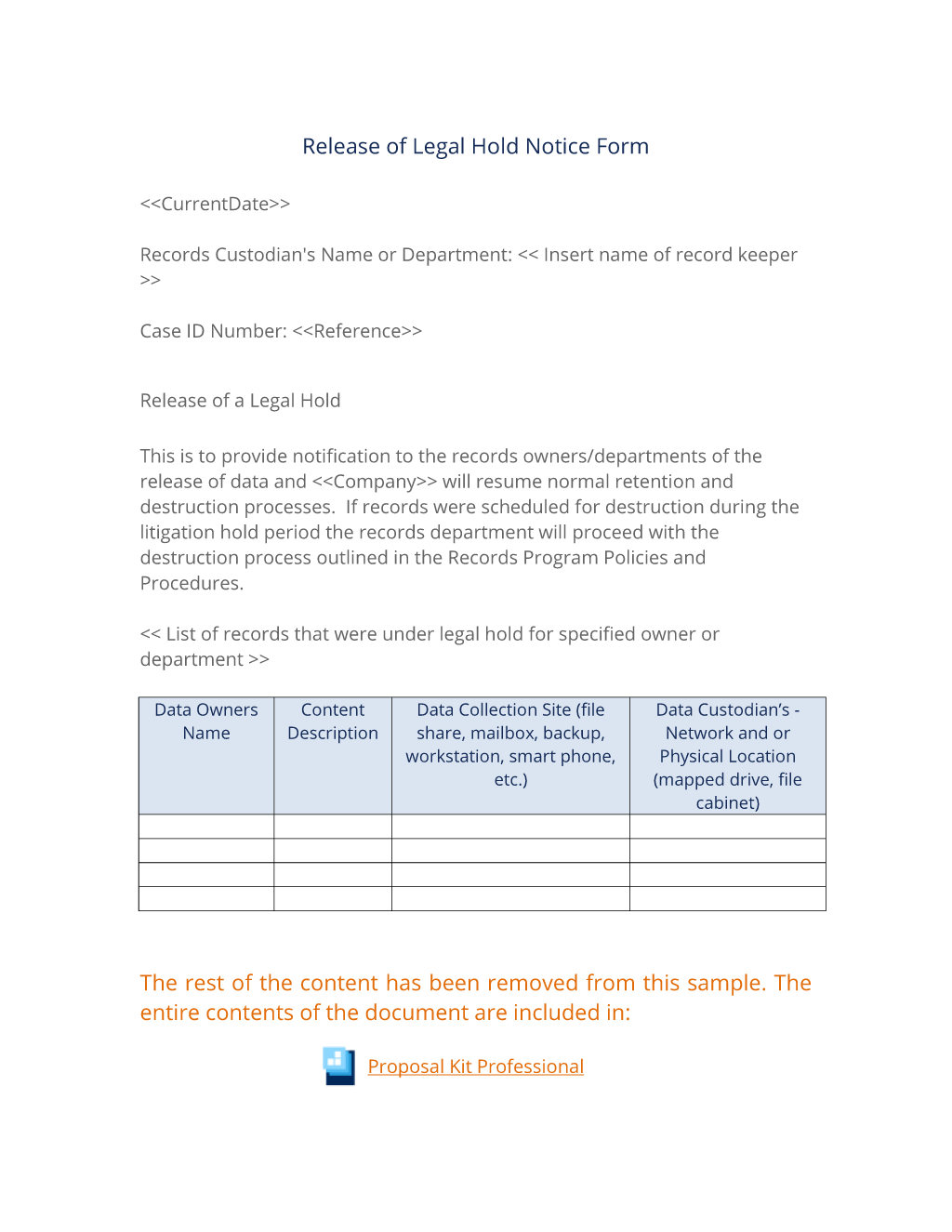
Records Custodian's Name or Department: Insert name of record keeper. Case ID Number: Contract Reference Number. Release of a Legal Hold. This is to provide notification to the records owners/departments of the release of data and Company Name will resume normal retention and destruction processes.
If records were scheduled for destruction during the litigation hold period the records department will proceed with the destruction process outlined in the Records Program Policies and Procedures. List of records that were under legal hold for specified owner or department. Data Owners Name Content Description Data Collection Site (file share, mailbox, backup, workstation, smart phone, etc.) Data Custodian's - Network and or Physical Location (mapped drive, file cabinet). Requires signature of the department or records owner for acknowledgement of the notification.
The editable Release of Legal Hold Notice Form document - complete with the actual formatting and layout is available in the retail Proposal Kit Professional.
20% Off Discount
 4.7 stars, based on 850 reviews
Related Documents
- Records Management Policies and Procedures
- Records Access Security Plan
- Records Management Governance Plan
- Records Management File Plan Template
- Records Management Expanded File Plan Template
- Application for Records Retention Form
- Authorization for Records Destruction Form
- Formal Record Hold Investigation Form
- Formal Record Hold Notice Form
- Record Retention Schedule Change Form
- Legal Hold and Discovery Log
- Records Disposition Log
- Records Access Security Plan (Expanded)
- Communication Plan
- RACI Matrix Worksheet
- User Acceptance Testing (UAT) Schedule
- User Acceptance Testing (UAT) Enhancements and Bug Tracker
- Risk Mitigation Plan
 Published by Proposal Kit, Inc.
We include a library of documents you can use based on your needs. All projects are different and have different needs and goals. Pick the documents from our collection, such as the Release of Legal Hold Notice Form, and use them as needed for your project.
 Facebook
 YouTube
 Bluesky
 Search Site
© 1997 - 2026, Proposal Kit, Inc. All rights reserved. Privacy Policy