

 Cart
Cart
Records Disposition Log
 Get 20% off ordering today: Click here for the code
Proposal Kit Professional adds business proposals, all six Contract Packs,
Project Management Pack library, and Expert Edition software.
We include this editable document in the Proposal Kit Professional. Order and download it for $199. Follow these steps to get started.
 DOWNLOADABLE, ONE-TIME COST, NO SUBSCRIPTION FEES
Key Takeaways
- One-time License, No Subscriptions: Pay once and use Proposal Kit forever-no monthly fees or per-use charges.
- Built for Business Projects: Start with a proven Records Disposition Log and tailor sections, fields, and branding for your day-to-day project work.
- Instant Access: Download immediately and open the document right away-no waiting, no onboarding delay.
- Project-Ready Structure: Use a ready, professional layout for real-world project tasks (checklists, forms, analysis pages) so teams can execute consistently.
- Fully Editable in Word: Edit everything in Microsoft Word-swap text, add/remove sections, and apply your logo/colors without special skills.
- Step-by-Step Wizard Help: The Proposal Pack Wizard guides you with training/help and keeps you moving-no getting stuck on formatting or assembly steps.
- Wizard Data Merge & Project Management: Let the Wizard manage projects and merge recurring data (company/client names, addresses, dates) across your project documents.
- Included in Proposal Kit Professional: Available exclusively in the Proposal Kit Professional bundle.
 What Our Clients Say
We are a small business and the tool kit helped us to put some templates of our own based on the tool kit and saved lot of time. Highly Recommend it!"
1. Get Proposal Kit Professional that includes this business document.
We include this Records Disposition Log in an editable format that you can customize for your needs.
2. Download and install after ordering.
Once you have ordered and downloaded your Proposal Kit Professional, you will have all the content you need to get started with your project management.
3. Customize the project template with your information.
You can customize the project document as much as you need. You can also use the included Wizard software to automate name/address data merging.
Use cases for this document
Redwood State University retires backlogged records before fiscal year end
The Challenge
Records manager Elena Park faced 900 boxes of mixed personnel files and research folders in off-site storage, inconsistent FE/CE codes on past entries, and a tight deadline to meet disposition dates while routing several projects for university archives review.
The Solution
She kept the existing records disposition log as the authoritative project document and used Proposal Kit only to create supporting materials: a step-by-step SOP, a training deck for departmental coordinators, an RFP for secure shredding vendors, and an executive brief for the provost; AI Writer drafted the training guide and brief, the RFP Analyzer organized vendor requirements, and line-item quoting produced cost estimates by box and pound.
The Implementation
Elena ran short workshops, validated dates of records and codes, flagged archival candidates for university archives staff, and, with Proposal Kit document creation, issued the SOP, RFP package, and a communications plan while the disposition team verified approvals and certificate-of-destruction procedures.
The Outcome
The team cleared the backlog on schedule, transferred historically valuable records to the archives, documented destruction via secure shredding, and cut storage spend by 38% with a clean paper trail ready for the annual compliance review.
Harborview Clinics modernizes retention to speed public request responses
The Challenge
Compliance officer Marcus Lee struggled with aging paper charts across clinics, slow responses to open-records-style inquiries, and confusion about which records were eligible for disposal after the retention period.
The Solution
He retained the disposition log as the control document and turned to Proposal Kit for the surrounding documents: a board report outlining risk and timeline, a privacy and patient notice packet, a vendor RFP for digitization and secure shredding, and a quarterly status report; AI Writer produced the FAQs and report drafts, the RFP Analyzer mapped the Statement of Work, and line-item quoting compared per-page scan and per-bin destruction pricing.
The Implementation
Teams reconciled dates of records, applied FE/CE codes consistently, scheduled quarterly destruction windows, and, using Proposal Kit document creation, published the board report, the RFP, and a clinic playbook that aligned departments without disrupting patient care.
The Outcome
Public inquiry turnaround dropped from weeks to days, redundant storage was eliminated, final logs were complete with certificates, and the clinic met policy obligations while freeing space for expansion.
BlueForge Robotics prepares for an audit and a pending warranty claim
The Challenge
Operations director Nina Alvarez had to prove retention compliance before an ISO audit while isolating engineering build logs for a supplier warranty claim, all while the company's past logs were inconsistent across plants.
The Solution
BlueForge continued using the records disposition log to steer the work and used Proposal Kit to create the support package: a cross-plant project plan, a risk and controls register, a vendor questionnaire for off-site storage, and a post-project report; AI Writer drafted the plan and report, the RFP Analyzer structured the vendor questionnaire, and line-item quoting modeled storage and transport scenarios.
The Implementation
Nina's team inventoried series, corrected FE/CE coding, set disposition dates, consolidated off-site boxes, and, with Proposal Kit document creation, issued the project plan, training handouts, and a vendor packet while supervisors verified approvals and destruction methods.
The Outcome
The audit passed with no findings, the claim evidence was produced in hours, not days, redundant records were destroyed securely, and leadership gained a repeatable process backed by clear supporting documents.
Abstract
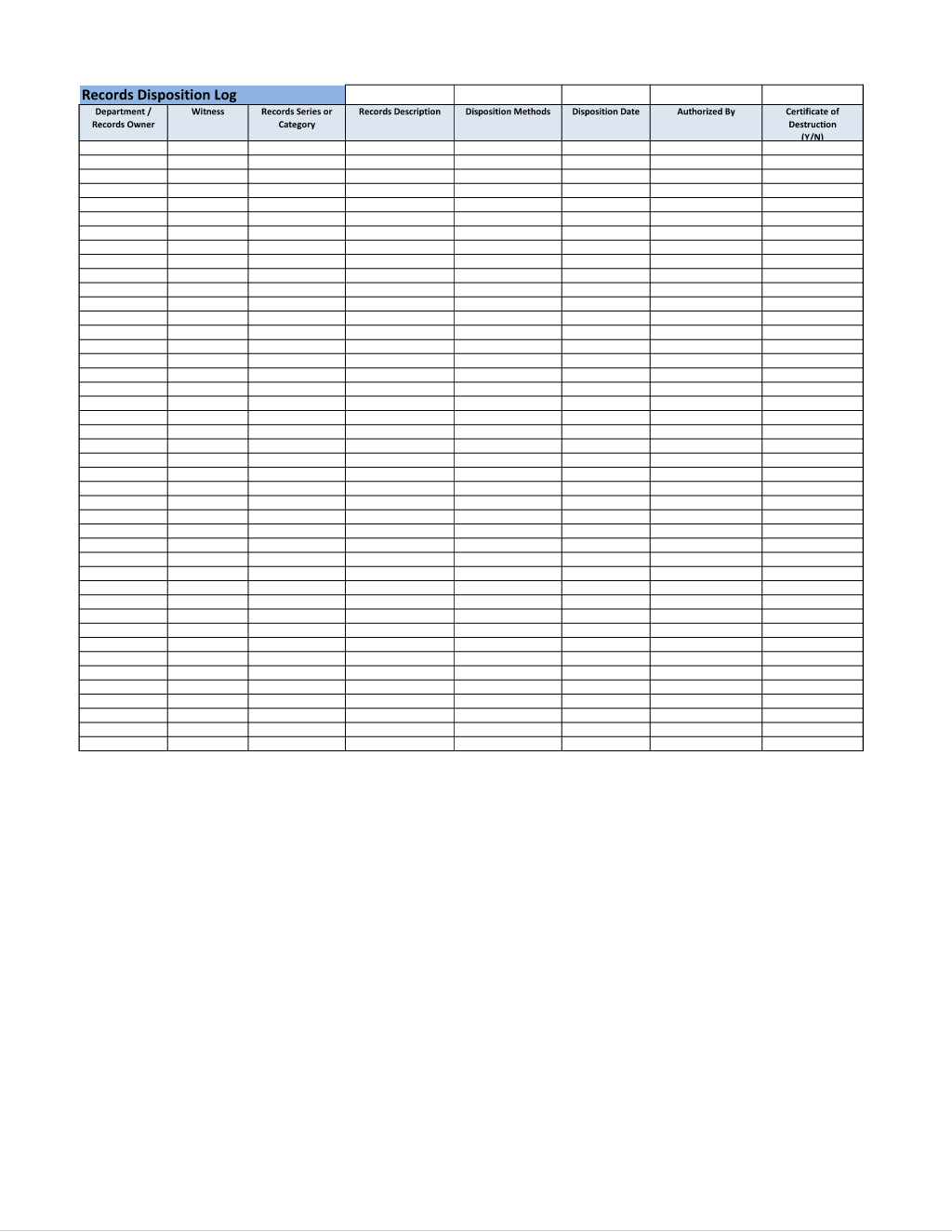
This simple disposition tracking tool documents how an organization lawfully retires information. It captures the Department/Records Owner, a Witness, the record series or category and description, the disposition method, the disposition date, the person Authorized By, and the Certificate of Destruction. Used with a records retention schedule, it provides a clear paper trail from retention period through final disposition.
Teams align each record series with the records retention schedule (RRS), noting retention time and retention requirements met before disposal. Many organizations map retention codes such as FE (fiscal year end), CE (calendar year end), and AC (event-based retention) to determine a disposition date. For example, calendar end plus 5 years or fiscal end retention after the fiscal year example closes.
Where an AC event code applies, staff wait for the triggering event to conclude. The records manager, records management coordinator, or records administrator then confirms the record series title and agency series number or agency identification number against the certified retention schedule.
The disposition instructions section supports a clear method for disposal: destroy records, shred confidential information, recycle trash, transfer to archives, or off-site storage retrieval. Some records require archival review or archives transfer for permanent preservation; others are archival records that go to university archives for archives preservation. When archival review is required, staff may flag the entry for archive review and transfer it to the university archives rather than disposing of it.
A records management officer oversees the approval process, ensuring an authorized signature, a disposition log signature, and that records eligible for disposition are correctly handled. If records are stored with Iron Mountain storage or other off-site storage, include the date span, record dates entry, and any digital records measurement or volume measurement.
Good practice considers legal holds and risk: retain for full retention to cover an audit or claim, negotiation, audit claim, administrative review, or open records request under open records law. Keep a departmental copy of the final disposition log; many policies require retaining logs for 10 years or retaining final signed logs for ten years, but not past 10 years. Distinguish master copy from convenience copies and non-records, and ensure convenience copy disposal follows university records management policy or state records guidance.
Universities may reference the Texas State Library and Archives Commission and Texas Government Code 441. 187; agencies may use training information, ethics and compliance training, and records management basics training or workshops to teach how to fill out the log, submit the form, scan and submit, wait for approval, and then dispose of records using the approved method for disposal. When archival records are identified, use archival transfer forms and the archives contact form, and follow the records disposition workflow through the FDL approval process. Use the records retention disposition log for records eligible for destruction and document the final disposition log outcome.
Use cases include: clearing departmental personnel records after the RRS shows FE or CE retention codes have matured; routing a research project's master copy for archival review with an archive code O or I; or purging convenience copies from off-site storage after a retention schedule update or RRS changes.
Proposal Kit helps teams assemble this documentation efficiently. Its document assembly and extensive template library streamline records disposal procedures, its automated line-item quoting supports related service estimates, and its AI Writer can build supporting documents like training and workshops or how-to guides, helping you implement an easy-to-use, compliant records disposition process.
Expanding on the core idea, the form's fields drive consistent records disposition steps 1-7: confirm the department name and ID; identify the record copy and dates of records; match the series to a retention schedule certified and approved and re-certified; apply university retention codes and retain schedule codes FE CE; set disposition dates using fiscal year FE, calendar year CE, or calendar end plus years; route for authorization; and document the method (secure shredding, recycling, or archiving materials). Only staff authorized to dispose should sign, ensuring the records retention policy and university policy are met. Note whether records are eligible for disposal or if an archives review is required. If a university archives review is needed, use an archive review flag A and note any archive code, so university archives staff can assess permanent value.
Include the RRS acronym, the RRS agency identification number, and any RRS revision map reference so the retention timeline is traceable even after RRS changes. Many teams keep a departmental copy retention rule: the department keeps a copy of the final log, but retains logs not past 10 years. When using off-site storage, include volume, disposition method, and disposition dates.
Maintain a clear link to the retained master copy schedule so convenience copies can follow later. For exceptions, contact the records office staff for guidance or records management training. If you need to start fresh, a blank disposition form or blank records disposition form helps standardize how the rrd log is captured, and it makes it easy to submit the form when records are eligible for disposal.
Proposal Kit supports this workflow by helping teams assemble a compliant packet: generate a tailored blank disposition form, reference the retention schedule, and include steps and training aids. Its document assembly, extensive template library, automated line-item quoting, and AI Writer for how-to content make it easier to align with policy, complete approvals, and produce a clean audit trail without slowing down daily operations.
Add a governance checkpoint before any disposal action. When staff view the records disposition log form, require them to verify that dates of records are complete and accurate, fee codes and any event-based triggers are applied consistently, and privacy classifications are correct. Supervisors can then spot-check batches grouped by fe ce codes to validate disposition dates against fiscal or calendar cycles and confirm the selected method aligns with sensitivity and business needs.
Set explicit eligibility criteria to remove ambiguity. Records eligible for disposal must have met their retention period, cleared all administrative reviews and holds, and received the appropriate approvals and authorized signatures. Confirm the record copy is accounted for and that any convenience copies are scheduled for follow-on disposal. Schedule routine windows for action, such as quarterly or post-closing cycles, so teams can stage secure shredding or archival transfer efficiently, minimize disruptions, and keep workloads predictable.
How do you write a Records Disposition Log document?
business,project,records,management,toolkit,information,documents,templates,boilerplate,form,outline,textThe editable Records Disposition Log document - complete with the actual formatting and layout is available in the retail Proposal Kit Professional.
20% Off Discount
 4.7 stars, based on 850 reviews
Related Documents
- Records Management Policies and Procedures
- Records Access Security Plan
- Records Management Governance Plan
- Records Management File Plan Template
- Records Management Expanded File Plan Template
- Application for Records Retention Form
- Authorization for Records Destruction Form
- Formal Record Hold Investigation Form
- Formal Record Hold Notice Form
- Release of Legal Hold Notice Form
- Record Retention Schedule Change Form
- Legal Hold and Discovery Log
- Records Access Security Plan (Expanded)
- Communication Plan
- RACI Matrix Worksheet
- User Acceptance Testing (UAT) Schedule
- User Acceptance Testing (UAT) Enhancements and Bug Tracker
- Risk Mitigation Plan
 Published by Proposal Kit, Inc.
We include a library of documents you can use based on your needs. All projects are different and have different needs and goals. Pick the documents from our collection, such as the Records Disposition Log, and use them as needed for your project.
 Facebook
 YouTube
 Bluesky
 Search Site
© 1997 - 2026, Proposal Kit, Inc. All rights reserved. Privacy Policy