

 Cart
Cart
Formal Record Hold Notice Form
 Get 20% off ordering today: Click here for the code
Proposal Kit Professional adds business proposals, all six Contract Packs,
Project Management Pack library, and Expert Edition software.
We include this editable document in the Proposal Kit Professional. Order and download it for $199. Follow these steps to get started.
 DOWNLOADABLE, ONE-TIME COST, NO SUBSCRIPTION FEES
Key Takeaways
- One-time License, No Subscriptions: Pay once and use Proposal Kit forever-no monthly fees or per-use charges.
- Built for Business Projects: Start with a proven Formal Record Hold Notice Form and tailor sections, fields, and branding for your day-to-day project work.
- Instant Access: Download immediately and open the document right away-no waiting, no onboarding delay.
- Project-Ready Structure: Use a ready, professional layout for real-world project tasks (checklists, forms, analysis pages) so teams can execute consistently.
- Fully Editable in Word: Edit everything in Microsoft Word-swap text, add/remove sections, and apply your logo/colors without special skills.
- Step-by-Step Wizard Help: The Proposal Pack Wizard guides you with training/help and keeps you moving-no getting stuck on formatting or assembly steps.
- Wizard Data Merge & Project Management: Let the Wizard manage projects and merge recurring data (company/client names, addresses, dates) across your project documents.
- Included in Proposal Kit Professional: Available exclusively in the Proposal Kit Professional bundle.
 What Our Clients Say
I have been using Proposal Kit for grants since Fall of 2009 and love it. It saves me valuable time so I can focus on what I am an expert in!"
Global Health Science Institute
1. Get Proposal Kit Professional that includes this business document.
We include this Formal Record Hold Notice Form in an editable format that you can customize for your needs.
2. Download and install after ordering.
Once you have ordered and downloaded your Proposal Kit Professional, you will have all the content you need to get started with your project management.
3. Customize the project template with your information.
You can customize the project document as much as you need. You can also use the included Wizard software to automate name/address data merging.
Use cases for this document
A startup faces a sweeping subpoena and races to preserve data
The Challenge
When Nimbus Robotics received a federal subpoena tied to a contract dispute, Records Officer Jenna Park had hours to notify engineers, freeze shared drives, and coordinate with counsel while assuring the board that the company would avoid premature disposal and meet discovery obligations.
The Solution
Using the project management hold templates as the backbone, Jenna used Proposal Kit's document creation tools to assemble a formal memo to department heads and a signed custodian request letter, then used the AI Writer to produce supporting materials-an evidence preservation plan, a custodian FAQ, and a weekly status report for executives-while the RFP Analyzer compared bids from two eDiscovery vendors and line-item quoting framed projected collection and hosting costs for stakeholders.
The Implementation
IT tagged mailboxes and cloud folders as records frozen, created a checklist for laptops and removable media, and logged chain-of-custody steps; meanwhile, Jenna issued periodic updates using Proposal Kit-built reports, and procurement used the RFP Analyzer output to negotiate scope, timing, and service tiers with the preferred vendor.
The Outcome
Nimbus met the court's deadlines, avoided sanctions, and, after reappraisal at case close, resumed the normal disposition cycle with documented sign-offs and clear cost transparency driven by the line-item budget created in Proposal Kit.
A public agency balances records requests and a tax dispute
The Challenge
Clearwater Municipal Water Authority faced a value adjustment board appeal and simultaneous public records requests, forcing Records Manager Luis Romero to freeze finance and property records while managing citizen inquiries and media scrutiny.
The Solution
The team relied on the hold templates for notices, then used Proposal Kit's document creation to build a multi-audience communications packet-a formal memo to divisions, an FAQ for requesters, and a briefing for the board-while the AI Writer generated a records search plan and a monthly transparency report; procurement applied the RFP Analyzer to shortlist a records storage facility partner and used line-item quoting to forecast scanning, retrieval, and storage fees.
The Implementation
Custodians acknowledged receipt, IT placed shared drives in read-only mode, and offsite boxes were labeled records frozen; Luis issued weekly Proposal Kit reports that mapped progress against the search plan, and finance used the line-item quote to allocate contingency funds while procurement finalized the vendor award.
The Outcome
Clearwater met statutory response timelines, preserved all relevant materials for the appeal, and demonstrated a defensible process, while the supporting documents built with Proposal Kit kept leadership, citizens, and auditors informed without adding administrative burden.
A hospital navigates a class action with tight timelines
The Challenge
Trinity Harbor Health was drawn into a fast-moving class action after a billing dispute, and Compliance Director Maya Zhao needed to launch a systemwide hold, coordinate with outside counsel, and maintain patient trust amid intense scrutiny.
The Solution
Maya used the hold templates to issue targeted notices, then leveraged Proposal Kit's document creation to craft a training brief for department leads and a communications plan for executives; the AI Writer produced a risk assessment and a discovery readiness study, while the RFP Analyzer evaluated proposals from forensic collection firms and line-item quoting modeled collection, processing, and review budgets for the finance committee.
The Implementation
Clinical, billing, and HR repositories were tagged as records frozen, mobile devices were enrolled in preservation workflows, and Proposal Kit-generated reports tracked custodian acknowledgments, search coverage, and deadlines; procurement used the Analyzer's scorecard to select a vendor and locked in costs against the line-item model.
The Outcome
The hospital met FRCP timelines, avoided data spoliation claims, and reduced spend through early scoping, while the extra documents created with the Proposal Kit kept all stakeholders aligned from notice to release and informed a smoother post-case return to routine records management.
Abstract
This litigation hold notice form provides a clear, repeatable process for preserving official records when a matter is under investigation or headed to court. It identifies the records custodian, the requestor, and a case or contract reference number, then calls for detailed legal hold information, including the nature of the complaint, the party making the claim, and instructions to implement the hold notice. By initiating a moratorium on destruction, the form helps preserve records and avoid premature disposal during subject litigation.
The form directs staff to search across all likely sources: local workstations and laptops, personal shares on servers, home computers and smartphones, email journals, backups, archives, removable media, and physical department files on and offsite. It supports the capture of official public records that may also exist in a recording division or eRecording system, such as notices of federal tax lien, mortgages, liens, deeds, or declarations of condominium. It anticipates public records requests and ensures content is verified before records are frozen. A signature from the department or records owner acknowledges the notification, and a companion Hold Investigation Form lists the relevant documents.
In matters involving a federal court, counsel's office aligns the hold with applicable regulations, including the FRCP, 36 CFR, and 44 U.S.C. The records officer and transfer & disposition coordinator suspend disposition and extend the retention period as needed, overriding the normal disposition cycle. The form fits within a records schedule or general records schedule, observing disposal authority and preventing premature disposition. It supports documenting record series, record group, current physical location, and physical custody. For agencies using the NARA federal records centers program, coordination may include federal records centers, ARCIS entries, accession numbers, transfer numbers, and records disposition decisions until the customer agency concurs on notices.
Use cases include vendor disputes, employment claims, bankruptcy, regulatory audits, value adjustment board appeals, and property records issues. Teams may search for forms such as federal court forms, court forms, or bankruptcy forms, and consult tools like a recording fee calculator, a recording notification service, and a judicial directory to manage timelines and filings.
Proposal Kit helps organizations assemble these notices, request letters, and formal memos quickly, using its extensive template library, document assembly tools, automated line-item quoting for related services, and an AI Writer to build supporting materials, improving consistency and ease of use.
Beyond initiating a hold, organizations need a clear process for the disposition of records when the matter concludes. A short reappraisal phase helps determine which items remain subject to the retention of records and which materials, clearly nonresponsive to the litigation, can return to the records schedule. Until then, records remain frozen.
Teams should suspend destruction, document an extension of the retention period, and track the current physical custody, whether on network storage or in a records storage facility. A formal memo and request letter can communicate hold notice implementation steps, while a signed request letter confirms that departments understand the instructions to agencies and agree to preserve the materials.
Practical governance aids include concise definitions, FAQs, and checklists that explain how to identify frozen records, where to search, and when to escalate questions to counsel. Agencies operating under federal regulations may consult internal policy and frcp hq guidance to align their actions with civil procedure and discovery obligations. When the hold lifts, a measured return to the normal cycle with documented records disposition decisions protects the organization by showing that the reappraisal and final disposition of records followed established policy.
Proposal Kit streamlines these tasks by providing structured templates for the formal memo, request letter, and signed request letter, plus companion narratives, instructions to agencies, definitions, and FAQs. Its document assembly, extensive template library, automated line-item quoting for related services, and AI Writer help teams standardize hold notice implementation, communicate that records are frozen, manage the extension of the retention period, and plan the eventual disposition without extra complexity.
Organizations can strengthen their governance by setting clear triggers for when to issue, update, and release a notice, plus requiring periodic custodian acknowledgments. A lightweight certification process asks each owner to confirm they searched designated locations, tagged items as records frozen, and reported any gaps in access. IT can assist by mapping systems beyond email-collaboration platforms, chat, mobile devices, and cloud archives, and by flagging affected folders and boxes as records frozen in inventories and case trackers. Labeling, audit logs, and chain-of-custody notes help demonstrate that preservation steps were consistent and defensible.
Cost and risk controls matter during long matters. Tiering storage, limiting collection to systems relevant to the claims, and coordinating with off-site vendors can reduce spend while keeping evidence secure. Regular briefings align counsel, the records officer, and operations on what remains in scope and which custodians can be released as facts change. When the hold lifts, teams follow the retention plan and resume normal processes with documented sign-offs.
Proposal Kit can help standardize these steps with role-specific templates for notices, acknowledgments, certifications, and close-out summaries, so teams communicate consistently, mark content as records frozen, and maintain a clear record of actions from issuance through release.
How do you write a Formal Record Hold Notice Form document?
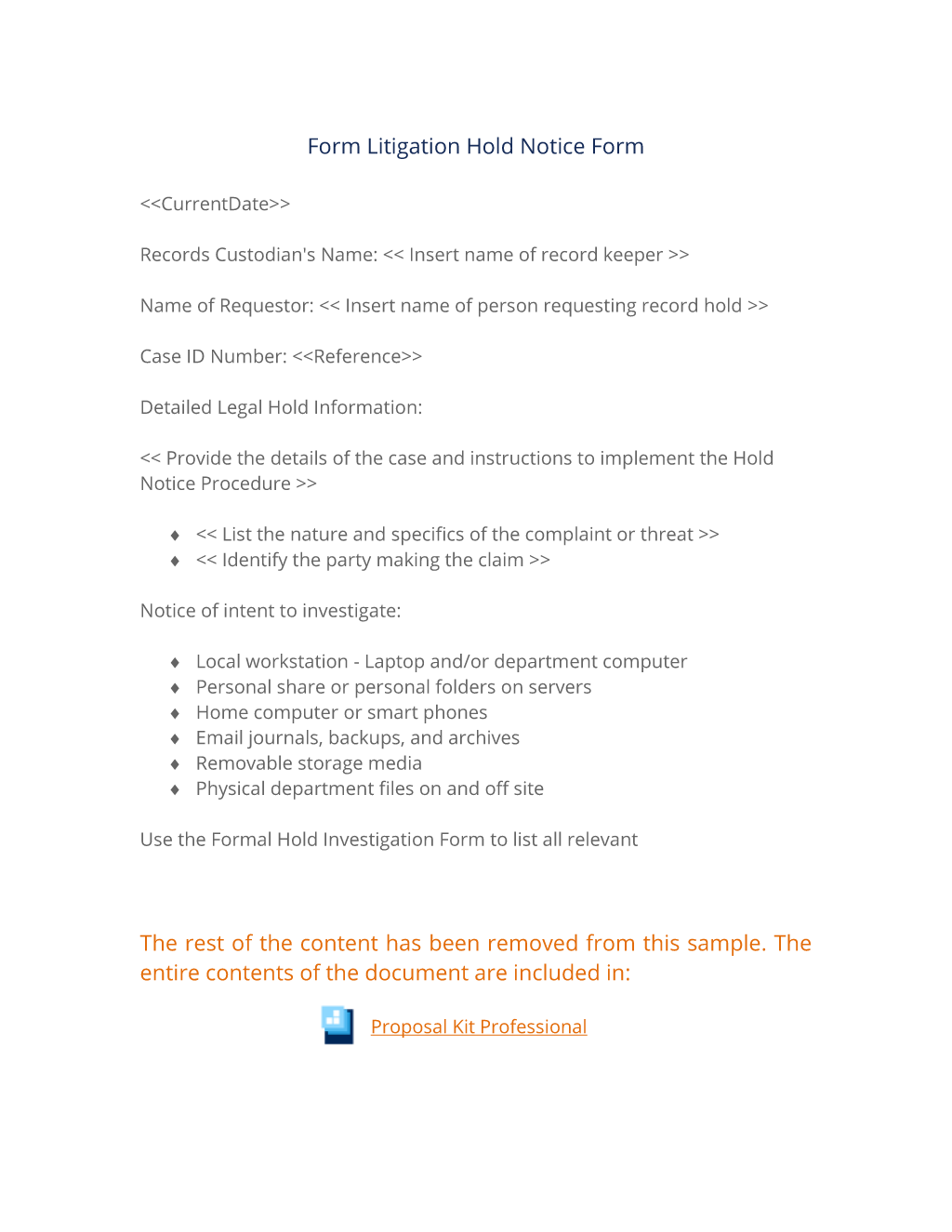
Form Litigation Hold Notice Form
Records Custodian's Name: Insert name of record keeper. Name of Requestor: Insert name of person requesting record hold. Case ID Number: Contract Reference Number.
Detailed Legal Hold Information:
Provide the details of the case and instructions to implement the Hold Notice Procedure. List the nature and specifics of the complaint or threat. Identify the party making the claim.
Notice of intent to investigate:
Local workstation - Laptop and/or department computer. Personal share or personal folders on servers. Home computer or smart phones.
Email journals, backups, and archives. Removable storage media. Physical department files on and off site.
Use the Formal Hold Investigation Form to list all relevant documents. You will be notified after the content has been reviewed and the records to be placed on hold have been verified. Requires signature of the department or records owner for acknowledgement of the notification.
The editable Formal Record Hold Notice Form document - complete with the actual formatting and layout is available in the retail Proposal Kit Professional.
20% Off Discount
 4.7 stars, based on 850 reviews
Related Documents
- Records Management Policies and Procedures
- Records Access Security Plan
- Records Management Governance Plan
- Records Management File Plan Template
- Records Management Expanded File Plan Template
- Application for Records Retention Form
- Authorization for Records Destruction Form
- Formal Record Hold Investigation Form
- Release of Legal Hold Notice Form
- Record Retention Schedule Change Form
- Legal Hold and Discovery Log
- Records Disposition Log
- Records Access Security Plan (Expanded)
- Communication Plan
- RACI Matrix Worksheet
- User Acceptance Testing (UAT) Schedule
- User Acceptance Testing (UAT) Enhancements and Bug Tracker
- Risk Mitigation Plan
 Published by Proposal Kit, Inc.
We include a library of documents you can use based on your needs. All projects are different and have different needs and goals. Pick the documents from our collection, such as the Formal Record Hold Notice Form, and use them as needed for your project.
 Facebook
 YouTube
 Bluesky
 Search Site
© 1997 - 2026, Proposal Kit, Inc. All rights reserved. Privacy Policy