

 Cart
Cart
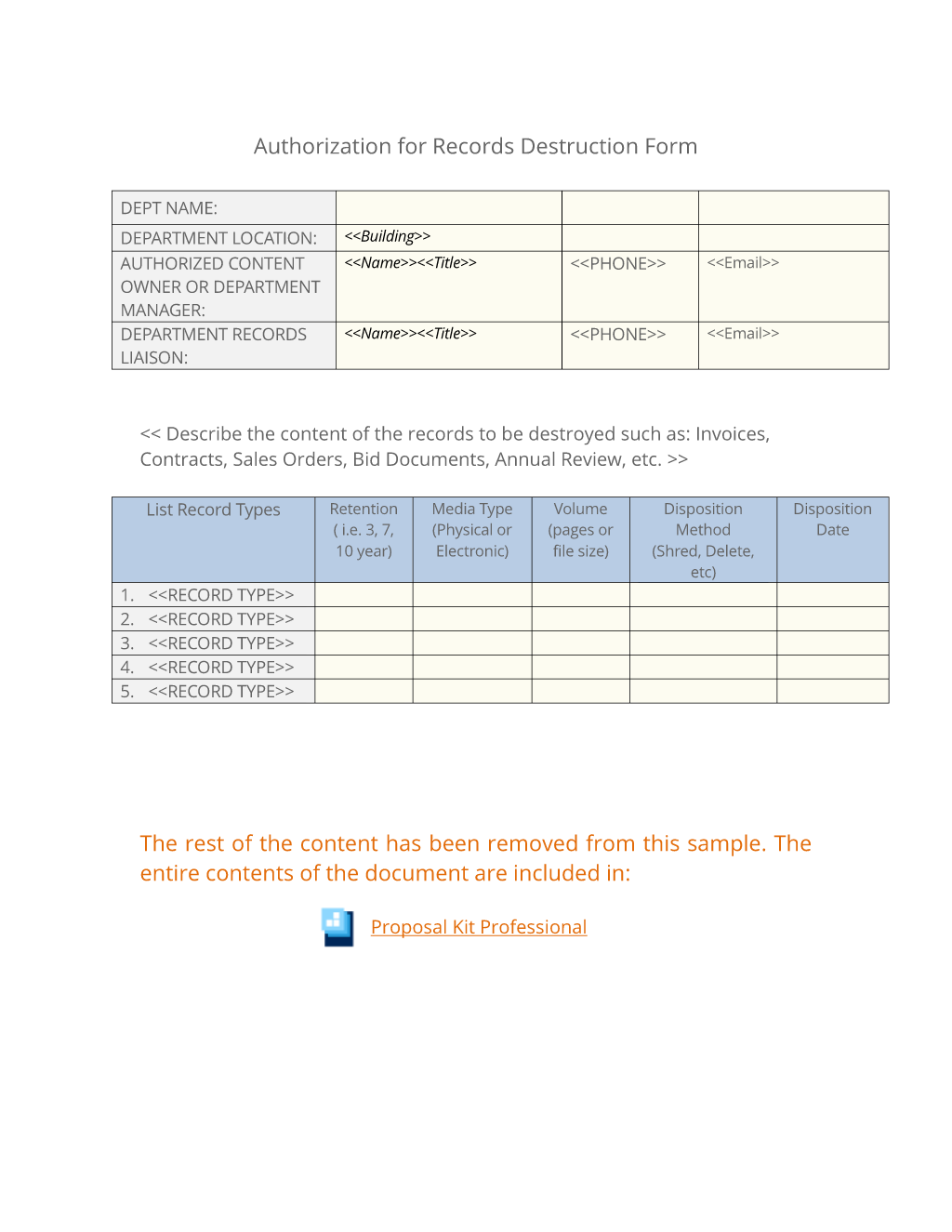
Authorization for Records Destruction Form
 Get 20% off ordering today: Click here for the code
Proposal Kit Professional adds business proposals, all six Contract Packs,
Project Management Pack library, and Expert Edition software.
We include this editable document in the Proposal Kit Professional. Order and download it for $199. Follow these steps to get started.
 DOWNLOADABLE, ONE-TIME COST, NO SUBSCRIPTION FEES
Key Takeaways
- One-time License, No Subscriptions: Pay once and use Proposal Kit forever-no monthly fees or per-use charges.
- Built for Business Projects: Start with a proven Authorization for Records Destruction Form and tailor sections, fields, and branding for your day-to-day project work.
- Instant Access: Download immediately and open the document right away-no waiting, no onboarding delay.
- Project-Ready Structure: Use a ready, professional layout for real-world project tasks (checklists, forms, analysis pages) so teams can execute consistently.
- Fully Editable in Word: Edit everything in Microsoft Word-swap text, add/remove sections, and apply your logo/colors without special skills.
- Step-by-Step Wizard Help: The Proposal Pack Wizard guides you with training/help and keeps you moving-no getting stuck on formatting or assembly steps.
- Wizard Data Merge & Project Management: Let the Wizard manage projects and merge recurring data (company/client names, addresses, dates) across your project documents.
- Included in Proposal Kit Professional: Available exclusively in the Proposal Kit Professional bundle.
 What Our Clients Say
We have been using the Professional Tools for the past 4 years. The packages have saved us countless hours of research, and documentation for various type of proposals. The templates are suitable for any organization of any sizes. This is really a must to have in your tool arsenal, and to impress your clients with a finished product to deliver to them."
1. Get Proposal Kit Professional that includes this business document.
We include this Authorization for Records Destruction Form in an editable format that you can customize for your needs.
2. Download and install after ordering.
Once you have ordered and downloaded your Proposal Kit Professional, you will have all the content you need to get started with your project management.
3. Customize the project template with your information.
You can customize the project document as much as you need. You can also use the included Wizard software to automate name/address data merging.
Use cases for this document
Safeguarding research files at Cypress Medical University
The Challenge
When Dr. Maya Lin, a requester in the College of Dentistry, faced a backlog of original paper records and digital lab data, the team had to reconcile retention requirements under the Florida Administrative Code, including chapter 1b-24.003 and chapter 1b-26.003, and decide which series had archival value for a permanent record. Some series were candidates for archival transfer to the health science center archives or the University of Florida archives, while others required a records destruction request and strict disposal of records controls. Sensitive material included confidential records and restricted and sensitive documents tied to grants, with a retention of 10 years.
The Solution
They standardized a records disposition request form to capture media (paper records, hard drives, computer tapes), volume, disposition method, disposition date, and to submit supporting documentation proving disposal eligibility. Under the discretion of the university records manager, with input from the records management librarian, archival personnel, and the university archivist, the team applied a scan & destroy workflow only after files were scanned and converted, met minimum scanning requirements and format readability, and backups were purged. Items with clear provenance of records and long-term value moved to records transfer and archival transfer; routine series proceeded to records disposal.
The Implementation
The team documented the disposition for each disposition request, then used procurement services and facilities services to begin arranging destruction services. Non-confidential documents went to local off-premise weekly pickup with Shred-it and high-volume shredding via a special pickup form, while sensitive material received on-premise destruction; original paper records were retained when the disposition of original records was not permitted. Proposal Kit supported the effort by assembling policy memos, an archival appraisal report, and a cost plan using automated line-item quoting, while the AI Writer produced a training guide and an audit-readiness report, and the RFP Analyzer helped structure a competitive RFP for document destruction services.
The Outcome
Cypress Medical University achieved compliant records disposal, efficient records transfer to university archives where warranted, and clear evidence trails for audits, with faster approvals and lower risk across paper materials and digital assets.
Redwood Manufacturing clears legacy media safely
The Challenge
CFO Lucas Vance discovered decades of paper materials, computer tapes, and decommissioned hard drives scattered across plants, plus mixed boxes of confidential records and non-confidential documents. The company needed a single request form to control records disposal while maintaining the chain of custody and backup purging, and to select on-premise destruction for restricted and sensitive documents versus off-premise destruction for routine files.
The Solution
Redwood adopted a records destruction request capturing record types, retention requirements, and disposal eligibility, then mapped vendors and options such as arranging shredding through Shred-it, high-volume shredding, weekly pickup, and special pickup form requests. The form required the requester to submit supporting documentation and to document the disposition steps, including certifications for legal holds and the final disposition method.
The Implementation
Facilities, services, and procurement services coordinated, arranging destruction services and local off-premise disposal services, while manufacturing sites used on-premise destruction for sensitive lines. Proposal Kit's document assembly generated a standard operating procedure, a vendor comparison report, and a risk control plan; the AI Writer drafted an executive briefing and budget narrative; automated line-item quoting produced a defensible cost model; and the RFP Analyzer ensured vendor responses aligned with service and security criteria.
The Outcome
Within a quarter, Redwood reduced storage, eliminated obsolete media, and proved compliance through well-documented disposition requests, with measurable savings and stronger governance across multiple facilities.
Harbor City Utilities modernizes public records lifecycle
The Challenge
Harbor City Utilities managed public records spanning paper originals, scanned and converted images, and operational databases, with some series marked retain until obsolete, superseded, or administrative value is lost, where a request for disposal is not required. Other series demanded a formal records disposition request form and careful decisions about long-term record status and archival value.
The Solution
The utility instituted a standardized disposition request process specifying disposition date and method (shred or delete) and verifying that disposition of original records occurs only after scan & destroy controls confirm minimum scanning requirements and format readability. Archival personnel advised on potential archival transfer with nearby university archives when provenance of records warranted preservation; otherwise, disposal of records moved forward.
The Implementation
Using Proposal Kit, the team created a public records policy, a scan & destroy procedures manual, and a records transfer plan, while automated line-item quoting supported budgeting for document destruction services; the AI Writer produced a staff training guide and a quarterly status report, and the RFP Analyzer evaluated bids for disposal services. Operations scheduled on-premise destruction for sensitive sets and local off-premise weekly pickup for routine paper records, and each requester documented the disposition with approvals.
The Outcome
Harbor City Utilities shortened cycle times, improved compliance, and cut storage costs while maintaining transparency and accountability across paper materials and digital holdings.
Abstract
This records destruction request form is a structured way to document the disposition of business information. It asks the requester to describe the content of records, specify record types and retention requirements, identify media (paper records, computer tapes, hard drives), and note whether items are physical or electronic. It also captures volume, the chosen disposition method, such as shred or delete, and a disposition date.
The certification confirms there is no legal hold, the records are past the retention schedule, and audits are complete. In short, it is a practical records disposition request form that helps document the disposition and control the disposal of records.
Organizations use such a request form to manage public records and confidential records, including restricted and sensitive documents and non-confidential documents. The form supports decisions about archival value and disposal eligibility, including whether an archival transfer to university archives is needed for a permanent record or long-term record. In higher education, a requester might work with a university records manager, a records management librarian, and archival personnel such as a university archivist.
These roles help evaluate provenance of records, transfer to archives when appropriate, and ensure alignment with rules like the Florida Administrative Code, including chapter 1b-24. 003 on records scheduling and disposition, and chapter 1b-26. 003 on electronic records, without providing legal advice.
Digital workflows often include scan & destroy strategies. When records are scanned and converted, the form provides a checkpoint to verify minimum scanning requirements, format readability, and that paper originals may be destroyed only after confirming that the disposition of original records is permitted. It can also prompt teams to ensure data is purged, including backups, and that backup purging aligns with retention of 10 years or other schedules.
Operations teams can use the form to arrange document destruction services. Depending on sensitivity, disposal services might be on-premise destruction or local off-premise options such as high-volume shredding and weekly pickup by vendors like Shred-it, with a special pickup form if needed. Facilities services or procurement services often assist in arranging shredding or off-premise destruction. Some schedules allow retention until obsolete, superseded, or administrative value is lost, in which case a request for disposal is not required.
Proposal Kit can streamline building these records disposal documents through document assembly, an extensive template library, and an AI Writer that can write supporting policies, procedures, and forms. Teams can also use automated line-item quoting to estimate archival transfer or destruction service costs, improving ease of use for routine records management.
Additional considerations strengthen the business case for this records disposal process. The form can act as a gate for arranging destruction services, requiring requesters to flag sensitive material, identify original paper records versus digital copies, and submit supporting documentation such as retention citations or vendor certificates. For universities, routing rules can direct permanent or long-term content to the University of Florida Archives or Health Science Center Archives, while routine paper materials go to shredding.
Decisions about archival transfer versus records disposal may occur at the discretion of the university records manager, guided by archival value, provenance, and format readability. Clear instructions also help units confirm that scanned and converted files meet minimum scanning requirements before authorizing destruction of the original paper records.
Use cases include a college department closing out grant files after the retention of 10 years, a clinic pitching of non-confidential documents once administrative value is lost, or an IT team documenting backup purging for obsolete computer tapes and hard drives. Facilities and procurement can coordinate on-premise or local off-premise solutions, while the requester tracks the disposition date and the disposition method to document the disposition.
Proposal Kit can simplify work by assembling consistent request forms and checklists, capturing fields for archival transfer decisions, approvals, and supporting evidence. Teams can use automated line-item quoting to estimate costs for on-premise shredding or off-premise destruction, and the AI Writer can produce companion procedures that outline records transfer steps to university archives. An extensive template library and ease of use help organizations standardize records management documentation while reducing effort and risk.
Beyond compliance, this disposition request can improve governance and reduce risk. Treat the request form as a control point to verify disposal eligibility before any disposal of records proceeds. Require business units to submit supporting documentation showing retention requirements, legal hold checks, and audit completion.
For digitized files, add a brief quality review step to confirm that scanned and converted images are indexable, meet minimum scanning requirements, and support format readability for a long-term record when needed. For IT assets like hard drives and computer tapes, note the sanitization method and ensure backups are purged, including backups per schedule. Maintain chain-of-custody notes for on-premise destruction versus off-premise destruction, especially for restricted and sensitive documents and confidential records, and keep vendor certificates with the records destruction request to document the disposition.
Operationally, clarify triggers such as contract closeout, project completion, or retain until obsolete, superseded, or administrative value is lost. For paper materials and paper originals, define when the disposition of original records is allowed after a scan & destroy workflow. In higher education, some series may route to archival transfer under the discretion of the university records manager, with referrals to archival personnel, the university archivist, the university archives, the University of Florida Archives, or Health Science Center Archives when a permanent record or provenance of records warrants it.
For routine records disposal, standardize arranging destruction services, high-volume shredding, weekly pickup, or a special pickup form, with Facilities Services or Procurement Services coordinating shredding and local off-premise options. Capture volumes to support budgeting and use cost estimates to plan document destruction services.
How to write my Authorization for Records Destruction Form document
Authorization for Records Destruction Form
Describe the content of the records to be destroyed such as: Invoices, Contracts, Sales Orders, Bid Documents, Annual Review, etc. List Record Types Retention: (i.e. 3, 7, 10 year) Media Type. Physical or Electronic: Volume (pages or file size) Disposition Method. (Shred, Delete, etc) Disposition Date 1.
I certify that no legal hold has been placed on the records listed above and that they are past the retention period specified by the Company Name Retention Schedule and that all regulatory audits have been reviewed.
The editable Authorization for Records Destruction Form document - complete with the actual formatting and layout is available in the retail Proposal Kit Professional.
20% Off Discount
 4.7 stars, based on 850 reviews
Related Documents
- Records Management Policies and Procedures
- Records Access Security Plan
- Records Management Governance Plan
- Records Management Taxonomy Topic Template
- Records Management File Plan Template
- Records Management Expanded File Plan Template
- Application for Records Retention Form
- Formal Record Hold Investigation Form
- Formal Record Hold Notice Form
- Release of Legal Hold Notice Form
- Record Retention Schedule Change Form
- Legal Hold and Discovery Log
- Records Disposition Log
- Records Access Security Plan (Expanded)
- Communication Plan
- RACI Matrix Worksheet
- User Acceptance Testing (UAT) Schedule
- User Acceptance Testing (UAT) Enhancements and Bug Tracker
- Risk Mitigation Plan
 Published by Proposal Kit, Inc.
We include a library of documents you can use based on your needs. All projects are different and have different needs and goals. Pick the documents from our collection, such as the Authorization for Records Destruction Form, and use them as needed for your project.
 Facebook
 YouTube
 Bluesky
 Search Site
© 1997 - 2026, Proposal Kit, Inc. All rights reserved. Privacy Policy