

 Cart
Cart%20is%20disposed%20of.%20Hundreds%20of%20project%20management%20documents%20available%20from%20ProposalKit.com. "Pin this Record Retention Schedule Change Form")
Record Retention Schedule Change Form
 Get 20% off ordering today: Click here for the code
Proposal Kit Professional adds business proposals, all six Contract Packs,
Project Management Pack library, and Expert Edition software.
We include this editable document in the Proposal Kit Professional. Order and download it for $199. Follow these steps to get started.
 DOWNLOADABLE, ONE-TIME COST, NO SUBSCRIPTION FEES
Key Takeaways
- One-time License, No Subscriptions: Pay once and use Proposal Kit forever-no monthly fees or per-use charges.
- Built for Business Projects: Start with a proven Record Retention Schedule Change Form and tailor sections, fields, and branding for your day-to-day project work.
- Instant Access: Download immediately and open the document right away-no waiting, no onboarding delay.
- Project-Ready Structure: Use a ready, professional layout for real-world project tasks (checklists, forms, analysis pages) so teams can execute consistently.
- Fully Editable in Word: Edit everything in Microsoft Word-swap text, add/remove sections, and apply your logo/colors without special skills.
- Step-by-Step Wizard Help: The Proposal Pack Wizard guides you with training/help and keeps you moving-no getting stuck on formatting or assembly steps.
- Wizard Data Merge & Project Management: Let the Wizard manage projects and merge recurring data (company/client names, addresses, dates) across your project documents.
- Included in Proposal Kit Professional: Available exclusively in the Proposal Kit Professional bundle.
 What Our Clients Say
Proposal Kit Professional is everything it says it is. Our company has utilized the software for just over 6 months and we have had great success with new business during that time period. Much of that is due to the software and the ease of use. I would recommend this to anyone that has the need for professional looking proposal."
Director Of Operations at Air Hawk Inc.
1. Get Proposal Kit Professional that includes this business document.
We include this Record Retention Schedule Change Form in an editable format that you can customize for your needs.
2. Download and install after ordering.
Once you have ordered and downloaded your Proposal Kit Professional, you will have all the content you need to get started with your project management.
3. Customize the project template with your information.
You can customize the project document as much as you need. You can also use the included Wizard software to automate name/address data merging.
Use cases for this document
Granite Ridge Utilities fixes its overloaded retention schedule
The Challenge
Records manager Maya Chen discovered that email records, social media records, and legacy files were piling up without clear retention period rules, audits were looming, and departments disagreed on what constitutes a record, which essential records to protect, and when authorization to destroy records applied.
The Solution
Maya used the Retention Schedule Change Request form to document each record series, record series description, and business case for change, while Proposal Kit's document creation tools produced a leadership briefing, an annotated guide for staff, and a records management training plan; its AI Writer drafted supporting policies and a summary of changes, the RFP Analyzer helped evaluate vendors for a records inventory and digitization study, and line-item quoting set budget estimates for inventory, digitization, and onboarding offboarding training.
The Implementation
Her team conducted a records inventory using a worksheet, identified essential records and confidential information, mapped disposition once retention met, and included schedule implementation in policies; Proposal Kit generated a project plan, vendor evaluation matrix, and a training schedule, and Maya routed the change package through the records retention schedule approval process until approval was assigned and the date set.
The Outcome
The city approved updated retention periods, issued authorization to destroy obsolete files, and implemented records management that saved space, time, and money, reduced audit risk, and clarified responsibilities across the organizational chart.
BlueHarbor Biomed aligns EDMS migration with retention controls
The Challenge
Compliance lead DeShawn Rivera faced an impending migration to electronic data management systems while staff still kept paper files; the company needed rules for electronic records replacing paper originals, file formats for transfer, and procedures for transferring electronic records without losing administrative value or legal value.
The Solution
He logged changes on the retention schedule change request, linking each records retention series to updated disposition instructions, and used Proposal Kit to create a vendor RFP for EDMS selection, a benefits of an EDMS white paper, and a management and preservation of digitized documents plan; the AI Writer produced a training syllabus and onboarding offboarding checklists, the RFP Analyzer compared vendor responses, and line-item quoting modeled costs for scanning and quality control.
The Implementation
DeShawn piloted digitization for lab notebooks, drafted procedures for destroying paper records after faithful digitized reproduction, and added controls for storing and classifying confidential information. Proposal Kit assembled the approval packet and a communications brief for teams to submit a schedule for review and include a phone number in email correspondence for support.
The Outcome
With approvals granted, BlueHarbor executed the EDMS cutover, reduced paper handling, tightened privacy safeguards, and accelerated audits by having clear retention period rules and documented disposition once retention was met.
City of Silver Mesa modernizes public records practices
The Challenge
City Clerk Leah Ortiz needed to update general records retention for city and county records, including social media posts and email, meet Public Records Act expectations, and coordinate transferring paper records to the state records center while preparing for a backlog of witnessed destruction requests.
The Solution
She packaged updates using the change request form and relied on Proposal Kit to produce a council proposal, a public transparency report, and a supplementary schedule overview; the AI Writer drafted community FAQs and a records management program charter, the RFP Analyzer supported vendor selection for scanning, and line-item quoting detailed costs for inventories, archives transfer, and staff training.
The Implementation
Leah's team completed a records inventory, identified essential records, set retention period lengths, and documented transferring paper records and transferring electronic records with approved file formats; Proposal Kit generated a replacement page or addendum log, rollout plan, and instructions to include schedule implementation in policies and onboarding and offboarding procedures.
The Outcome
The records retention schedule approval process moved smoothly, approvals were assigned and dates set, obsolete files received authorization to be destroyed, and residents saw faster responses and better transparency due to clearer processes and standardized accountability.
Abstract
This Retention Schedule Change Request Form is a governance tool used to propose and approve updates to a records retention schedule. It captures the division, the requestor, the record series title and description, the requested change, and the reason, such as a legal, business, or audit requirement. It routes for signatures by the division or department manager, the records administrator, and legal, and sets the effective date in schedules or policy. By formalizing approvals, it supports records retention schedule requirements, general retention schedules, and special records retention, and helps maintain public trust and transparency under public records laws.
Organizations use this form after they conduct an inventory and document a records inventory worksheet (for example, STD 70) or an inventory form SSARC-960. That inventory records media type, file location, years covered, reference status, and informs how to define retention periods. Changes often address administrative, legal, and fiscal value; important or vital record status; personally identifiable information and confidential records; and retention period considerations that lead to disposition instructions.
Disposition may include transfer to a state records center, archives transfer to state archives under a state archivist, or authorization to dispose, including witnessed destruction. If records are lost or accidentally destroyed, a notification form and notification to archives may be required. Always consult your legal team and align with regulatory agencies and industry standards.
Implementation typically involves a records management coordinator (and assistant coordinator), a records officer designation form, and procedures that include schedule implementation for onboarding and offboarding. For electronic records and EDMS, address email records, electronic mail records, social media records, metadata categories, file naming conventions, personal digital devices, privacy concerns, security concerns, and the 3-2-1 rule for backups. If digitization replaces paper, apply digitization standards, faithful digitized reproduction, quality control, and trustworthy systems. Review annually, renew every five years when required, and document amendments and revisions with a summary of changes during organizational change or updating due to digitization.
Jurisdictions vary: some use a records retention schedule form STD 73 (with STD 73 cover page) and calrim review via the CALRIM website, Athena database, government code section 12236, and State Administrative Manual Chapter 1600. Others use a disposal form SSARC-930, records center authorization list form, archives transfer form CSA-TL-01, or supplementary schedule and special authorization via a state records committee, local government records program, or state records appraisal program. Use cases include city and county records, special district schedule updates, the University System of Georgia records retention policies and procedures, and tribal cultural or research purposes. The life of a record, from creation to disposition, should be documented in the retention schedule process, records retention schedule approval procedure, approval number, approval date, and records retention schedule approval.
Proposal Kit can help teams assemble this form alongside related policies, develop retention schedules, and submit inventory and retention schedule documents. Its template library, document assembly, and AI Writer can produce supporting procedures and a retention schedule process, while automated line-item quoting helps scope services like records inventory, digitization, or EDMS implementation, making implementation in policies and procedures easier.
Beyond capturing approvals, this change request supports a broader records management program. It frames general records retention decisions by clarifying what a record is, organizing each record retention series with a record series description, and balancing legal, fiscal, and administrative needs. Teams document the retention period, the length of time, identify important records, and set disposition once retention is met, including authorization to destroy records, destroying paper records, transferring paper records, or transferring to the state records center.
When records are lost or destroyed, a lost or destroyed notification closes the loop. An annotated guide and records management training help staff manage drafts, oral histories, and ephemera, and store and classify confidential information and personally identifiable information.
Electronic data management systems and EDMS policies deserve equal attention. Many agencies move to electronic records, replacing paper originals. Selecting an EDMS should highlight the benefits of an EDMS, including trustworthy electronic data management, metadata, and management and preservation of digitized documents.
Procedures cover transferring electronic records, file formats for transfer, and quality checks. Policies should include instructions for onboarding and offboarding, require contact metadata, such as including phone numbers in email correspondence, and align with the organizational chart, assigning a records management coordinator and a records management assistant coordinator.
Governance requires a clear records retention schedule process. Use the records inventory worksheet STD 70 to conduct the inventory, then submit the schedule for review. Track updates by noting approval assigned, date set, and any replacement page or addendum when updating a retention schedule.
Implementing records retention schedules in written procedures helps save space, time, and money, maintains compliance with the Public Records Act and the State Records Management Act, and supports accountability expected by the California Secretary of State and similar authorities. The standardized program of accountability improves administrative value and legal value while ensuring confidential information and important records receive proper safeguards.
Proposal Kit can streamline this work. Teams can assemble the change request, build an annotated guide, and generate onboarding and EDMS procedures using its template library and AI Writer. Automated line-item quoting helps scope inventory, digitization, and schedule implementation services, making it easier to implement schedules in policies and keep approvals and submissions organized.
Further, the benefits of records management go beyond compliance. A disciplined change request process improves decision speed, reduces storage and discovery costs, and strengthens audit readiness. It also supports business continuity by identifying important records that must be available during disruptions.
Teams can apply simple criteria-does the record enable core services, prove rights or obligations, or document financial transactions- to prioritize protection and retention. Clear labeling of confidential information and mapping each record to its owner, system, and retention period make downstream disposition and transfer decisions faster and safer.
To sustain results, include schedule implementation in policies. Translate each approved change into procedures for everyday work, assign roles, and embed steps in onboarding and offboarding checklists. Reference filing practices for both paper and electronic systems, and specify where evidence of disposition is stored. Routine refresher briefings and quick-reference job aids help staff recognize which records are official and how to handle them from creation through disposition.
Finally, make the records retention schedule approval process clear. Standardize submission, review, and sign-off milestones; document the rationale for changes; and publish the effective date so departments can adjust workflows. Track approvals and versions so users know which schedule governs today's operations. When the process is clear and repeatable, managers gain confidence to request updates promptly, and leadership gains assurance that the organization is managing information responsibly.
Writing the Record Retention Schedule Change Form document
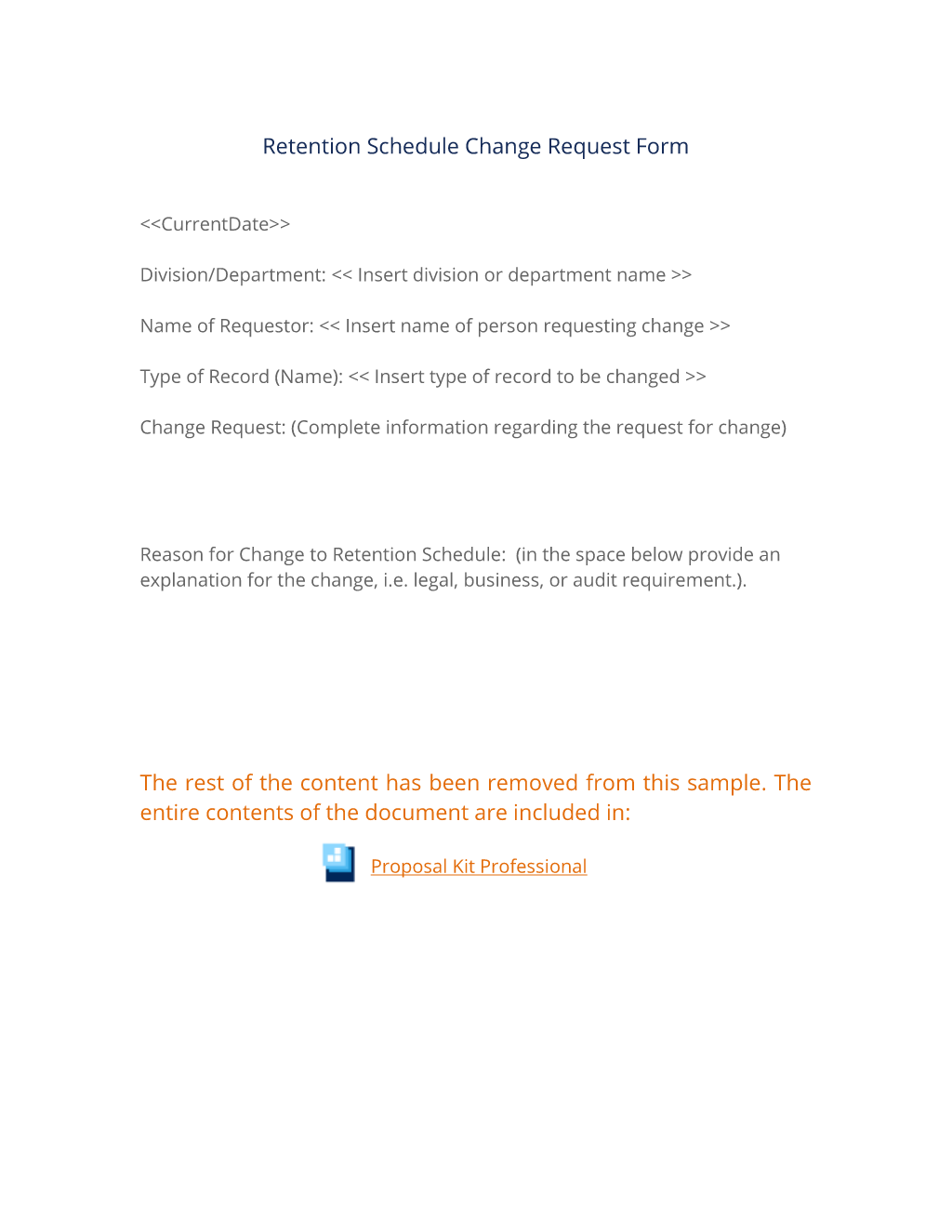
Retention Schedule Change Request Form
Division/Department: Insert division or department name. Name of Requestor: Insert name of person requesting change. Type of Record (Name): Insert type of record to be changed. Change Request: (Complete information regarding the request for change).
Reason for Change to Retention Schedule: (in the space below provide an explanation for the change, i.e. legal, business, or audit requirement.
Approved By:
Division / Department Manager
PRINTED NAME Division / Department Manager. AUTHORIZED SIGNATURE DATE Records Administrator.
PRINTED NAME Records Administrator
AUTHORIZED SIGNATURE DATE
PRINTED NAME Legal
AUTHORIZED SIGNATURE DATE Change Effective in Schedules or Policy: DATE.
The editable Record Retention Schedule Change Form document - complete with the actual formatting and layout is available in the retail Proposal Kit Professional.
20% Off Discount
 4.7 stars, based on 850 reviews
Related Documents
- Records Management Policies and Procedures
- Records Access Security Plan
- Records Management Governance Plan
- Records Management File Plan Template
- Records Management Expanded File Plan Template
- Application for Records Retention Form
- Authorization for Records Destruction Form
- Formal Record Hold Investigation Form
- Formal Record Hold Notice Form
- Release of Legal Hold Notice Form
- Legal Hold and Discovery Log
- Records Disposition Log
- Records Access Security Plan (Expanded)
- Communication Plan
- RACI Matrix Worksheet
- User Acceptance Testing (UAT) Schedule
- User Acceptance Testing (UAT) Enhancements and Bug Tracker
- Risk Mitigation Plan
 Published by Proposal Kit, Inc.
We include a library of documents you can use based on your needs. All projects are different and have different needs and goals. Pick the documents from our collection, such as the Record Retention Schedule Change Form, and use them as needed for your project.
 Facebook
 YouTube
 Bluesky
 Search Site
© 1997 - 2026, Proposal Kit, Inc. All rights reserved. Privacy Policy